The Drum · Weekly AI news, freeSubscribe →

Share
Fishing communities at the mouth of the Amazon say Petrobras is drowning out their safety concerns with influencer campaigns and conservation sponsorships, even as the company downplays the climate risks of drilling 30 billion barrels of new oil.
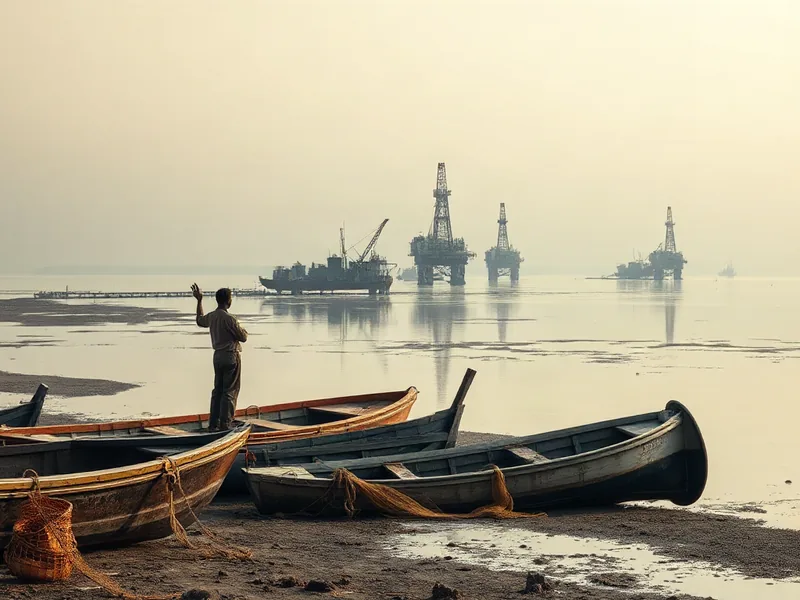
Nelson Bastos knows the wind. For 58 years, the fisherman has watched how a current called the Geral moves across the stretch of ocean where the Amazon river meets the sea. So when Petrobras representatives told a room full of his neighbors that an oil spill risk was manageable, he grabbed the microphone they hadn't offered him.
"When one of our buoys breaks loose up there in the north, the Geral wind brings the buoy to the shore," he told the crowd gathered in a hut in Cachoeira do Arari, a small town on Marajó island, last November. "It could bring the oil here, in the event of a spill."
The room, by most accounts, agreed with him. But that moment of local pushback is a rare exception to a pattern that a new investigation by DeSmog and the Brazilian magazine piauí has documented in detail. Since 2020, when Petrobras began consolidating ownership of oil blocks in the Foz do Amazonas, the company has built what can only be described as a PR machine, and it has scaled that machine up fast.
Think of it like this: if you can't win an argument on the facts alone, you flood the room with so much friendly noise that the dissenting voice gets harder to hear. That's roughly what has happened here. Petrobras increased its advertising and sponsorship spending five-fold between 2020 and 2025. Influencer videos made on the company's behalf racked up more than 1.5 billion views across 2024 and 2025, enough for every person in Brazil, a country of 213 million, to have watched one eight times over.
The Foz do Amazonas, the "Mouth of the Amazon," isn't just another patch of ocean. It sits atop an estimated 30 billion barrels of oil, part of a broader area known as the Brazilian Equatorial Margin that industry has eyed for decades as one of the last great deepwater frontiers. For Brazil, it's central to an ambition to become the world's fourth-largest oil exporter. Petrobras CEO Magda Chambriard put it bluntly at a Texas oil conference last May: "Let's drill, baby, drill!"
Five months later, Petrobras started sinking an exploratory well in an area called Block 59, roughly 175 kilometers off the coast near the French Guiana border. If that test succeeds, it could open the door to drilling across hundreds more blocks stretching south toward Marajó, some already owned by Petrobras and others by companies like ExxonMobil, which is already pulling more than 900,000 barrels a day from waters off neighboring Guyana.
The ecological stakes are just as large as the economic ones. These waters host the world's largest continuous stretch of mangroves, coastal trees that act as nurseries for fish and absorb enormous amounts of carbon dioxide. More than 100 prospective oil blocks overlap with the Great Amazon Reef System, a coral and sponge reef spanning 9,300 square kilometers. Brazil's own environmental regulator, IBAMA, denied Petrobras a drilling license in 2023, citing inadequate oil spill planning given what it called the basin's "extreme socio-environmental sensitivity." Dozens of IBAMA staff recommended denying a second application in 2024.
President Lula, who views the project as a major economic opportunity, publicly criticized those denials. IBAMA eventually approved an updated plan on the eve of COP30, the UN climate conference Brazil hosted in the Amazon city of Belém last October, a decision that dismayed climate advocates given Brazil's role as host nation urging the world to curb fossil fuels.
Suely Araújo, who led IBAMA from 2016 to 2018 and rejected a similar application from TotalEnergies, says the atmosphere around permitting has shifted into what she calls a "war of narratives." Her agency's earlier rejection barely made headlines. "It wasn't even in the papers," she said. This one hasn't gone quietly.
Petrobras has tripled the number of social media influencers on its payroll since 2022, up to 72 by 2024, according to data obtained through freedom of information requests and shared by Greenpeace's investigative unit Unearthed. Its spending on TV ads, billboards, and targeted social campaigns hit R$372 million, about $74 million, in 2025, more than five times what it spent in 2020. Advertising agencies Propeg and Ogilvy, the latter owned by the British conglomerate WPP, hold five-year contracts worth over R$450 million, around $87 million. Both agencies declined to answer questions, directing them back to Petrobras. WPP did not respond at all.
The company has also quadrupled its sponsorship of cultural and environmental projects since 2020, with contract values quintupling to R$1.25 billion, roughly $240 million. Gertjan Plets, who studies oil industry philanthropy at Utrecht University, says this is a familiar playbook. "Fossil fuel companies are very afraid of local communities protesting because they can make it difficult on the ground," he said. "So they enter the local cultural sector, the local ecological preservation groups, to really make sure that they have the social license to operate."
Petrobras disputes any direct link between its drilling ambitions and its spending increase, saying 2020 figures were unusually low due to asset sales aimed at reducing debt, and that current spending reflects the "scale, reach, and institutional responsibility" of Brazil's largest company. It also notes its inflation-adjusted ad spending in 2012 was higher than in 2025.
What's harder to explain away is what's missing from the company's community meetings. IBAMA requires Petrobras to hold "informational meetings" like the one in Cachoeira do Arari, and the company held 17 of them in November and December 2025 alone. Presenters touted 12 environmental projects in the area, downplayed disruption to fishing, and promised economic benefits. One slide listed everyday products made from oil, from footballs to fishing bait, with a presenter noting each time that "oil touches many parts of our daily lives."
Climate change barely came up. Beyond a passing, unexplained reference to "the greenhouse effect," neither presenters nor materials addressed the well-established link between burning oil and rising global temperatures, something the International Energy Agency has said leaves no room for new oil exploration if the world hopes to avoid catastrophic warming. Asked about this, Petrobras pointed instead to the fact that most of Brazil's domestic emissions come from agriculture. IBAMA, for its part, said climate impacts were "relevant" but fell "outside the scope of an exploratory drilling project."
A peer-reviewed study published in March in the journal Global Environmental Change examined Petrobras materials from 2022 to 2024 and found at least ten false or misleading statements. Among them: Petrobras's own website claims Block 59 isn't located near rivers, lakes, floodplains, or reef systems, a claim that directly contradicts IBAMA's own stated reasons for denying the company's 2023 license application, which cited risks to the Great Amazon Reef System and nearby mangroves.
The company also ran a 2022 training course for local journalists that covered the project's economic upsides without once mentioning environmental or climate risks, according to materials obtained through records requests. One attendee, blogger Seles Nafes, who has 90,000 Instagram followers and runs a news site in the state of Amapá, has since published at least ten articles promoting the project's benefits and criticizing its critics. Petrobras declined to confirm his attendance or that of any of the other 35 journalists invited, citing personal privacy.
This isn't simply a dispute about messaging. It's a test of whether communities with the most to lose from an oil spill or a warming planet get a meaningful voice in decisions made about their coastline. Nelson Bastos and his neighbors understand their waters better than any slide deck can capture. When regulators limit climate discussion to a footnote and a company spends hundreds of millions of dollars shaping public opinion before drilling even begins, the imbalance of power becomes the real story, long before the first barrel of oil is pumped.
Tags
Original Sources
Drilling in the Mouth of the Amazon: How Brazil’s Oil Giant Is Drowning Out Critics
↗ https://www.desmog.com/2026/06/17/drilling-in-the-mouth-of-the-amazon-how-brazils-oil-giant-is-drowning-out-critics
About the author
Amara's entry point into AI was an epidemiology role at a London research hospital, where she spent five years studying how digital health tools reached — or conspicuously failed to reach — underserved communities. Watching early algorithmic systems in healthcare quietly entrench existing inequalities, she redirected her career toward the systemic consequences of AI at scale. She covers AI through an unflinching lens: who benefits, who bears the cost, and what evidence actually says versus what the press release claims. Her writing is calm and precise, but she doesn't mistake balance for neutrality.
More from The Steward →This Week's Edition
4 November 2026
32 articles
Related Articles

UK Megafarm Applications Routinely Skip Climate Data, Letting Emissions Slip Past Councils
Environment & Climate · 6 min

CMS Picks Six Tech Firms to Run AI-Powered Medicare Prior Authorization Pilot
Policy & Regulation · 5 min

FDA and CMS Signal Joint Push to Work With States on AI Health Tech Oversight
Policy & Regulation · 5 min
Related Articles
UK Megafarm Applications Routinely Skip Climate Data, Letting Emissions Slip Past Councils
Environment & Climate · 6 min
CMS Picks Six Tech Firms to Run AI-Powered Medicare Prior Authorization Pilot
Policy & Regulation · 5 min
FDA and CMS Signal Joint Push to Work With States on AI Health Tech Oversight
Policy & Regulation · 5 min
More Stories
© 2026 Cedar & Bloom. All rights reserved.
