The Drum · Weekly AI news, freeSubscribe →

Share
Five musicians went head to head with an AI songwriter in a New York Times experiment, and the results were lopsided. What the behind-the-scenes diaries reveal matters more than who "won."
Imagine asking someone to describe their worst breakup, then asking a very fast, very confident stranger to do the same without ever having had a heart broken. That's roughly what happened when the New York Times recently pitted five professional musicians against an AI system in a songwriting competition. The humans won, decisively. But the real story isn't the scoreboard. It's what the process revealed about the gap between making art and manufacturing something that sounds like it.
The Times documented the songwriting process for both sides in diary form, and the contrast is telling. Human musicians wrestled with lyrics, second-guessed melodies, revised and rewrote. The AI, by comparison, produced its songs with a fraction of the friction. According to the Times' own framing, and echoed by Verge writer Terrence O'Brien in his coverage of the piece, the AI songs simply "suck," and in side-by-side listening it was "pretty easy to tell which is human and which is AI."
That might sound like a predictable outcome dressed up as news. But the value here isn't in confirming that AI music still falls short of human songwriting, plenty of listeners already sense that intuitively. The value is in the diary-style documentation of how each side arrived at its finished product. That process reveals something important about effort, intention, and what gets lost when you automate the hardest parts of creative work.
Songwriting, at its core, is a kind of translation work. A musician takes something formless, grief, longing, a half-remembered summer, and translates it into structure: verses, hooks, chord changes that rise and fall in ways that mirror emotional arcs. That translation requires judgment calls at every turn. Does this line ring true? Does this melody earn its payoff? Human songwriters make hundreds of these micro-decisions, often revising a single lyric a dozen times before it feels right.
AI music generation tools, by contrast, work more like a highly efficient prediction engine. Think of it like autocomplete, but for entire songs. The system has been trained on enormous catalogs of existing music and learned statistical patterns, which words tend to follow which, which chord progressions typically resolve in which ways. It can output something that formally resembles a song remarkably fast. What it struggles to replicate is the deliberation, the dead ends, the moments where a human writer throws out a perfectly serviceable line because it doesn't feel honest.
That distinction showed up clearly in the Times' side-by-side comparison. The low-effort quality of the AI tracks wasn't just an aesthetic failure, it was a process failure. When a system can generate a finished song in moments, with no revision loop driven by emotional judgment, the output tends to reflect that shortcut. It's polished in a technical sense but hollow in the way that matters most to listeners.
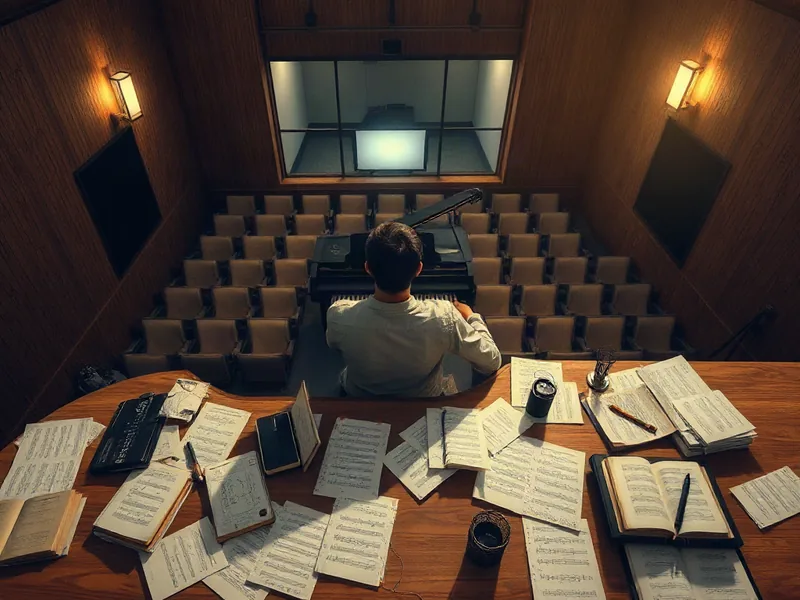
This isn't a new tension in the broader AI music debate. Tools like Suno and Udio have already drawn lawsuits from record labels over how they were trained, and musicians across genres have raised alarms about AI-generated tracks flooding streaming platforms, sometimes convincingly enough to rack up real plays and real royalties. The Times competition adds a useful, concrete data point to that conversation: even when AI output is evaluated purely on craft, head to head against working professionals, it still falls noticeably short.
That matters for musicians worried about job displacement, but it also matters for listeners. Part of what makes a song resonate isn't just the notes themselves, it's the knowledge that someone lived through something and chose to tell you about it. Strip that out, and even technically competent music can start to feel like wallpaper. The Times piece, titled "Musicians Versus the A.I. Machine. Why Bother Writing Songs Anymore?", frames this as an existential question for the industry. The evidence it presents suggests the answer, for now, is that the "why bother" cuts the other way: human songwriting still does something AI hasn't figured out how to fake convincingly.
None of this means AI music tools are harmless or that the competitive pressure on musicians is overstated. Even flawed AI-generated songs are cheap and fast to produce at scale, which creates economic pressure on an industry already squeezed by streaming payouts. A musician might spend weeks refining one song for modest compensation, while an AI system can generate dozens of tracks in an afternoon. Quality isn't the only variable that determines what gets made, licensed, or monetized.
The stakes here go beyond who wins a magazine-style showdown. Musicians depend on their craft for a living, and the perception that AI is "close enough" could shape licensing decisions, streaming algorithms, and advertising budgets, regardless of whether the music actually holds up on close listening. If decision-makers treat AI output as a cost-effective substitute rather than a clearly inferior product, working musicians could lose opportunities even when, as this competition suggests, their work is demonstrably better.
There's also a cultural cost worth naming plainly. Songs carry memory, particular years, relationships, griefs, and joys. That function depends on the song having come from a real experience in the first place. If AI-generated music becomes ambient background noise, cheap to produce and endlessly available, it risks diluting the cultural weight that human-made songs have long carried.
The Times experiment doesn't settle the bigger questions about AI's role in creative industries. But it does offer a clear, well-documented snapshot of where things stand today: human songwriters, with all their revisions and self-doubt, are still making something AI can't quite reach. Whether that gap persists, narrows, or simply gets ignored by an industry chasing lower costs is the part worth watching closely in the months ahead.
Tags
Original Sources
The New York Times pitted five musicians against an AI in a songwriting competition.
↗ https://www.theverge.com/ai-artificial-intelligence/1004401/the-new-york-times-pitted-five-musicians-against-an-ai-in-a-songwriting-competition
About the author
Amara's entry point into AI was an epidemiology role at a London research hospital, where she spent five years studying how digital health tools reached — or conspicuously failed to reach — underserved communities. Watching early algorithmic systems in healthcare quietly entrench existing inequalities, she redirected her career toward the systemic consequences of AI at scale. She covers AI through an unflinching lens: who benefits, who bears the cost, and what evidence actually says versus what the press release claims. Her writing is calm and precise, but she doesn't mistake balance for neutrality.
More from The Steward →This Week's Edition
4 October 2026
25 articles
Related Articles

DARPA's RSGS Program Aims to Put a Repair Robot in Geosynchronous Orbit
Products & Applications · 5 min

Text-Message AI Agents Multiply as Instinct's $10B Valuation Draws a Crowded Field
Products & Applications · 5 min

STEM Toys Worth Your Money in 2026: What Actually Holds Kids' Attention
Products & Applications · 5 min
Related Articles
DARPA's RSGS Program Aims to Put a Repair Robot in Geosynchronous Orbit
Products & Applications · 5 min
Text-Message AI Agents Multiply as Instinct's $10B Valuation Draws a Crowded Field
Products & Applications · 5 min
STEM Toys Worth Your Money in 2026: What Actually Holds Kids' Attention
Products & Applications · 5 min
More Stories
© 2026 Cedar & Bloom. All rights reserved.
