The Drum · Weekly AI news, freeSubscribe →

Share
Patients feel forgotten and clinicians feel exhausted, but the culprit isn't the technology on the screen. It's decades of workflows that digitized old problems instead of solving them.
Walk into most clinics today and you will see the same scene. A physician typing while a patient waits. A nurse juggling three different systems just to find a lab result. A patient repeating their medical history for the fourth time because nothing followed them through the door.
It is easy to look at that scene and blame the screens. Technology, the story goes, has crowded out the human connection that used to define medicine. That conclusion feels intuitive. It is also incomplete.
The real problem is not automation itself. It is friction, the accumulated weight of clunky processes that ask too much of the people delivering care and give too little back. When systems demand constant attention just to function, the humans inside them have less attention left for each other. That is a design failure, not a technology failure, and the distinction matters enormously for how we fix it.
Think about what fills a typical healthcare worker's day. Finding information that should already be visible. Entering the same data into multiple fields. Routing messages, checking results, completing documentation that exists mainly to satisfy the system rather than the patient. None of these tasks are dramatic on their own. Stacked together, they consume something healthcare cannot manufacture more of: human attention.
A clinician buried in navigating a workflow cannot fully attend to the person sitting across from them. Staff burn hours tracking down information that should be one click away. Patients, meanwhile, experience the gaps as something more personal. They feel like nobody is paying attention, because in a very real sense, the system has pulled that attention elsewhere.
Here is where the industry made its critical mistake. Rather than rethinking outdated processes, healthcare largely digitized them as they were. A paper form became a digital form. A manual handoff became an electronic handoff. The steps stayed the same, redundant, repetitive, riddled with unnecessary checkpoints. Only the medium changed.
Layering more technology onto a flawed process does not fix the process. It just moves the friction from paper to pixels. Anyone who has been stuck in a maddening phone tree understands this instinctively. The technology worked exactly as programmed. It just never solved the human problem it was supposed to address.
That is why the more useful question for healthcare leaders is not how many tasks a new tool can eliminate. It is what that elimination actually gives back to the people involved. Can it hand clinicians more uninterrupted time with patients? Can it lift routine administrative burdens off staff who are already stretched thin? Can it spare patients from explaining their symptoms for the fifth time to the fifth different person?
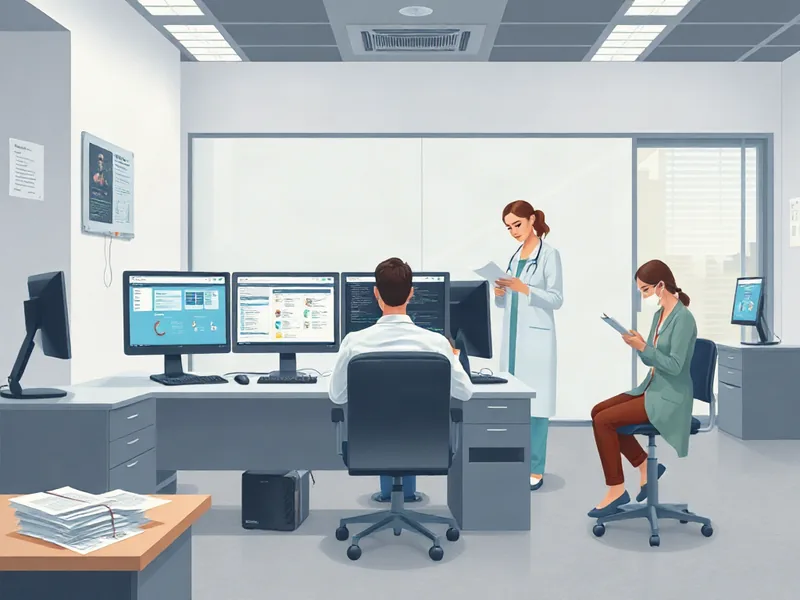
Framed that way, automation stops being something imposed on care and starts becoming something that protects it. Routine information can surface automatically instead of requiring someone to dig for it. Simple administrative steps can move forward without a person having to manually push them along. Data can travel with the patient instead of resetting at every stop. None of that requires replacing human judgment. It requires removing the noise around it.
Good workflow design starts by listening to the people already inside the workflow. Clinicians usually know exactly where they lose time. Staff can point to the specific steps that require workarounds just to keep patients moving through the day. Patients feel the friction too, though it shows up differently for them: unexplained delays, redundant paperwork, the sense that one part of the system does not talk to another.
Paying attention to those three perspectives, clinician, staff, and patient, reveals where automation genuinely helps and where the underlying process itself needs to change first. Automating a broken workflow just makes the brokenness move faster. The goal is not automation for its own sake. It is making sure people spend their time where their presence actually matters.
That reframing also changes how organizations should measure success. Traditional return on investment metrics like efficiency, cost savings, and productivity still matter, especially given the financial pressure much of the healthcare sector operates under. But those numbers only tell part of the story.
A harder, more important question is what changes for the people living inside a workflow every single day. Does it reduce the mental load clinicians carry home with them? Does it cut down on the interruptions that fragment a nurse's shift? Does it make the patient experience simpler, with fewer handoffs and faster access to the right information at the right moment? Automation should be measured not only by what it removes, but by what it makes possible once that burden is gone.
For years, the healthcare system has quietly asked its workers to absorb the cost of poor design. Remembering an extra step nobody streamlined. Chasing down information that got lost between two disconnected systems. Bridging gaps that should never have existed in the first place. That kind of effort should not be mistaken for dedication or resilience. It is compensation for a system that was never built with the humans inside it in mind.
The stakes here go beyond convenience. Every minute a clinician spends fighting a clunky interface is a minute not spent listening to a patient describe symptoms that matter. Every redundant form a patient fills out chips away at their trust that the system actually knows them. Burnout among healthcare workers has been a persistent crisis for years, and friction-heavy workflows are part of what feeds it.
Healthcare now has a real opportunity to design systems that give people back capacity for the work that only humans can do: listening, reassuring, deciding, comforting. Automation did not strip healthcare of its humanity. Bad systems did that, one redundant step at a time. Used with care and built around the people who actually use it, automation can help undo that damage instead of deepening it.
Tags
Original Sources
Automation Didn’t Dehumanize Care. Bad Systems Did. - MedCity News
↗ https://medcitynews.com/2026/09/automation-didnt-dehumanize-care-bad-systems-did
About the author
Amara's entry point into AI was an epidemiology role at a London research hospital, where she spent five years studying how digital health tools reached — or conspicuously failed to reach — underserved communities. Watching early algorithmic systems in healthcare quietly entrench existing inequalities, she redirected her career toward the systemic consequences of AI at scale. She covers AI through an unflinching lens: who benefits, who bears the cost, and what evidence actually says versus what the press release claims. Her writing is calm and precise, but she doesn't mistake balance for neutrality.
More from The Steward →This Week's Edition
3 September 2026
24 articles
Related Articles

Anthropic's Own Workforce Data Shows AI Is Already Reshaping Who Gets Hired
Job Market & Society · 5 min

Relational Intelligence: The Workplace Skill Nobody Is Teaching, and Why AI Can't Replace It
Job Market & Society · 6 min

xAI Launches Grok Bot, an Autonomous Agent That Logs Into Your Tools and Does the Work
Products & Applications · 5 min
Related Articles
Anthropic's Own Workforce Data Shows AI Is Already Reshaping Who Gets Hired
Job Market & Society · 5 min
Relational Intelligence: The Workplace Skill Nobody Is Teaching, and Why AI Can't Replace It
Job Market & Society · 6 min
xAI Launches Grok Bot, an Autonomous Agent That Logs Into Your Tools and Does the Work
Products & Applications · 5 min
More Stories
© 2026 Cedar & Bloom. All rights reserved.
