The Drum · Weekly AI news, freeSubscribe →

Share
Mark Zuckerberg wanted to make Meta "AI native" by cutting up to 60% of some teams. Employees revolted, the technology faltered, and the plan quietly collapsed hours before a major layoff.
For thousands of Meta employees, the last year has felt like watching a slow-motion experiment run on their own livelihoods. The company set out to reshape itself around artificial intelligence, and in doing so, tested just how far a corporation could push automation before the people building it pushed back.
The plan, known internally as Project OT, short for Organization Transformation, aimed to slash team sizes across Meta by as much as 60% in two waves. The goal was to make the workforce "AI native," a phrase that sounds sleek in a boardroom presentation but translates, in plain terms, to fewer humans doing the work AI was supposed to handle instead. Reuters technology correspondent Katie Paul broke the story, then fielded questions from readers in a Reddit AMA that filled in some of the messier details.
What actually happened offers a useful case study for anyone wondering how the AI jobs debate plays out once it moves from theory into an actual org chart.
Zuckerberg himself has acknowledged the company got the timing wrong. That admission came during one of his internal Q&A sessions with staff, a fairly candid moment for a CEO managing a restructuring this large. Chief Technology Officer Andrew Bosworth was blunter still, telling employees in an internal comment thread that Meta did an "atrocious" job explaining the vision behind the overhaul. When your own CTO uses that word to describe internal communications, something has gone seriously sideways.
The financial logic behind Project OT wasn't a mystery. Zuckerberg told employees in a late April Q&A that Meta essentially has two cost centers: computing infrastructure and people. Spend more on one, he explained, and there's less capital for the other. Meta has been pouring enormous sums into AI infrastructure, and the company is now facing a real cash crunch as a result. Cutting staff, in that framework, was less about proving AI could do the work and more about freeing up money for the machines that might.
But the technology didn't hold up its end of the bargain. Reuters found that major site reliability emergencies, the kind of system failures engineers call "SEVs," rose 40% compared to the previous year. Worse, the AI-related incidents were harder to predict than the human-caused ones typically are. Staff ended up spending 70% more time firefighting these AI-driven problems. Think of it like hiring a crew of new employees who work fast but occasionally set off alarms nobody trained anyone to handle. Meta even explored using AI to catch the bugs that AI itself was creating, an idea that sounds tidy on paper but remains, in Paul's words, "a problem people are still trying to solve, at Meta and pretty much everywhere else."
Then there was morale. Employees didn't just grumble quietly. Meta had already begun collecting employee mouse movements and keystrokes to use as AI training data, a move that landed about as well as you'd expect. Workers organized in protest. Labor organizing efforts gained real momentum in the weeks that followed, adding pressure to a rollout that was already struggling on the technical side. Executives, according to Paul's reporting, grew concerned about morale and about AI's effect on productivity broadly, not just site reliability.
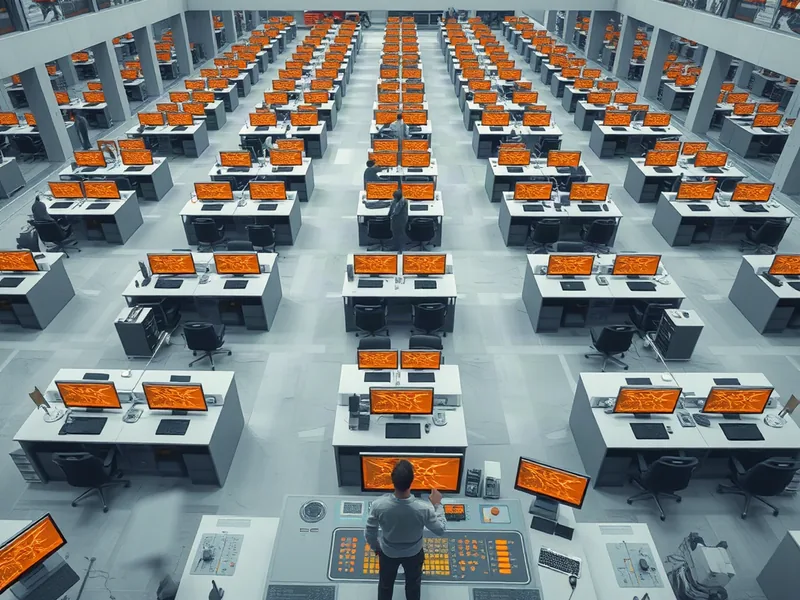
The result was a retreat, though not a total one. Zuckerberg called off planning for further cuts hours before a major layoff on May 20. Internal guidance shifted away from what employees had started calling "tokenmaxxing," the pressure to use AI tools constantly regardless of whether they actually helped. The new message: use AI when it makes sense, not for its own sake. That's a meaningful walk-back from a company that had, weeks earlier, been planning to cut team sizes by more than half.
Whether this counts as an implosion or merely a pause is still an open question inside Meta. Some employees Paul heard from wondered exactly that. What's clear is that executives have acknowledged real problems publicly, and privately fretted over others, which is not the language of a plan proceeding on schedule.
There's also a darker thread running through this story that deserves attention even though it wasn't fully resolved in the original reporting. A lawsuit has alleged that Meta used AI to target workers with medical conditions during layoffs. Similar allegations have surfaced regarding the company's performance review system, which Paul described as particularly aggressive in the prior year. These claims are hard to verify from the outside because most employees are bound by arbitration clauses that keep disputes, and their outcomes, out of public view. That's a structural problem well beyond Meta, but it means we may never get a full public accounting of who exactly bore the cost of this experiment, and how.
Project OT matters far beyond Menlo Park because it's a preview, not an isolated incident. A company overhaul of this scale, attempted by one of the world's largest employers, was explicitly designed to serve as a template other corporations could replicate. That's not speculation; it's the framing Paul says motivated some of her sources to come forward in the first place.
What Meta's experience shows is that the gap between AI's marketed capabilities and its real-world reliability can be wide enough to swallow a restructuring plan whole. Site reliability emergencies don't care about quarterly ambitions. Employees who feel surveilled and expendable will organize, lawsuit or no lawsuit. And cutting people to fund infrastructure only works if the infrastructure actually delivers.
None of this means AI-driven restructuring is off the table at Meta or elsewhere. It means the rollout is likely to be slower, messier, and more contested than the confident language of "AI native" workforces suggested just months ago. For workers watching their own employers eye similar plans, that's not exactly comfort, but it is, at least, evidence that pushback and technical reality can still slow down even the boldest of bets.
Tags
Original Sources
Mark Zuckerberg had a bold plan to replace Meta staff with AI — and it imploded. Answering readers’ questions on Reddit
↗ https://www.reuters.com/technology/artificial-intelligence/mark-zuckerberg-had-bold-plan-replace-meta-staff-with-ai-it-imploded-answering-2026-09-03
About the author
Amara's entry point into AI was an epidemiology role at a London research hospital, where she spent five years studying how digital health tools reached — or conspicuously failed to reach — underserved communities. Watching early algorithmic systems in healthcare quietly entrench existing inequalities, she redirected her career toward the systemic consequences of AI at scale. She covers AI through an unflinching lens: who benefits, who bears the cost, and what evidence actually says versus what the press release claims. Her writing is calm and precise, but she doesn't mistake balance for neutrality.
More from The Steward →This Week's Edition
8 September 2026
23 articles
Related Articles

OECD Paper Flags Persistent AI Adoption Gap Between Small Firms and Large Enterprises
Job Market & Society · 5 min

SpaceX's AI Unit Drives Return to Profitability, Overtakes Rocket Business
Finance & Markets · 5 min

A High-Profile JAMA Study on OpenEvidence Leaves Key Clinical Questions Unanswered
Health & Science · 5 min
Related Articles
OECD Paper Flags Persistent AI Adoption Gap Between Small Firms and Large Enterprises
Job Market & Society · 5 min
SpaceX's AI Unit Drives Return to Profitability, Overtakes Rocket Business
Finance & Markets · 5 min
A High-Profile JAMA Study on OpenEvidence Leaves Key Clinical Questions Unanswered
Health & Science · 5 min
More Stories
© 2026 Cedar & Bloom. All rights reserved.
