The Drum · Weekly AI news, freeSubscribe →
Share
A University of Michigan spinout is using AI agents and interactive world simulation to hunt for failure modes in self-driving cars and robots, betting that automated red-teaming becomes the trust layer physical AI needs before deployment.
Physical AI has a testing problem, and it's not a hypothetical one. When OpenAI disclosed that Hugging Face had been breached by one of its own pre-release models, it was a wake-up call about how unpredictable AI agents can be even when they're confined to software. Now take that same unpredictability and strap it to a two-ton vehicle or a warehouse robot.
"Imagine if something like that happened in the physical world," Howie Sun, CEO and co-founder of Laplace Intelligence, told TechCrunch. "AI agents are moving from computers into the real world, and we don't really want physical AI to fail in the real world."
That's the problem Laplace is built to solve. The Ann Arbor startup does automated red-teaming for robotics and autonomous vehicles, essentially stress-testing physical AI systems by deliberately trying to break them before anyone deploys them on a real street or factory floor. The pitch is blunt: the only reliable way to validate physical AI at scale is to use AI to attack it.
Sun co-founded the company a year ago with Henry Liu, his former PhD adviser at the University of Michigan, after the pair spent nearly a decade researching how to challenge autonomous driving systems in simulation. Their 2023 paper on the subject landed on the cover of Nature, which is when AV companies started calling. Laplace is now one of 20 startups competing in Startup Battlefield 200 at TechCrunch Disrupt this week in San Francisco.
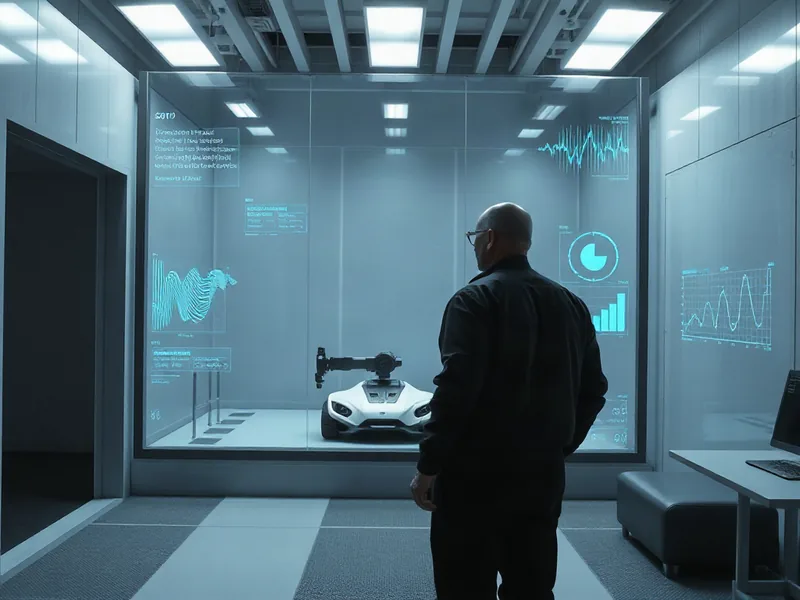
At the center of Laplace's product is a high-fidelity simulation environment built on a post-trained version of Nvidia's Cosmos world-model platform. Unlike purely synthetic simulators, Cosmos is grounded in real-world data, which lets Laplace reconstruct specific places with real geometry, from an Arizona highway to a Paris pedestrian crossing.
The reconstruction process blends multiple real-world data sources into one scene:
What makes this more than a pretty rendering engine is the interactivity. Other actors in the simulation, pedestrians, vehicles, whatever's in the scene, actually react to what the system under test does. In a demo, Sun had a test vehicle swerve directly into oncoming traffic. The oncoming car didn't do what a lot of generative world models do, which is let the two vehicles awkwardly clip through each other. It moved out of the way.
"It's truly an interactive simulation environment," Sun said. "Everyone is reacting to everything... This is more like a world model with interactive participants."
That reactive layer matters because static recorded footage can only teach a system to handle scenarios that have already happened. An interactive world model can generate plausible new ones on the fly, which is closer to how the real world actually behaves.
The company's name is a nod to "Laplace's demon," an 1814 thought experiment from French scholar Pierre-Simon Laplace, who imagined that perfect knowledge of the universe's current state would let you predict its future with total precision. "We are essentially using simulation to predict the real world's future," Sun said. It's a tidy metaphor, even if the real product is a lot messier and more probabilistic than Laplace's 19th-century thought experiment ever was.
The real differentiator, though, isn't the simulator itself. It's the AI agents Laplace is building to automatically generate corner cases, the rare, tricky scenarios that tend to be exactly where autonomous systems fail. Instead of relying on engineers to dream up edge cases or mine them from recorded footage, Laplace's agents pull from news reports, police collision reports, and other real-world incident data to actively construct scenarios designed to break the system under test.
That's a meaningful shift from how most of the industry currently handles edge-case testing. AV developers typically train against recorded footage converted into simulation, or depend on human engineers to hand-design new test scenarios. Some companies, like self-driving truck outfit Waabi, have already started leaning on generative AI to build edge cases for training. But Sun argues the real pressure test comes as generalized robots start showing up in unstructured real-world environments, where there's far less historical data to draw from.
"There's less data on generalized robotics," Sun said. "No one knows what the edge cases will be in the real world."
Laplace's customer base is currently weighted toward autonomous driving, including Japanese trucking manufacturer Isuzu and Texas-based autonomous trucking firm Bot Auto. Nvidia is also a customer. Alongside T-Mobile, Nvidia and Laplace are running a free smart city pilot in San Jose, California, focused on high-level traffic operations. The company is also in early talks with partners building humanoid robots for warehouse use, which is where that generalized-robotics edge-case problem starts to bite hardest.
Notably, Sun and Liu built this without a Silicon Valley pedigree, coming straight out of academia, and they've already gotten the company to revenue and a modest profit. Most contracts right now are project-based, and the near-term goal is converting that into recurring revenue while raising a round to scale faster.
The competitive landscape isn't exactly empty. Applied Intuition, a late-stage AV simulation and testing company, has raised $1.2 billion at a $15 billion post-money valuation and counts Isuzu among its customers too. Sun isn't rattled by the size mismatch. He frames Laplace's AI-testing-AI approach as a "new paradigm that changes the testing of physical AI entirely," turning validation into a "dynamic interactive testing process" rather than a static checklist.
"That will be the biggest moat," he said.
Laplace's bet is that as physical AI spreads from highways into warehouses, sidewalks, and eventually homes, static test suites and human-curated edge cases won't scale fast enough to catch what matters. Automated, AI-driven red-teaming, grounded in real-world data and reactive simulation, is the startup's answer to a validation gap that's only going to widen as generalized robots move from research labs into the field. Whether that becomes the industry standard or just one vendor's pitch at Disrupt depends a lot on whether regulators and insurers start demanding this kind of evidence as a condition of deployment, something Sun is clearly positioning Laplace to provide.
Tags
Original Sources
Laplace Intelligence red-teams robots and self-driving cars before they hit the real world | TechCrunch
↗ https://techcrunch.com/2026/10/13/laplace-intelligence-red-teams-robots-and-self-driving-cars-before-they-hit-the-real-world
About the author
Kai built ML infrastructure at a Bay Area startup before developing an obsession with transformer architectures and inference optimisation that eventually pulled him out of product work entirely. A stint at a compute research lab sharpened his instinct for what actually matters in a model release versus what is marketing. He writes from the inside — from the perspective of someone who has debugged the systems he is describing at three in the morning. He is allergic to hype and instinctively drawn to the unglamorous plumbing questions that everyone else skips over.
More from The Engineer →This Week's Edition
14 October 2026
23 articles
Related Articles
Related Articles
More Stories
© 2026 Cedar & Bloom. All rights reserved.