The Drum · Weekly AI news, freeSubscribe →

Share
A five-month, project-based artificial intelligence fellowship at the Naval Postgraduate School promises hands-on research experience for Marines and civilians, but the fine print includes a 15-month service commitment worth understanding before applying.
When people picture military innovation, they often imagine jets or submarines, not spreadsheets full of algorithms. But the Marine Corps is betting that its future competitiveness depends just as much on talent trained to build artificial intelligence tools as on anyone trained to fly or fight. That bet now has a name and a deadline: the 2027-1 Marine Corps Artificial Intelligence Fellowship, announced in MARADMIN 471/26 and open for nominations through October 30, 2026.
The program is run by the Deputy Commandant for Information, through its Chief Data and AI Office, in partnership with the Naval Postgraduate School in Monterey, California. It is not a classroom lecture series. Fellows work in interdisciplinary teams on a single, command-endorsed AI project, something unclassified, actionable, and tied to a real mission problem the applicant's unit already cares about. Think of it less like a university course and more like a startup incubator embedded inside a government bureaucracy, where the "founders" are active-duty Marines and government civilians instead of entrepreneurs chasing venture funding.
That structure matters for a workforce that has, for years, struggled to recruit and retain people with deep technical skills. Private-sector AI salaries can dwarf military pay, and the Pentagon has long worried about losing its best data scientists to Silicon Valley before they ever get to apply their training to defense problems. A fellowship that lets someone stay in uniform, keep their security clearance and institutional knowledge, and still build real AI systems is one way to close that gap without competing dollar-for-dollar on salary.
Eligibility is fairly specific. Officers from O1 to O5, enlisted Marines from E4 to E8, chief warrant officers from CWO1 to CWO5, and GS-5 through GS-14 civilians can apply, but only if they're active duty and have a completed Military Occupational Specialty. Marines still holding a student or training MOS, like the placeholder code 7599, are not eligible. Applicants also can't be passed over for promotion or have an approved resignation or retirement date already on the books.
Each cohort includes at least two people, and the fellowship runs five months. During that stretch, fellows remain administratively tied to their home command but operationally under the Naval Postgraduate School's control, working remotely most of the time. Three funded trips to the Monterey campus are built into the schedule for the upcoming cohort: January 11-14, April 5-8, and June 7-10, 2027. Sponsoring commands should expect to cover roughly five thousand dollars for travel costs, a relatively modest investment for a program meant to produce usable research.
Graduation isn't just about finishing a program. Fellows must produce a publishable research paper based on their capstone project, meaning the work doesn't disappear into a filing cabinet when the fellowship ends. It's designed to generate something the Marine Corps, or the broader field, can actually use.
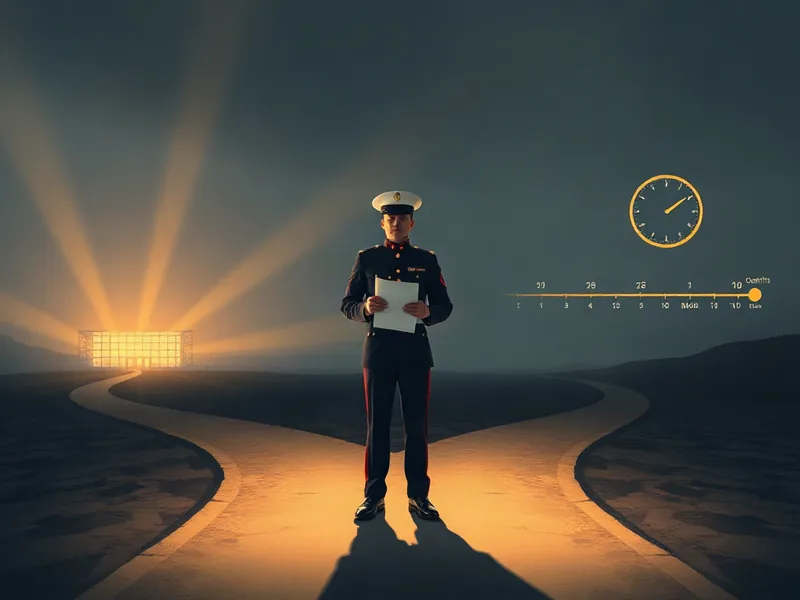
Here's where the fine print gets serious. Completing the fellowship triggers a 15-month active-duty service obligation on top of the program itself. To even qualify, applicants need at least 20 months of obligated service remaining when the fellowship starts, enough to cover the five months of training plus the 15 months afterward. Marines who don't have that cushion aren't eligible, full stop, regardless of how qualified they might otherwise be.
That's a real tradeoff for anyone eyeing an exit from active duty in the near term. The Corps does offer an exception-to-policy process for Marines who want to separate, retire, or transition before fulfilling the obligation, but those requests have to move through the chain of command and get decided case by case. There's no guarantee of approval. For some, that uncertainty might be reason enough to wait for a future cohort rather than gamble on an ETP request.
Every application also needs an endorsement letter from the first O-6 commander in the applicant's chain of command, underscoring that this isn't a personal side project. Commands have to buy in, both by sponsoring a real AI use case with available data and by signing off that the fellowship is worth the investment. The selection board convenes around November 4, 2026, with notifications going out no later than November 20. Applications go through an online portal, and the Deputy Commandant for Information retains authority to override board results if mission needs require it.
Fellowship programs like this one sit at an interesting crossroads of workforce development and national security policy. On one hand, they offer a genuine career pathway: hands-on AI research experience, a publishable paper, and exposure to cutting-edge problem-solving that few military career tracks provide. For Marines interested in data science or emerging technology, that's a meaningful credential, one that could shape assignments and opportunities for years afterward.
On the other hand, the structure reveals the tension every institution faces when it tries to build specialized talent internally rather than simply hiring it. The service obligation exists because training is expensive and the Corps wants a return on that investment before people take their new skills elsewhere. That's a reasonable instinct, but it also means the opportunity comes bundled with a binding commitment that not everyone will be positioned to accept.
For the broader conversation about AI talent development, this program is a small but telling data point. Government and military organizations are recognizing that waiting for ready-made AI expertise to show up isn't a viable strategy. They have to grow it from within, using incentives, structured mentorship, and real projects rather than theoretical coursework. Whether that model scales, and whether the retention requirements strike the right balance between institutional investment and individual flexibility, will matter well beyond this one fellowship cohort.
Tags
Original Sources
2027-1 ARTIFICIAL INTELLIGENCE FELLOWSHIP PROGRAMS
↗ https://www.marines.mil/News/Messages/Messages-Display/Article/4615393/2027-1-artificial-intelligence-fellowship-programs
About the author
Amara's entry point into AI was an epidemiology role at a London research hospital, where she spent five years studying how digital health tools reached — or conspicuously failed to reach — underserved communities. Watching early algorithmic systems in healthcare quietly entrench existing inequalities, she redirected her career toward the systemic consequences of AI at scale. She covers AI through an unflinching lens: who benefits, who bears the cost, and what evidence actually says versus what the press release claims. Her writing is calm and precise, but she doesn't mistake balance for neutrality.
More from The Steward →This Week's Edition
2 October 2026
28 articles
Related Articles

When AI Helps Students Practice But Hurts Them on Test Day
Job Market & Society · 5 min

County Officials Get a Crash Course in AI, But Questions Remain About Who Gets Left Behind
Job Market & Society · 5 min

The All of Us Data Gap Isn't About Trust. It's About Turning Records Into Usable Data
Job Market & Society · 6 min
Related Articles
When AI Helps Students Practice But Hurts Them on Test Day
Job Market & Society · 5 min
County Officials Get a Crash Course in AI, But Questions Remain About Who Gets Left Behind
Job Market & Society · 5 min
The All of Us Data Gap Isn't About Trust. It's About Turning Records Into Usable Data
Job Market & Society · 6 min
More Stories
© 2026 Cedar & Bloom. All rights reserved.
