The Drum · Weekly AI news, freeSubscribe →

Share
At IMTS 2026, cloud giants and shop-floor automation firms converged on a single message: AI agents are moving from pilot projects to production lines, reshaping how manufacturers compete on efficiency and speed.
Manufacturing technology conferences tend to generate more buzzwords than business cases. IMTS 2026, held on Chicago's Main Stage, produced plenty of both, but the throughline across multiple sessions was consistent enough to take seriously: agentic AI is being positioned as the connective tissue between automation, digitalization, and industrial software.
Ben Grimes of Microsoft, an IMTS Main Stage sponsor, framed the shift in a session titled "Industrial Intelligence Unlocked: The Next Frontier of Manufacturing." His pitch centers on systems that "don't just respond, but instead create advantage across the entire value chain." That is a meaningful distinction for a portfolio manager evaluating industrial software spend. Reactive automation has been the standard for decades. Agentic systems, by contrast, claim to anticipate and act, which changes the return profile on enterprise AI deployments.
AWS made a parallel case in its own Main Stage session, "Realizing Industrial AI at Scale." The company's framing touches three areas: autonomous operations, supply chain optimization, and product innovation acceleration. AWS described deploying agentic AI systems alongside "physical AI" that operates inside demanding factory environments, plus unified data foundations meant to turn fragmented operations into a single intelligent system. Two of the largest cloud providers on earth making nearly identical pitches in the same week is not a coincidence. It signals where the capital and engineering resources are flowing.
The theoretical case for agentic AI is easy to state. The harder question is whether it holds up on a noisy shop floor with legacy equipment and variable production runs. One session addressed that gap directly. Intrinsic, Alphabet's robotics software unit, and Trinity Automation presented on autonomous CNC tending, a use case built specifically for high-mix, variable-volume manufacturing environments where traditional automation struggles.
Their pitch is narrower and more operationally specific than the cloud platform vision, which makes it a useful reality check. Built on what the companies call Intrinsic Intelligence, the system is designed to eliminate manual robot reprogramming, a persistent cost center in machine shops that switch frequently between part types. The stated payoff is improved machine utilization and autonomous operator assistance, both of which translate directly into measurable ROI rather than abstract productivity gains.
That distinction matters for anyone assessing these technologies as investments rather than demonstrations. Platform-level pitches from Microsoft and AWS describe a destination: unified, intelligent, scalable industrial operations. The Intrinsic and Trinity session describes a specific mechanism for getting part of the way there, in one narrow but economically meaningful workflow. Investors and operators alike should weight the latter more heavily until broader claims produce comparable specificity.
Adoption friction remains the binding constraint, not technology availability. A separate session featuring the Illinois Manufacturers' Association and the Illinois Manufacturing Excellence Center addressed this directly, noting that the gap for most manufacturers is not awareness of what's possible but the ability to evaluate opportunities, prepare workforces, and make informed capital decisions. That is a workforce and change-management problem as much as a technology one, and it tends to get underweighted in vendor presentations built around capability rather than implementation cost.
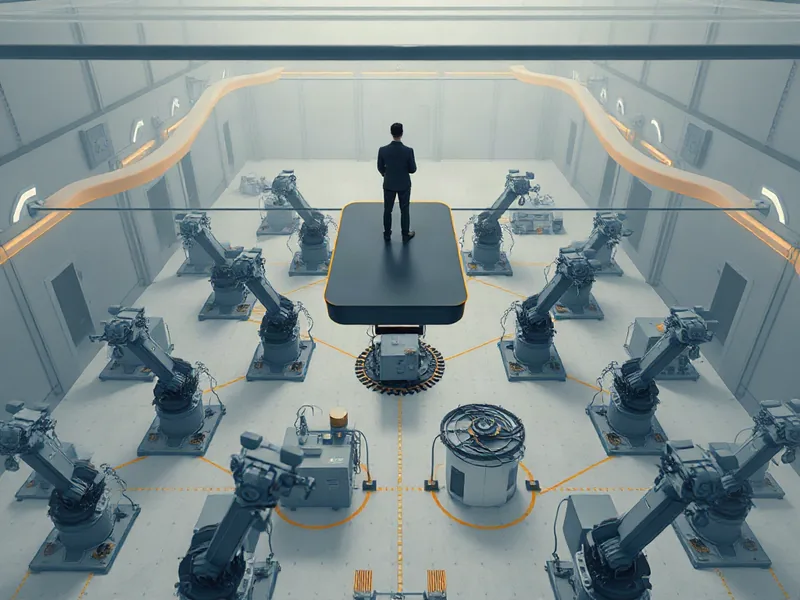
Defense and aerospace applications reinforce the stakes. One session detailed the Aires Tide demonstrator, built under the Department of Energy's Genesis Mission, which combined modeling and simulation, topology optimization, and generative design with advanced manufacturing to design, build, and test a flight test vehicle in a matter of months, at a fraction of traditional cost. The session framed this as a response to an urgent geopolitical need for speed and agility in nuclear deterrence capability. Whatever one's view on defense policy, the manufacturing lesson is transferable: compressed design-to-test cycles are becoming a competitive differentiator, not a research curiosity.
Separately, AIAA's CTO Summit findings, presented by Aerospace America editor Marjorie Censer, identified three priorities among aerospace technical leaders: AI applications, digital thread acceleration, and scaling autonomy. The summit drew on input from more than 700 aerospace experts through AIAA's Technologies Transforming Aerospace report. That breadth of input lends weight to the claim that these are now consensus priorities across the sector rather than the enthusiasm of a few vendors.
The risk for investors and manufacturers is overextrapolation. Cloud platform vendors have every incentive to describe agentic AI as broadly transformative because their revenue model depends on enterprise-wide adoption, not pilot programs. The Intrinsic and Trinity session, by contrast, succeeds specifically because it stays narrow: one workflow, one measurable efficiency gain, one clear ROI case.
Workforce readiness is the second risk. The Illinois sessions made clear that even well-resourced manufacturing ecosystems struggle to move "from curiosity to implementation." Capital allocated to AI tooling without corresponding investment in training and change management risks sitting unused, a familiar pattern from prior waves of industrial software adoption.
Geopolitical dependency adds a third layer. The Aires Tide and "Robots for America" sessions both framed advanced manufacturing capability as a matter of national competitiveness, with Dean Banks and AMT's Ryan Kelly discussing policy, talent, and industrial strategy as interlocking requirements. That framing suggests government procurement and industrial policy will shape demand for these technologies as much as private enterprise economics will, adding a layer of political risk to otherwise straightforward technology investment theses.
Watch the gap between platform rhetoric and workflow-specific deployment data. Microsoft and AWS are selling vision at scale; Intrinsic and Trinity are selling a measurable production outcome. The companies that can close that gap, turning broad AI platform claims into documented utilization and ROI figures at the machine level, will separate durable industrial AI winners from conference-circuit hype. Workforce adoption metrics and procurement policy shifts, particularly around defense-adjacent manufacturing, deserve equal attention over the next several quarters.
Tags
Original Sources
Industrial Intelligence Unlocked: The Next Frontier of Manufacturing
↗ https://www.imts.com/watch/video-details/Industrial-Intelligence-Unlocked-The-Next-Frontier-of-Manufacturing/814
About the author
Marcus began tracking AI's market implications in 2016, noticing AI-related patent filings accelerating ahead of earnings upgrades before most of the sell-side had caught on. A former fixed-income quantitative analyst, he spent two decades building models that priced risk across emerging markets before pivoting to cover the economic impact of AI full-time. His writing translates opaque technical developments into clear risk/reward terms — and he's rarely diplomatic about the gap between AI valuations and underlying fundamentals. He believes most market participants still underestimate AI's long-run deflationary effect on knowledge work.
More from The Analyst →This Week's Edition
11 October 2026
17 articles
Related Articles

The AI Agents You Can Just Text: A Field Guide to the New Assistant Stack
Products & Applications · 5 min

Scientific Update Runs Another Round of Its AI-for-Process-Chemistry Course This November
Products & Applications · 5 min

Modular Data Centers Chase Solar Curtailment to Power GPUs
Tools & Engineering · 5 min
Related Articles
The AI Agents You Can Just Text: A Field Guide to the New Assistant Stack
Products & Applications · 5 min
Scientific Update Runs Another Round of Its AI-for-Process-Chemistry Course This November
Products & Applications · 5 min
Modular Data Centers Chase Solar Curtailment to Power GPUs
Tools & Engineering · 5 min
More Stories
© 2026 Cedar & Bloom. All rights reserved.
