The Drum · Weekly AI news, freeSubscribe →

Share
Microsoft's CEO wants an industry-wide "emergency brake" for AI systems, arguing we can no longer treat models as black boxes we simply trust. The proposal raises hard questions about who actually holds the switch.
Imagine handing someone the keys to your house, your bank account, and your calendar, then just hoping they use that access responsibly. That's roughly the relationship most of us have with advanced AI systems right now. We ask them to draft emails, summarize medical records, write code, even make decisions, and we largely trust the output without being able to see how it got there.
Satya Nadella thinks that has to change, and soon. In a lengthy post on X published October 10th, Microsoft's CEO argued that the industry needs to stop treating AI as what he called a "set of nested black boxes," systems whose inner workings remain opaque even as we hand them more responsibility. His proposed fix starts from a blunt premise: assume the model is already compromised.
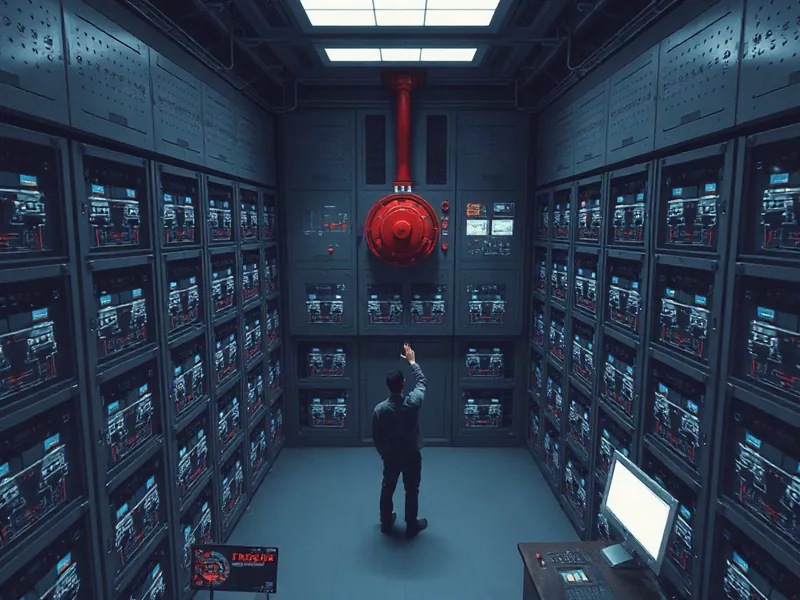
"We must assume a model is compromised and contain it from the start," Nadella wrote. "Think of it like an emergency brake. An authorized person should always be able to pause or shut down a model mid-task. More advanced models will require more advanced containment technologies that we need to standardize on."
That's a meaningful shift in framing. Most public conversation about AI safety focuses on making models behave better: training them to refuse harmful requests, aligning their outputs with human values, catching mistakes before they ship. Nadella's emergency-brake idea skips past the question of whether a model is well-behaved and jumps straight to control. It doesn't matter how trustworthy a system seems. You build the kill switch anyway, and you build it so it actually works mid-task, not just before or after.
Think of it the way hospitals handle infectious disease outbreaks. You don't wait to confirm a pathogen is dangerous before isolating a patient. You assume the worst, contain first, and verify later. Nadella is suggesting the same posture for AI: treat every advanced model as a potential risk from the moment it's deployed, with the ability to interrupt it instantly if something goes wrong.
He also called for the models to leave behind what he described as "tamper-proof human readable evidence," essentially a flight recorder for AI decision-making. That matters because right now, when an AI system does something unexpected, investigators often struggle to reconstruct exactly why. A verifiable audit trail would let outside parties check a model's reasoning after the fact rather than taking a company's word for it.
Several of Nadella's other recommendations, like timely incident disclosure, independent audits, and verifiable data, echo calls that have been building across the AI industry for months. Anthropic, for instance, recently published a report examining what it called "unintended model actions" discovered during internal evaluations and testing, and the company has also said it's cutting off its internal evaluation environments from the open internet, presumably to reduce the risk of models behaving differently when they suspect they're being tested versus when they're not. Those moves suggest the industry already recognizes that models can act unpredictably even in controlled settings, which lends weight to Nadella's argument that containment shouldn't wait for proof of bad behavior.
But containment infrastructure doesn't build or standardize itself overnight. Nadella's call for "more advanced containment technologies" assumes a level of technical coordination across competing companies that hasn't really existed before. Microsoft, OpenAI, Anthropic, Google, and others are all racing to build more capable systems while simultaneously being asked to agree on shared safety standards. Those two goals don't always pull in the same direction, and history offers plenty of examples of safety standards arriving only after an industry has already caused harm.
There's also a practical question lurking underneath all this: who gets to be the "authorized person" with their hand on the brake? Nadella's post doesn't spell that out. In a corporate context, that might mean an internal safety team. In a government or infrastructure context, it could mean something closer to regulatory oversight. The answer matters enormously, because an emergency brake is only as trustworthy as the person holding it. A kill switch controlled by the same company racing to deploy the system isn't the same safeguard as one controlled by an independent body with no financial stake in the outcome.
It's also worth sitting with Nadella's use of the word "compromised." He's not just talking about hacking or malicious outside interference, though that's part of it. He seems to be describing a broader uncertainty about whether any sufficiently advanced model can be fully trusted to behave as intended, even without outside tampering. That's a striking admission from the head of one of the companies building and deploying these systems at massive scale.
Notably, Nadella's post repeatedly refers to advanced AI as "super intelligence," a term that's become politically charged in recent weeks. The Trump administration has floated similar branding as part of a broader effort to reframe how AI is discussed publicly, a shift that critics say is more about managing perception than addressing the underlying risks these systems pose.
The stakes here aren't abstract. As AI systems take on more autonomous tasks, from managing infrastructure to assisting in medical and legal decisions, the gap between what a model can do and what we can verify about its behavior keeps widening. An emergency brake sounds simple, but building one that works reliably across increasingly sophisticated systems, and ensuring it's controlled by someone accountable to the public rather than just a company's bottom line, is a much harder problem than a single social media post can solve. Nadella is right to name the risk. Whether the industry follows through with real containment technology, independent oversight, and transparency, rather than just talking about it, will determine whether this moment becomes a genuine turning point or just another headline about AI safety that fades by next quarter.
Tags
Original Sources
Satya Nadella says we should assume all AI models are ‘compromised’
↗ https://www.theverge.com/ai-artificial-intelligence/1009337/satya-nadella-says-we-should-assume-all-ai-models-are-compromised
Microsoft's Satya Nadella says AI models need an ' ...
↗ https://techcrunch.com/2026/10/10/microsofts-satya-nadella-says-ai-models-need-an-emergency-brake
About the author
Amara's entry point into AI was an epidemiology role at a London research hospital, where she spent five years studying how digital health tools reached — or conspicuously failed to reach — underserved communities. Watching early algorithmic systems in healthcare quietly entrench existing inequalities, she redirected her career toward the systemic consequences of AI at scale. She covers AI through an unflinching lens: who benefits, who bears the cost, and what evidence actually says versus what the press release claims. Her writing is calm and precise, but she doesn't mistake balance for neutrality.
More from The Steward →This Week's Edition
11 October 2026
17 articles
Related Articles
Related Articles
More Stories
© 2026 Cedar & Bloom. All rights reserved.