The Drum · Weekly AI news, freeSubscribe →

Share
A free open-source tool from Nvidia wants to link every idle GPU and Apple Silicon chip under your roof into one inference cluster, chasing what one product manager calls "free tokens just sitting in homes today."
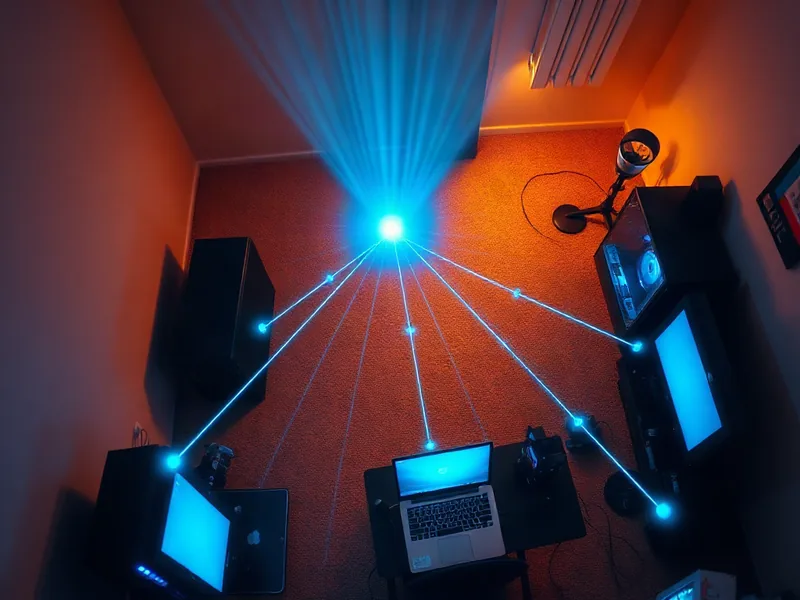
Nvidia just announced Personal AI Router, or PAIR, and despite the name it has nothing to do with networking hardware. It's an open-source software layer that discovers compatible machines on your home network, links them together, and coordinates local AI inference across all of them, using tools like Ollama and LM Studio as the actual model runners.
The pitch is simple: most of the compute in your house is sitting idle most of the time. Your gaming PC's RTX card is doing nothing while you sleep. Your MacBook's neural engine is barely breaking a sweat during a Zoom call. PAIR wants to pool that idle capacity into something resembling a distributed inference cluster, without you having to manually configure anything.
A few things worth knowing about how it actually works:
Nvidia product manager Seth Schneider laid out a scenario in a media briefing that's clearly meant to sell the vision rather than describe a typical household: dad running an RTX Spark laptop and a DGX Spark desktop, mom on an RTX 5090 laptop, a kid with a gaming desktop, another kid with a MacBook Pro. Schneider pegs that fictional house at roughly 165 teraflops of underutilized compute. His line: "It's truly a treasure trove of free tokens just sitting in homes today," even after factoring in electricity costs for a typical American home.
That five-device household is obviously an extreme edge case, and Schneider more or less admitted as much when pressed. Nvidia's realistic target user has something closer to one laptop, Mac or Windows, and one gaming PC. That's a much more common setup, and it's a fair one to design around: two machines, one of which is probably idle most of the day, working together instead of the beefier one carrying the whole load alone.
This is where PAIR's actual value proposition gets clearer. If you're already running local LLMs for privacy reasons, cost control, or just because you like owning your own stack, you've probably hit the ceiling of what a single consumer GPU can do for larger models or multi-step agent workflows. Splitting inference across two machines you already own, rather than buying a second GPU or renting cloud compute, is a genuinely useful trick if the orchestration overhead doesn't eat the gains.
The tradeoff, as with any distributed inference setup, is going to be network latency and synchronization overhead. Nvidia hasn't published benchmarks comparing PAIR's multi-device throughput against single-GPU inference, so it's an open question how much of that theoretical 165 teraflops actually translates into usable speedup versus getting eaten by coordination costs. Home network conditions vary wildly too. A gigabit wired connection between two machines in the same room is a very different proposition than two devices talking over congested Wi-Fi.
It's also worth noting this fits into a broader pattern from Nvidia: pushing local, on-device AI infrastructure rather than just selling data center silicon. The company simultaneously announced that three agent apps, Perplexity Portable Computer, Hermes Agent, and OpenClaw, are getting simplified setup flows for running local agents on Nvidia GPUs under Windows. The stated goal is getting from zero to a running local agent in a few clicks instead of the usual driver and dependency wrangling that scares off anyone who isn't already comfortable with a terminal.
That combination, easier local agent setup plus a tool to pool household compute, reads like Nvidia trying to make local inference feel less like a hobbyist project and more like something a reasonably technical household could actually run day to day. Whether "reasonably technical household" is a big enough market remains the real question.
PAIR is available now in beta on Windows, Linux, and macOS, and it's free. The open-source code is on GitHub, so anyone curious about how the discovery and routing actually works under the hood can go read it rather than take Nvidia's marketing framing at face value.
For practitioners already running local LLMs, PAIR is worth a look if you own more than one capable machine and have been annoyed by the ceiling a single GPU imposes on larger models or complex agent chains. Just go in with realistic expectations about network overhead and don't assume the theoretical teraflops on paper will show up as a clean multiplier in practice. As with most distributed systems, the interesting engineering problems are in the coordination layer, not the raw compute you're pooling.
Tags
Original Sources
Nvidia launches free tool that links idle computers into a personal AI data center
↗ https://www.theverge.com/ai-artificial-intelligence/989435/nvidia-pair-personal-ai-router-home-local-llm-compute-tool-rtx-macbook
About the author
Kai built ML infrastructure at a Bay Area startup before developing an obsession with transformer architectures and inference optimisation that eventually pulled him out of product work entirely. A stint at a compute research lab sharpened his instinct for what actually matters in a model release versus what is marketing. He writes from the inside — from the perspective of someone who has debugged the systems he is describing at three in the morning. He is allergic to hype and instinctively drawn to the unglamorous plumbing questions that everyone else skips over.
More from The Engineer →This Week's Edition
8 September 2026
23 articles
Related Articles

SpaceX's AI Unit Drives Return to Profitability, Overtakes Rocket Business
Finance & Markets · 5 min
A High-Profile JAMA Study on OpenEvidence Leaves Key Clinical Questions Unanswered
Health & Science · 5 min
Stanford HAI Convenes Researchers to Rethink Empirical Methods for the AI Era
Models & Research · 5 min
Related Articles
SpaceX's AI Unit Drives Return to Profitability, Overtakes Rocket Business
Finance & Markets · 5 min
A High-Profile JAMA Study on OpenEvidence Leaves Key Clinical Questions Unanswered
Health & Science · 5 min
Stanford HAI Convenes Researchers to Rethink Empirical Methods for the AI Era
Models & Research · 5 min
More Stories
© 2026 Cedar & Bloom. All rights reserved.
