The Drum · Weekly AI news, freeSubscribe →

Share
A free open-source tool from Nvidia links up spare compute across your household's GPUs and Macs, pooling idle cycles for local AI inference instead of leaving that hardware sitting dark.
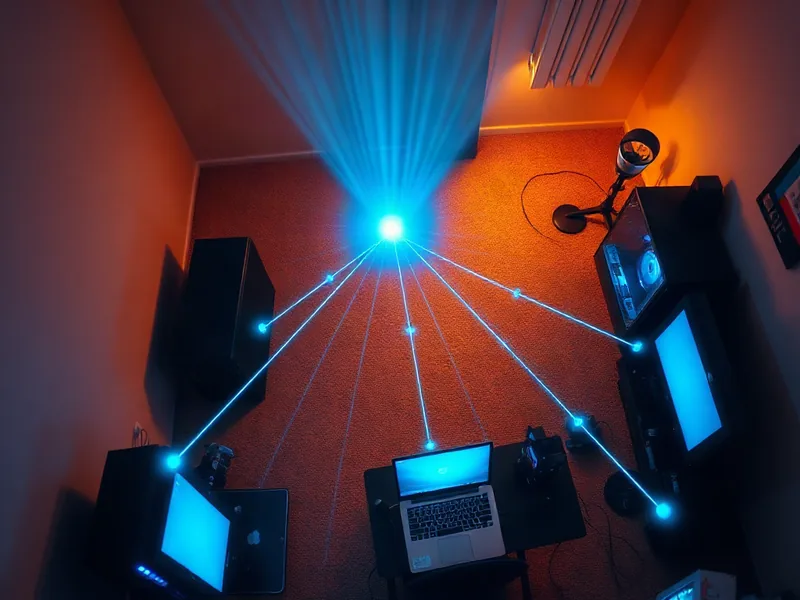
Nvidia just announced Personal AI Router, or PAIR, and despite the name, it's not a piece of networking hardware. It's an open-source software layer that discovers compatible machines on your home network, links them together, and puts their spare GPU cycles to work on local AI inference. Think of it as a poor man's compute cluster for your living room, built for anyone running local LLMs through tools like Ollama or LM Studio.
The pitch is straightforward: most home compute sits idle most of the time. Your gaming desktop's RTX card isn't doing much while you're browsing the web. Your MacBook's M4 chip is mostly loafing during a Zoom call. PAIR's job is to find those idle cycles across every device on the network and pool them into a single resource for agentic workflows, the kind of task where an AI agent breaks a big job into a bunch of smaller subtasks that need to run somewhere.
That mixed hardware support is worth pausing on. Nvidia building a tool that happily includes Apple Silicon in the mix is a little unusual for a company whose business model depends on people buying its GPUs. But it makes sense here: if the whole point is aggregating whatever compute already exists in a household, artificially excluding Macs would just shrink the addressable pool of "free tokens," to borrow language from Nvidia's own pitch.
The technical hook is dynamic scheduling. PAIR is designed to lean on devices only when they're idle, and to back off the instant they're needed for something else. Nvidia's example: if your desktop is quietly contributing GPU cycles to a distributed inference job and you fire up a game, PAIR is supposed to detect that shift and reroute the workload elsewhere on the network without you noticing a hiccup.
That's the harder engineering problem here, frankly. Discovering devices on a LAN and encrypting traffic between them is well-trodden ground. Building a scheduler that can gracefully add and remove compute nodes in real time, mid-inference, without stalling a running agentic task, is the part that actually differentiates this from just running Ollama on each machine separately. Nvidia says the system adapts as devices join or leave the network, which implies some kind of continuous health-checking and workload migration happening under the hood, though the company hasn't published deep architectural details yet.
Security is handled through a pairing flow that should feel familiar if you've set up a smart TV or streaming stick: devices connect using a six-digit code, and once paired, the channel is secured via mutual TLS (mTLS). Regular TLS, the thing securing most HTTPS traffic, only verifies the server's identity to the client. mTLS flips that around so both sides authenticate each other, which matters here because every device on a PAIR network is simultaneously a client and a compute provider. You want assurance that the "device" asking to borrow your GPU cycles is actually who it claims to be, not just that you're talking to a server somewhere.
To illustrate the scale of the opportunity, Nvidia product manager Seth Schneider walked through a hypothetical household during a media briefing: a dad with an RTX Spark laptop and a DGX Spark desktop, a mom with an RTX 5090 laptop, a daughter with a gaming desktop, and a son with a MacBook Pro. Add it up, Schneider said, and that family is sitting on roughly 165 teraflops of underutilized compute. "It's truly a treasure trove of free tokens just sitting in homes today," he said, adding that the math holds up even after factoring in typical US electricity costs.
That example is clearly the extreme end of the spectrum, and Nvidia knows it. When pressed on who the realistic target user actually is, Schneider was more modest: most PAIR users will probably have something like one laptop and one gaming PC, not a five-device household fleet spanning three different GPU generations. It's a reasonable admission. Multi-GPU households with DGX Spark systems sitting around are not exactly the median American home. But even a two-device setup, a MacBook and a gaming rig, is a meaningfully bigger inference pool than either machine running alone.
Alongside PAIR, Nvidia is also rolling out simplified local-setup flows for three AI agent apps: Perplexity Portable Computer, Hermes Agent, and OpenClaw. All three will support streamlined onboarding with Nvidia GPUs on Windows, aimed at cutting down the manual configuration that currently stands between "I want to run an agent locally" and actually having one running. That's a separate but complementary push: PAIR handles the distributed compute layer, and these onboarding improvements handle the "getting an agent running at all" friction that scares off a lot of would-be local-AI users.
PAIR is a bet that the local AI movement needs infrastructure, not just better models. Running LLMs on-device has been gaining traction for privacy and cost reasons, but a single consumer GPU still hits hard limits on model size and throughput. Pooling idle compute across a household is a clever way to extend those limits without buying new hardware.
The beta is live now for Windows, Linux, and macOS, and it's fully open source, so expect the usual pattern: early adopters kicking the tires, GitHub issues piling up around edge cases in device discovery, and probably some benchmarks comparing PAIR-clustered inference against single-device baselines within the next few weeks. Whether "your family's spare GPUs" becomes a real category of compute infrastructure, or stays a neat demo for households with a DGX Spark lying around, is the thing worth watching.
Tags
Original Sources
Nvidia launches free tool that links idle computers into a personal AI data center
↗ https://www.theverge.com/ai-artificial-intelligence/989435/nvidia-pair-personal-ai-router-home-local-llm-compute-tool-rtx-macbook
About the author
Kai built ML infrastructure at a Bay Area startup before developing an obsession with transformer architectures and inference optimisation that eventually pulled him out of product work entirely. A stint at a compute research lab sharpened his instinct for what actually matters in a model release versus what is marketing. He writes from the inside — from the perspective of someone who has debugged the systems he is describing at three in the morning. He is allergic to hype and instinctively drawn to the unglamorous plumbing questions that everyone else skips over.
More from The Engineer →This Week's Edition
6 September 2026
24 articles
Related Articles

Microsoft Unveils Maia 300, Its Next AI Inference Chip, With Multi-Gigawatt Rollout Planned for 2027
Tools & Engineering · 5 min
3D Chip Stacking Moves From Lab Curiosity to Production Necessity
Tools & Engineering · 6 min

Why AI Pilots Stall: Enterprises Are Missing a Decision Layer, Not a Better Model
Tools & Engineering · 5 min
Related Articles
Microsoft Unveils Maia 300, Its Next AI Inference Chip, With Multi-Gigawatt Rollout Planned for 2027
Tools & Engineering · 5 min
3D Chip Stacking Moves From Lab Curiosity to Production Necessity
Tools & Engineering · 6 min
Why AI Pilots Stall: Enterprises Are Missing a Decision Layer, Not a Better Model
Tools & Engineering · 5 min
More Stories
© 2026 Cedar & Bloom. All rights reserved.
