The Drum · Weekly AI news, freeSubscribe →

Share
Nurses lose hours to charting and record searches every shift. Oracle Health's expanded AI agent tries to claw that time back by living inside the EHR itself, not bolted on beside it.
Nurses spend a surprising chunk of every shift doing things that have nothing to do with actually being with patients. Searching charts. Documenting vitals. Finishing notes after the shift technically ended. Oracle Health put it plainly in an interview this week: "This can take time away from direct patient care and contribute to after-shift charting."
The company's answer is to extend its Clinical AI Agent, already in use by physicians across the US, to nursing staff. The agent handles two core jobs: chart navigation and real-time documentation. Both are built to slot into workflows nurses already follow, rather than asking them to learn something new on top of an already packed shift.
Here's how it works in practice. Instead of manually digging through a patient's record, a nurse can just ask for what they need using natural language voice commands. Once the chart is pulled up, AI-generated summaries give a quick snapshot of the patient's current condition, skipping the full manual review that used to eat up minutes nurses don't have. The agent also supports voice-enabled discrete charting, letting nurses dictate specifics like weight, blood pressure, and symptoms in real time instead of typing them in later.
That last part matters more than it might sound. Discrete charting, meaning structured, itemized data entry rather than free-text notes, is often the tedious part of documentation. Making it voice-driven and immediate cuts down on the backlog of notes that pile up for after-shift completion, which is exactly the kind of unpaid, unglamorous work burnout researchers have flagged for years.
Oracle Health isn't alone in chasing this problem, and the competitive landscape says a lot about where healthcare AI is headed.
Lifepoint Health announced earlier this month that it's piloting ambient listening technology, tools that passively capture conversations between nurses and patients and auto-document them into records. Lifepoint is also exploring AI agents that could help nurses prioritize patient assignments before a shift even starts, tackling the administrative burden from a scheduling angle rather than a documentation one.
Hippocratic AI is working a different corner of the same problem. Its Nurse Co-Pilot voice assistant calls patients directly, walking them through discharge prep, medication instructions, and post-discharge care. Clinical notes from those calls get logged into patient charts automatically afterward.
Both of those approaches are useful, but they're separate tools bolted onto separate workflows. Oracle Health's pitch is different: the Clinical AI Agent lives directly inside the Oracle Health Foundation EHR. No app-switching, no toggling between systems built for different tasks.
"This embedded approach helps reduce context switching and keeps nurses in control while fitting AI into the systems and processes they already use," Oracle Health said. That's a real distinction from an engineering standpoint. Context switching isn't just annoying, it's a documented source of cognitive load and error risk in clinical settings. A tool that requires nurses to jump between a voice assistant, an ambient listening app, and the actual EHR introduces friction at every handoff. Embedding removes at least one of those seams.
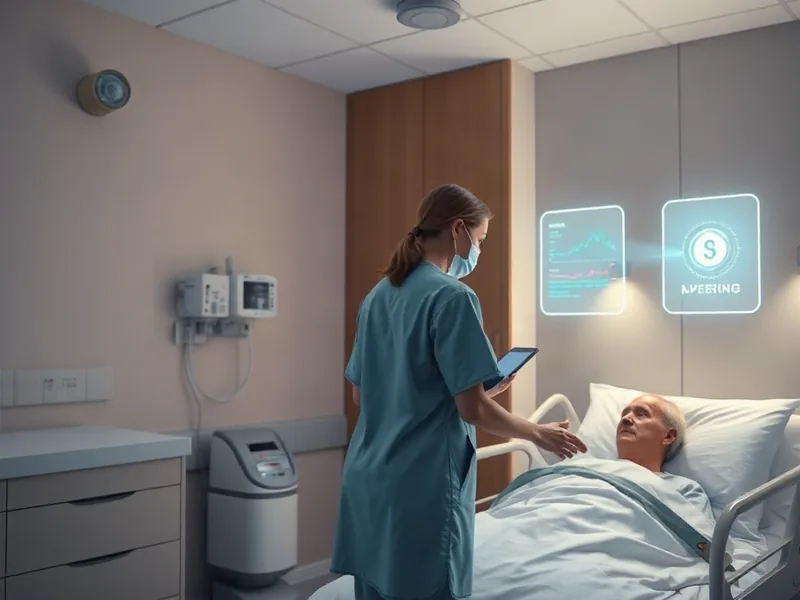
Control matters just as much as convenience here. The agent doesn't auto-populate the record without a human checking it first. Nurses review and approve documentation before it gets entered into the EHR, giving them a chance to catch anything the agent got wrong.
"The agent is intended to assist nurses, while keeping them in control of reviewing and approving the resulting documentation," Oracle Health said. That review step is the kind of guardrail you'd expect in a clinical setting where a misheard word or a misattributed vital sign isn't a minor bug, it's a patient safety issue.
Voice-driven AI in clinical environments still carries real risk if outputs go unchecked. Speech recognition struggles with accents, background noise, and medical terminology that sounds similar but means very different things. Building in a mandatory approval step before anything hits the permanent record is a sensible way to manage that risk without giving up on the speed benefits voice interfaces provide.
The bigger strategic move here is Oracle stacking this agent on top of an existing AI portfolio already aimed at reducing administrative load for clinicians. Physicians got this tool first. Now nurses get a version tuned to their specific workflow. That's a deliberate expansion pattern: prove the concept with one clinical role, then adapt the underlying architecture for adjacent roles facing similar friction.
It also positions Oracle to compete less on flashy standalone features and more on integration depth. Ambient listening tools and voice co-pilots are compelling, but they're add-ons. An agent embedded in the record system itself is harder to replicate for competitors who don't own the EHR layer. That's Oracle's actual moat here, not the AI model, but the fact that it already sits underneath the workflow.
The nurse-focused rollout signals where clinical AI is heading: less about flashy standalone assistants, more about quietly disappearing into the systems clinicians already use all day. Oracle Health's bet is that reducing context switching, not just automating tasks, is what actually gives nurses time back.
Whether this actually reduces after-shift charting at scale is something hospitals will need to measure over the next few deployment cycles. But the design philosophy, meet nurses where they already work instead of adding another app to the pile, is the part worth watching.
Tags
Original Sources
How is Oracle Health's Nurse AI Agent Different? - MedCity News
↗ https://medcitynews.com/2026/09/how-is-oracle-healths-nurse-ai-agent-different
About the author
Kai built ML infrastructure at a Bay Area startup before developing an obsession with transformer architectures and inference optimisation that eventually pulled him out of product work entirely. A stint at a compute research lab sharpened his instinct for what actually matters in a model release versus what is marketing. He writes from the inside — from the perspective of someone who has debugged the systems he is describing at three in the morning. He is allergic to hype and instinctively drawn to the unglamorous plumbing questions that everyone else skips over.
More from The Engineer →This Week's Edition
23 September 2026
29 articles
Related Articles

Pelago Launches Unified Platform to Treat Substance Use, Mental Health and Behavioral Addiction Together
Products & Applications · 5 min

HealthEx Plugs Patient Records Into Meta's Muse AI as TEFCA Network Adds Two More QHINs
Products & Applications · 6 min

ABBYY repackages decades-old OCR engine as a self-hosted preprocessor for LLM pipelines
Products & Applications · 5 min
Related Articles
Pelago Launches Unified Platform to Treat Substance Use, Mental Health and Behavioral Addiction Together
Products & Applications · 5 min
HealthEx Plugs Patient Records Into Meta's Muse AI as TEFCA Network Adds Two More QHINs
Products & Applications · 6 min
ABBYY repackages decades-old OCR engine as a self-hosted preprocessor for LLM pipelines
Products & Applications · 5 min
More Stories
© 2026 Cedar & Bloom. All rights reserved.
