The Drum · Weekly AI news, freeSubscribe →

Share
At Disrupt 2026, Qualcomm's XR and wearables chief told founders that AI agents are migrating off phones and into glasses, rings, and earbuds, reshaping what hardware startups need to build and sell.
The center of gravity for consumer AI is shifting away from the smartphone screen. That was the core message from Ziad Asghar, Senior Vice President and General Manager of XR, Wearables, and Personal AI at Qualcomm Technologies, during a conversation with PC Magazine's Florence Ion on the Builders Stage at TechCrunch Disrupt 2026 in San Francisco. His thesis is straightforward: AI agents no longer live exclusively inside an app waiting to be opened. They now run on the body, through glasses, watches, earbuds, rings, and pins, operating alongside phones and PCs rather than underneath them.
For investors tracking hardware startups, this is a meaningful shift in where value gets created. If agents are becoming ambient rather than app-bound, the device itself becomes the interface. That changes the calculus for what makes a wearable company investable versus merely novel.
Why it matters
The distinction matters because it reframes the competitive battlefield. For the better part of a decade, the smartphone has been the default access point for AI tools, from voice assistants to chatbots. Asghar's framing suggests that era is ending, or at least fragmenting. Agents embedded in wearables promise lower friction: no unlocking a phone, no opening an app, just a glance or a voice command processed on-device.
This matters commercially because it lowers the bar for a new category of hardware company to compete. A startup does not need to build a general-purpose computing platform to win. It needs to own a specific interaction, translation through earbuds, navigation through glasses, health monitoring through a ring, and let the underlying silicon handle the heavy lifting. Qualcomm's pitch, implicit throughout the session, is that its next-generation platforms are the enabling layer making these device categories technically and economically viable.
That is also where the risk concentrates. Hardware founders building on a single chip vendor's roadmap inherit that vendor's timeline, pricing power, and strategic priorities. Qualcomm has strong incentives to talk up agentic AI's hardware diversification because it stands to supply the silicon across glasses, watches, and earbuds alike. That does not make the thesis wrong, but it does mean founders and investors should weigh the message against the messenger.
Asghar's remarks to founders centered on two practical requirements: trust and scalability. Those are not abstract virtues in this context. They are the two variables that determine whether a wearable AI product survives past its first product cycle.
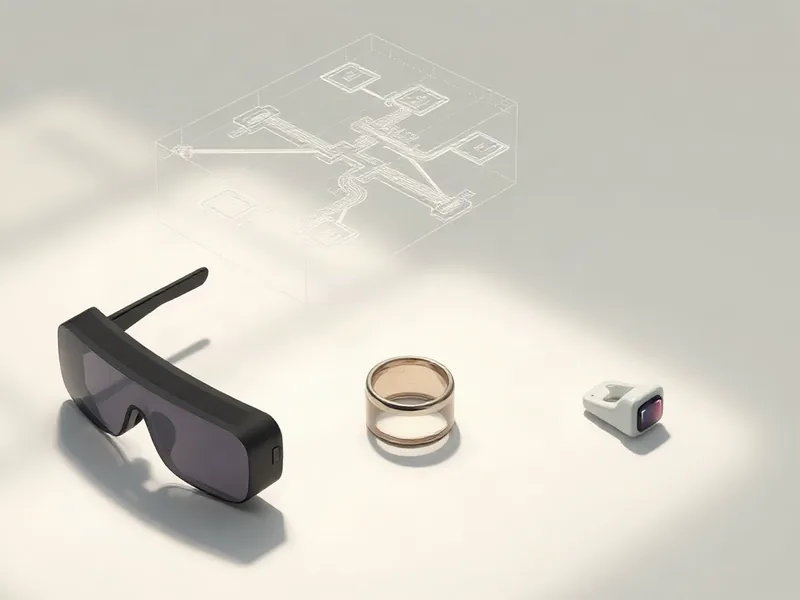
Trust, in Asghar's framing, is about the reliability of always-on, body-worn AI that processes personal data continuously. A phone AI assistant that a user consults occasionally carries different risk than a pair of glasses or a ring that is always listening, watching, or sensing. Founders building in this space need to design for data handling and on-device processing from day one, not retrofit it after a privacy controversy forces the issue.
Scalability is the second constraint, and it is where many hardware startups historically stumble. Building one impressive prototype is very different from shipping a device that performs consistently across battery life, thermal limits, and network conditions, at a price point consumers will actually pay. Asghar's point, consistent with Qualcomm's long-standing pitch to device makers, is that platform-level silicon and software stacks reduce the engineering burden so founders can focus on the product experience rather than reinventing low-level AI inference from scratch.
This is a familiar dynamic in hardware investing. The companies that win are rarely the first to demonstrate a flashy capability. They are the ones that can manufacture, certify, and distribute a reliable product at volume while managing unit economics. Agentic AI wearables will be no exception. A smart ring that can summarize your calendar is a demo. A smart ring that does so reliably for a million users across firmware updates and battery degradation is a business.
There is also a go-to-market lesson embedded in Asghar's comments. By positioning agents as working "alongside" smartphones and PCs rather than replacing them, Qualcomm is signaling that the near-term opportunity is complementary hardware, not a wholesale platform shift. That is a more conservative and, frankly, more credible framing than claims of an imminent post-smartphone world. It suggests the realistic market for the next several years is accessory and companion devices that extend existing ecosystems, not devices that attempt to unseat them outright.
The agentic AI wearables narrative is compelling, but it remains early-stage and vendor-driven. Qualcomm has an obvious commercial interest in founders believing that next-generation device categories are both necessary and imminent, since it intends to supply the chips that power them. That conflict of interest does not invalidate the underlying trend, but it should temper how much weight investors place on a single sponsored session as evidence of market readiness.
What is genuinely useful here is the operational guidance: build for trust through on-device processing and transparent data handling, and build for scale by leaning on platform infrastructure rather than reinventing it. Those are sound engineering principles regardless of whether glasses, rings, or pins turn out to be the breakout category.
For investors, the signal to watch is not the rhetoric around "agentic AI" itself, which has become a crowded buzzword across the industry, but concrete adoption metrics: unit shipments of AI-native wearables, battery life improvements tied to on-device inference, and whether major device makers commit multi-year roadmaps to these categories rather than one-off product launches. Qualcomm's platform strategy gives it leverage across multiple device types, which is a reasonable hedge against uncertainty about which wearable form factor ultimately wins. Founders and investors without that diversification need to be more selective about which bet they are actually making.
Tags
Original Sources
The rise of agentic AI: lessons for hardware founders | TechCrunch
↗ https://techcrunch.com/sponsor/qualcomm/the-rise-of-agentic-ai-lessons-for-hardware-founders
About the author
Marcus began tracking AI's market implications in 2016, noticing AI-related patent filings accelerating ahead of earnings upgrades before most of the sell-side had caught on. A former fixed-income quantitative analyst, he spent two decades building models that priced risk across emerging markets before pivoting to cover the economic impact of AI full-time. His writing translates opaque technical developments into clear risk/reward terms — and he's rarely diplomatic about the gap between AI valuations and underlying fundamentals. He believes most market participants still underestimate AI's long-run deflationary effect on knowledge work.
More from The Analyst →This Week's Edition
30 October 2026
28 articles
Related Articles

OpenEvidence Lands NYU Langone, Deepening Its Grip on New York's Hospital Systems
Products & Applications · 5 min

BCBSMA Taps Medzown to Steer Complex-Condition Members Toward Clinical Trials
Products & Applications · 5 min

Tech PR Agency The Colab Adds Ten to Leadership After 322% Revenue Growth
Products & Applications · 5 min
Related Articles
OpenEvidence Lands NYU Langone, Deepening Its Grip on New York's Hospital Systems
Products & Applications · 5 min
BCBSMA Taps Medzown to Steer Complex-Condition Members Toward Clinical Trials
Products & Applications · 5 min
Tech PR Agency The Colab Adds Ten to Leadership After 322% Revenue Growth
Products & Applications · 5 min
More Stories
© 2026 Cedar & Bloom. All rights reserved.
