The Drum · Weekly AI news, freeSubscribe →

Share
Why does a plant burger never quite gel like real meat? Pasqal and True Nexus think quantum computers can finally crack the protein chemistry that has stumped food scientists for two decades, with a $1 trillion market at stake.
Think about the last time you bit into a plant-based burger and it fell apart in your hands, or a dairy-free cheese that never quite melted right. That texture problem isn't a minor inconvenience. It's the reason an entire industry built on good intentions, lower emissions, less land use, more food security, has struggled to win over skeptical eaters for twenty years running.
Pasqal, a French company building quantum computers using individually controlled atoms, and True Nexus, a Saudi computational biology firm, announced this week that they've cleared a real hurdle in that struggle. The two companies used Pasqal's neutral-atom quantum hardware to encode protein structures tied to gelation, the chemical process that turns a liquid into a gel and gives foods like gelatin, egg whites, or dairy their characteristic bite and structure.
This matters because proteins are strange, stubborn things. Scientists have gotten quite good at reading a protein's genetic sequence, the string of amino acids that spells out what it's made of. But sequence isn't function. Knowing the letters of a word doesn't tell you how it sounds when spoken aloud, and knowing a protein's sequence doesn't tell you how it will behave when you heat it, whip it, or mix it with water. That behavior, whether it gels, binds, foams, or holds moisture, is what actually determines whether a plant-based ingredient can replace animal protein in a product people want to eat.
For decades, the only way to figure that out was trial and error at the lab bench. Cook it, test it, tweak it, repeat. Slow, expensive, and often unsuccessful. Despite billions of dollars poured into alternative proteins over the past twenty years, plant-based ingredients still haven't consistently matched the functional performance of gelatin, dairy, egg, or meat proteins. The industry could see the ingredients. It just couldn't see how they worked.
Classical computers struggle with this kind of problem because protein folding and interaction involve enormous numbers of possible configurations, more than a supercomputer can practically sort through using conventional methods. Neutral-atom quantum processors work differently. They use individual atoms held in place by laser light to represent and manipulate quantum information, which makes them particularly suited to modeling the kind of complex, interacting systems found in molecular chemistry.
Mark Armstrong, Pasqal's chief commercial officer for EMEA, described the milestone as evidence that quantum computing is moving out of theoretical labs and into problems with real economic weight. "Encoding real protein structures on our neutral-atom processors shows how quantum can move from the lab toward the problems that matter to industry and to nations," he said. "Protein functionality is exactly the kind of high-value, classically hard challenge neutral-atom technology is built for."
Dominik Grabinski, True Nexus's chief executive, framed the achievement in more sweeping terms. "This is the moment protein functionality stops being a mystery and starts becoming designable," he said. "Together with Pasqal, we are bringing the chemistry that governs how proteins behave onto neutral-atom quantum hardware, opening a new path to understand, predict and ultimately design protein functionality."
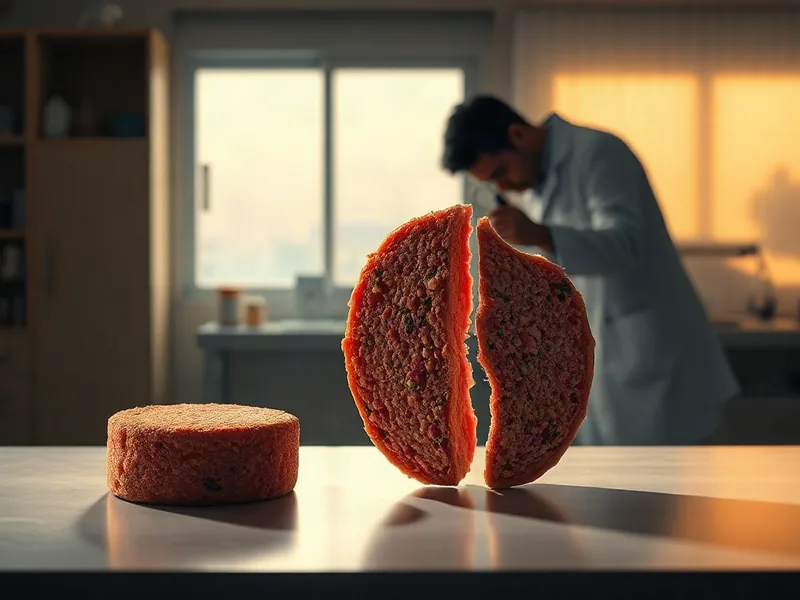
That word, designable, is doing a lot of work. If the collaboration succeeds, it wouldn't just help scientists understand why a given plant protein behaves the way it does. It could let them engineer new proteins from the ground up, tailored to gel, bind, or foam exactly the way food manufacturers need. That would be a genuine shift from reactive testing to proactive design, the kind of leap that pharmaceutical researchers have long chased in drug discovery, now applied to the food we eat every day.
The stakes are sizable. Bloomberg Intelligence projects global protein demand will approach $1 trillion by 2030. Plant-based, halal, and regionally grown protein sources remain largely untapped, held back not by demand but by the absence of a reliable design tool. Solving the functionality puzzle could unlock a market that has been circling for years without finding its footing.
There's also a geopolitical layer here. The project was delivered through Saudi Arabia's Ministry of Communications and Information Technology, and it's being positioned as a flagship for the Kingdom's broader quantum ambitions under Vision 2030. Beyond food security, the goal is to establish Saudi Arabia as a serious player in AI and quantum applications for life sciences and biotechnology. There's talk of a proposed Saudi Quantum DeepTech Foundry that would extend the same computational approach to energy, environmental science, drug discovery, materials science, and finance.
It's worth being clear-eyed about where things stand. This is an early, foundational step, encoding structures relevant to gelation, not a finished protein-design platform ready for commercial rollout. Quantum computing itself is still maturing. Pasqal's neutral-atom systems currently handle what are called analog workloads, with the company working toward fault-tolerant quantum computing down the road. The technology is promising, but promising is not the same as proven at scale.
Food texture might sound like a trivial thing to chase with cutting-edge quantum hardware, but it sits at the intersection of some genuinely important problems. Getting plant-based proteins to perform like their animal counterparts would remove one of the biggest barriers to broader adoption of foods that require less land, less water, and generate fewer greenhouse gas emissions than conventional meat and dairy production. For a planet under climate pressure, that's not a niche concern.
There's also a public health angle worth watching. Diversifying protein sources, particularly toward regionally grown and halal-compliant options, could improve food security and affordability in parts of the world where supply chains are fragile or import-dependent. If quantum-assisted design tools genuinely make plant proteins more functional and more appealing, the ripple effects could reach well beyond grocery store shelves, touching everything from agricultural land use to nutrition access in underserved regions. That's a future worth tracking closely, even as the underlying technology continues to prove itself.
Tags
Original Sources
Pasqal and True Nexus Advance Quantum Approach to Protein Design - HPCwire
↗ https://www.hpcwire.com/off-the-wire/pasqal-and-true-nexus-advance-quantum-approach-to-protein-design
About the author
Amara's entry point into AI was an epidemiology role at a London research hospital, where she spent five years studying how digital health tools reached — or conspicuously failed to reach — underserved communities. Watching early algorithmic systems in healthcare quietly entrench existing inequalities, she redirected her career toward the systemic consequences of AI at scale. She covers AI through an unflinching lens: who benefits, who bears the cost, and what evidence actually says versus what the press release claims. Her writing is calm and precise, but she doesn't mistake balance for neutrality.
More from The Steward →This Week's Edition
7 September 2026
23 articles
Related Articles

A High-Profile JAMA Study on OpenEvidence Leaves Key Clinical Questions Unanswered
Health & Science · 5 min

Cell and Gene Therapies Can Cure Disease. Can We Afford to Pay for Them?
Health & Science · 6 min

FDA Clears Jemperli for Rectal Cancer, Offering Some Patients a Path Without Surgery
Health & Science · 6 min
Related Articles
A High-Profile JAMA Study on OpenEvidence Leaves Key Clinical Questions Unanswered
Health & Science · 5 min
Cell and Gene Therapies Can Cure Disease. Can We Afford to Pay for Them?
Health & Science · 6 min
FDA Clears Jemperli for Rectal Cancer, Offering Some Patients a Path Without Surgery
Health & Science · 6 min
More Stories
© 2026 Cedar & Bloom. All rights reserved.
