The Drum · Weekly AI news, freeSubscribe →

Share
Sim2Real training, digital twins, and synthetic data are letting manufacturers teach robots new skills in hours instead of weeks, with some perception systems already hitting 98% accuracy before a single unit touches a real production line.
Industrial robot training has historically meant something tedious: engineers hand-tuning commands, running the same pick-and-place motion hundreds of times, burning days to get a single task reliable. That's changing. A cluster of AI techniques, bundled loosely under the "industrial metaverse" banner, is compressing that timeline from weeks to hours by moving the bulk of training into simulation.
The core idea is called Sim2Real (simulation to reality). You train a model in a virtual environment built to mimic real factory conditions, then transfer that trained behavior to a physical robot. It sounds simple. The engineering behind it isn't.
Why does this matter for practitioners? Traditional robot learning follows the same playbook as a lot of deep learning: feed the model huge amounts of labeled data and let it learn by trial and error. That works fine for image classifiers. It breaks down fast in robotics, where "grab a bottle" can mean a near-infinite number of variations in shape, color, lighting, and placement. Collecting enough real-world examples to cover that space, with a human supervising every attempt, is slow and expensive. It's also kind of a dead end: you can throw more robot-hours at the problem and still get diminishing returns.
Generalization is the real bottleneck
The fix researchers are converging on is generalization rather than brute-force data collection. Researchers from NYU, Meta, and Hello Robot built what they call robot utility models, which hit a 90% success rate on basic tasks in environments the models had never seen before, no additional fine-tuning required. The trick is pairing large language models with computer vision to give the robot continuous feedback on whether it actually completed the task. That feedback loop lets the system learn faster by combining techniques instead of grinding through repetitive trial-and-error cycles.
Italian automation company EPF felt this shift firsthand. Rather than building bespoke robotic solutions from the ground up for each client, the company restructured around modular components that could be recombined for different use cases. "We changed our development strategy from designing entire solutions from scratch to developing modular, flexible components that could be combined to create complete solutions, allowing for greater coherence and adaptability across different sectors," says EPF chairman and CEO Franco Filippi. EPF worked with Siemens to bake visual AI and object recognition into its robots, so they can adapt to different product shapes and conditions without physical reconfiguration.
Data scarcity is the perennial problem in robotics AI. There's rarely enough real-world footage of, say, a bin full of randomly oriented parts under every possible lighting condition. Synthetic data, computer-generated simulations of shapes, materials, textures, and environments, is turning out to be a workable substitute.
Siemens' SIMATIC Robot Pick AI is a good example of what this unlocks in practice. It's trained entirely on synthetic data: virtual renderings of objects, materials, and bin conditions. The result is a system that can pick unknown items out of chaotic, unsorted bins with over 98% accuracy, a task that used to require rigid, pre-programmed pick points. When the system makes a mistake, it incorporates that feedback and improves. Because it's software-based, the improvements roll out across entire robot fleets at once rather than requiring a technician to visit each unit.
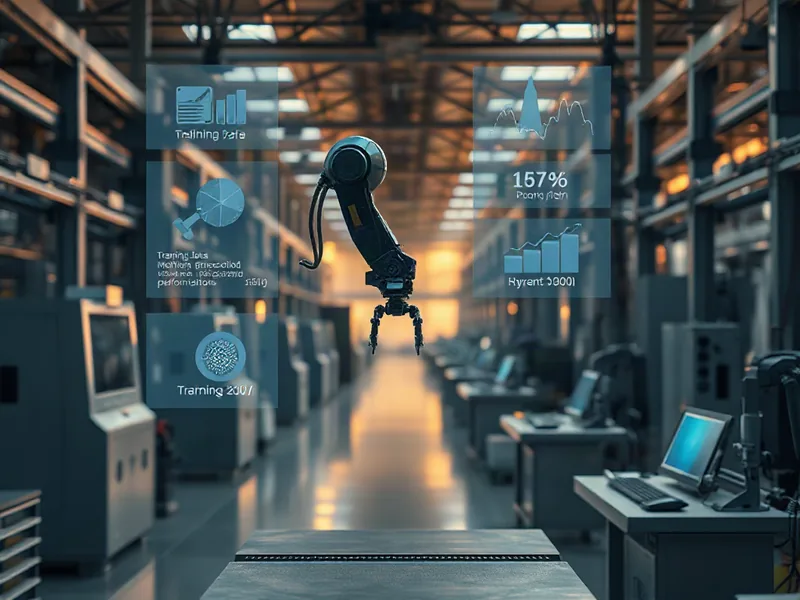
Siemens project lead Vincenzo De Paola described the process: "By using synthetic data, we create variations in object orientation, lighting, and other factors to ensure the AI adapts well across different conditions. We simulate everything from how the pieces are oriented to lighting conditions and shadows. This allows the model to train under diverse scenarios, improving its ability to adapt and respond accurately in the real world."
ANYbotics takes a related but distinct approach, building full 3D digital twins of industrial sites rather than just synthetic object libraries. The company folds in real operational data, temperature, pressure, flow rates, to make the virtual replica behave like the actual facility. An energy plant can feed in its site plans and generate inspection-task simulations before a robot ever sets foot (or tread) on location. That cuts both training time and on-site setup.
"In simulation, we can create thousands of virtual robots to practice tasks and optimize their behavior," says Péter Fankhauser, CEO and co-founder of ANYbotics. "This allows us to accelerate training time and share knowledge between robots." That's one of the underrated advantages of simulation: you're not limited to one physical unit learning sequentially. You can parallelize training across thousands of virtual instances and pool what they learn.
ANYbotics also partnered with Digica to generate thousands of synthetic images specifically for robot vision training, sidestepping the grind of manually collecting shop-floor photos. Since robots need to recognize objects regardless of angle or lighting, having a synthetic pipeline that can generate those variations on demand removes one of the biggest time sinks in the whole process.
De Paola frames the validation benefit plainly: "We validate our models in this simulated environment before deploying them physically. This approach allows us to identify any potential issues early and refine the model with minimal cost and time." That's a meaningful shift in risk profile for companies deploying robotics, since you catch failure modes in simulation rather than on a live production line.
There's also a feedback loop that extends past initial deployment. Real-world performance data gets fed back into the digital twin, which gets re-analyzed for optimization opportunities, creating an ongoing cycle rather than a one-time training event.
The business case is straightforward: faster deployment, lower setup costs, and a lot less risk in offering AI-powered robotics as a service. "It's a game-changer," says De Paola. "Our clients can now offer AI-powered robotics solutions as services, backed by data and validated models. This gives them confidence when presenting their solutions to customers, knowing that the AI has been tested extensively in simulated environments before going live."
The longer-term trajectory points toward robots that don't just execute pre-defined tasks but help define them. Filippi expects digital twins to let manufacturers design machines today for products that don't exist yet. Fankhauser goes further, predicting robots intelligent enough to generate their own missions from accumulated digital-twin knowledge rather than waiting on human direction. Neither is production-ready yet, but the simulation infrastructure being built right now, synthetic data pipelines, digital twins, Sim2Real transfer, is the groundwork that would make it possible.
Tags
Original Sources
Training robots in the AI-powered industrial metaverse
↗ https://www.technologyreview.com/2025/01/14/1109104/training-robots-in-the-ai-powered-industrial-metaverse
About the author
Kai built ML infrastructure at a Bay Area startup before developing an obsession with transformer architectures and inference optimisation that eventually pulled him out of product work entirely. A stint at a compute research lab sharpened his instinct for what actually matters in a model release versus what is marketing. He writes from the inside — from the perspective of someone who has debugged the systems he is describing at three in the morning. He is allergic to hype and instinctively drawn to the unglamorous plumbing questions that everyone else skips over.
More from The Engineer →This Week's Edition
4 November 2026
32 articles
Related Articles
Can AI Catch What Human Supervisors Miss on Suicide Crisis Lines?
Products & Applications · 5 min

Epic Bets on Microsoft-Powered AI Scribe as EHR Giant Races Rivals on Clinical Tools
Products & Applications · 5 min

Humana and athenahealth Scale Electronic Prior Authorization Nationwide
Products & Applications · 5 min
Related Articles
Can AI Catch What Human Supervisors Miss on Suicide Crisis Lines?
Products & Applications · 5 min
Epic Bets on Microsoft-Powered AI Scribe as EHR Giant Races Rivals on Clinical Tools
Products & Applications · 5 min
Humana and athenahealth Scale Electronic Prior Authorization Nationwide
Products & Applications · 5 min
More Stories
© 2026 Cedar & Bloom. All rights reserved.
