The Drum · Weekly AI news, freeSubscribe →

Share
As California's older population now outnumbers its children, a new partnership between Rosarium Health and Anthem Medi-Cal aims to turn ramps and stair lifts into a standard, accessible benefit rather than a luxury few can arrange.
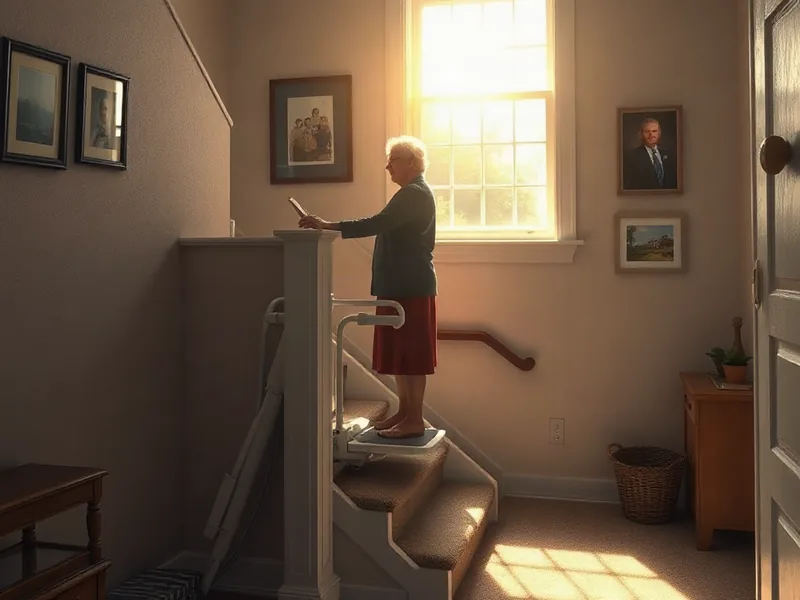
Picture a grandmother who wants nothing more than to keep living in the house where she raised her kids. The stairs to her bathroom have become a hazard. A single fall could mean a hospital stay, a loss of independence, maybe a permanent move into a facility she never wanted. For millions of older Americans, that scenario isn't hypothetical. It's a daily risk calculation.
Rosarium Health, a company focused on helping people age safely at home, announced Thursday that it is partnering with Anthem Medi-Cal to tackle exactly that problem. The partnership will let Rosarium provide in-home assessments for members who are at risk of falling, conducted by occupational and physical therapists who evaluate both the person's physical condition and the safety of their living environment.
Think of it as a home inspection, but for human bodies instead of foundations and wiring. The therapists look at where someone struggles, a steep staircase, a slippery bathtub, a doorway too narrow for a walker, and then recommend fixes. Based on those assessments, Rosarium can install modifications like accessible ramps and stair lifts. California's Medi-Cal program already covers certain home modifications for eligible members, generally up to a $7,500 lifetime limit, so this partnership plugs Rosarium's assessment and installation process directly into an existing benefit structure.
Rosarium doesn't stop at the assessment. The company also handles the paperwork trail that often stalls these kinds of benefits: documentation, benefit authorization with Anthem, quality review of completed work, and even contractor payment. For a family already stretched thin caring for an aging relative, that administrative lift matters almost as much as the physical ramp itself.
The timing isn't an accident. Cameron Carter, founder and CEO of Rosarium Health, pointed to a demographic shift that's reshaping the state's health needs. California has crossed what he calls the "age acuity cliff," the point where people over 65 outnumber those under 18.
That's a profound reversal. For decades, pediatric care and school infrastructure dominated policy conversations. Now the math has flipped, and the built environment, the homes, sidewalks, and neighborhoods people actually live in, has to catch up fast.
"With Anthem specifically, one of the things we're able to do with them is not only provide those modifications to help people age in place, but provide Anthem for the first time really a deeper understanding of the built environment their patient population is living in and wants to live in," Carter said in an interview.
That second part deserves attention. Insurers typically see claims data: what procedures were billed, what medications were prescribed. They rarely get a clear picture of whether a member's home is actually safe to live in. Rosarium's assessments give Anthem a window into that gap, information that could eventually shape how the insurer designs future benefits or identifies members at elevated risk before a fall happens rather than after.
This is not Rosarium's first California partnership. The company already works with Health Net, Central California Alliance for Health, CalViva, and Community Health Plan of Imperial Valley. Adding Anthem expands Rosarium's footprint into Los Angeles, Sacramento, San Francisco, Santa Clara, Fresno, and Kern, a geographic spread that covers both dense urban centers and more rural Central Valley communities where access to specialized home modification services can be harder to come by.
Measuring whether any of this actually works matters as much as rolling it out. Carter said Rosarium will track emergency room visits and inpatient stays, total cost of care, and satisfaction reported by both members and caregivers. Those metrics will determine whether the partnership is a genuine win for member safety and insurer costs, or just a well-intentioned pilot that never scales.
Falls are not a minor concern dressed up in health policy language. They are one of the leading causes of injury-related hospitalization among older adults, and the costs ripple outward: medical bills, lost independence, caregiver burnout, and in many cases, a permanent transition to assisted living that families and members alike often want to avoid. Preventing even a fraction of those falls through relatively modest home modifications, a ramp here, a stair lift there, can save both money and dignity.
Carter frames the company's ambition in broad terms. "We feel like modifying your home should be as accessible as [possible]. So that's our north star, to make sure we can do it across any population that exists," he said. He compares the goal to how dental or vision coverage works today, benefits people expect as a matter of course rather than something they have to fight for.
"We want to make sure everyone has access to this benefit, just like if they wanted to go to the gym or if they wanted glasses, and we want to make sure that reality is consistent from coast to coast," Carter said.
That's an ambitious standard to set. Benefit design varies wildly state to state, and Medi-Cal's $7,500 lifetime cap, while helpful, isn't unlimited. A single stair lift can run close to that amount depending on the home's layout, meaning the benefit may stretch further for simple ramp installations than for more complex modifications.
Home modification benefits sit at an unusual intersection of healthcare and infrastructure. They're not glamorous. Nobody is announcing a breakthrough drug or a diagnostic algorithm here. But for the person who can finally reach their bathroom safely, or the caregiver who no longer has to worry every time their parent climbs the stairs, these changes carry real weight.
As more states confront their own version of California's age acuity shift, partnerships like this one offer a template: pair clinical assessment with practical construction, embed it in existing insurance infrastructure, and measure outcomes honestly. Whether other insurers and states follow that template will likely depend on whether Rosarium's tracked metrics, fewer ER visits, lower total costs, satisfied members, bear out the promise.
Tags
Original Sources
Rosarium Health Forms Home Modification Partnership with Anthem Medi-Cal - MedCity News
↗ https://medcitynews.com/2026/10/rosarium-health-forms-home-modification-partnership-with-anthem-medi-cal
About the author
Amara's entry point into AI was an epidemiology role at a London research hospital, where she spent five years studying how digital health tools reached — or conspicuously failed to reach — underserved communities. Watching early algorithmic systems in healthcare quietly entrench existing inequalities, she redirected her career toward the systemic consequences of AI at scale. She covers AI through an unflinching lens: who benefits, who bears the cost, and what evidence actually says versus what the press release claims. Her writing is calm and precise, but she doesn't mistake balance for neutrality.
More from The Steward →This Week's Edition
16 October 2026
29 articles
Related Articles

Meta's new open-weight model runs on Macs, if you have 1TB of RAM to spare
Products & Applications · 5 min

Persona AI Bets on Calm Execution in a Noisy Humanoid Robotics Market
Products & Applications · 5 min

OpenAI Commits $5 Million to Help Mathematicians Vet AI-Generated Proofs
Products & Applications · 5 min
Related Articles
Meta's new open-weight model runs on Macs, if you have 1TB of RAM to spare
Products & Applications · 5 min
Persona AI Bets on Calm Execution in a Noisy Humanoid Robotics Market
Products & Applications · 5 min
OpenAI Commits $5 Million to Help Mathematicians Vet AI-Generated Proofs
Products & Applications · 5 min
More Stories
© 2026 Cedar & Bloom. All rights reserved.
