The Drum · Weekly AI news, freeSubscribe →
Share
A massive cell-by-cell survey of the basal ganglia has uncovered a previously unknown neuron linked to schizophrenia and pointed toward safer, more targeted gene therapies for Parkinson's disease.
For millions of people living with Parkinson's disease, schizophrenia, depression, or bipolar disorder, treatment often feels like a blunt instrument. Drugs flood the whole brain when the problem may live in just a sliver of tissue. That mismatch between where disease actually happens and where treatment actually goes helps explain why so many psychiatric and neurologic therapies come with side effects that can feel almost as hard to live with as the disease itself.
A new scientific effort is trying to narrow that gap by doing something deceptively simple: counting and cataloging the cells in a brain region called the basal ganglia, one by one, until a clear picture emerges of what's actually there.
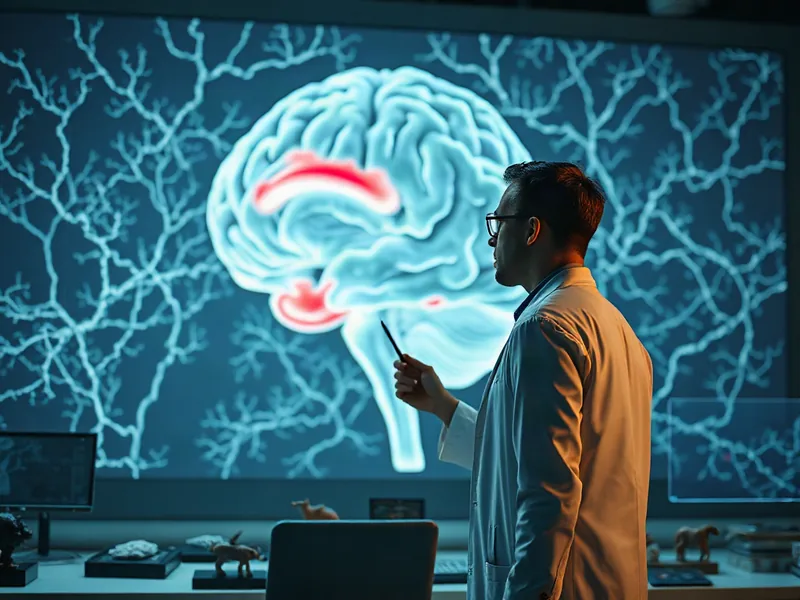
Researchers profiled more than 25 million cells from donated human brain tissue to build what amounts to a parts list for this region, a deeply folded structure buried near the center of the brain that helps control movement, motivation, and emotional regulation. Think of it like finally getting a detailed inventory of everything inside a complex machine, down to each gear and wire, after years of only knowing roughly what the machine does as a whole.
The basal ganglia has long been a region of outsized interest to doctors and researchers, because so many conditions trace back to disruptions there. Parkinson's disease, marked by tremors and slowed movement, stems largely from the loss of specific basal ganglia cells. Schizophrenia, bipolar disorder, depression, and post-traumatic stress disorder have all been linked to this same neural neighborhood, even though the symptoms of those conditions look nothing alike on the surface.
In the course of mapping the region, the research team identified a type of neuron never described before, one that appears to play a role in schizophrenia. They also pinpointed cell types connected to depression, bipolar disorder, and PTSD. The findings were published in the journal Cell.
This kind of discovery matters because psychiatric medicine has historically operated with limited precision. Many existing drugs for schizophrenia and mood disorders act broadly on brain chemistry, adjusting neurotransmitter levels across wide swaths of tissue rather than targeting the specific cells thought to drive symptoms. It's a bit like trying to fix a flickering light by rewiring an entire building instead of replacing the one faulty switch. A newly identified neuron tied specifically to schizophrenia gives researchers a far more precise switch to study, and potentially, to target.
The practical value of this kind of mapping became clear in a companion study, published in Cell Reports, where researchers tested whether their more granular understanding of basal ganglia cell types could actually improve treatment. Working in mouse models of Parkinson's disease, the team compared two versions of a gene therapy: one designed to act broadly across the region, and one engineered to reach only a specific subset of basal ganglia cells.
The targeted version worked just as well as the blanket approach at addressing Parkinson's-related symptoms in the mice. It was also safer, producing fewer unwanted effects. That finding offers a proof of concept that more precise cell mapping doesn't just deepen scientific understanding, it can translate directly into therapies that do their job with less collateral damage. For patients, that distinction can be the difference between a treatment that improves quality of life and one that trades one set of problems for another.
Gene therapies for neurological conditions have generally struggled with a delivery problem. Getting a therapeutic gene into the brain is hard enough. Getting it into the right cells, and only the right cells, has been harder still. A detailed cellular map functions almost like a street address system for the brain, letting researchers aim treatments at specific neighborhoods of tissue rather than delivering them to the whole city and hoping for the best.
This basal ganglia atlas is part of a broader, long-running push to chart the full diversity of human brain cells, an undertaking involving large research consortia and institutions dedicated to neuroscience data collection. The scale of that ambition is hard to overstate. The human brain contains an estimated 86 billion neurons, and scientists are still working out how many distinct cell types exist even within smaller, well-studied regions like the basal ganglia. Each new map, like this one, fills in a piece of a much larger and still incomplete picture.
The promise of this kind of research is not instant cures. Mouse studies don't always translate cleanly to humans, and a newly identified neuron tied to schizophrenia is a research lead, not a ready-made drug target. There's real work ahead to confirm these findings, understand how this neuron behaves in living human brains, and figure out whether targeting it, or the other newly cataloged cell types, actually changes outcomes for patients.
Still, the direction matters. For decades, treatments for conditions rooted in the basal ganglia have relied on relatively crude tools: drugs that act broadly, therapies with significant side effect profiles, and surgical interventions that, while sometimes life-changing, carry real risks. A more precise map of the cellular terrain gives researchers and clinicians a chance to design treatments that are gentler as well as more effective, reaching the cells that matter while leaving the rest of the brain's delicate machinery undisturbed.
For patients and families living with Parkinson's, schizophrenia, or mood disorders rooted in this brain region, that kind of precision could eventually mean fewer side effects, better symptom control, and treatments tailored to the actual biology driving their condition rather than a one-size-fits-all approach. Getting there will take years of additional research. But knowing precisely what's in the machine is the necessary first step toward fixing it with care instead of guesswork.
Tags
Original Sources
Scientists debut map of basal ganglia, a key brain region involved in an array of diseases
↗ https://www.statnews.com/2026/11/12/brain-map-basal-ganglia-offers-treatment-clues-parkinsons-schizophrenia
About the author
Amara's entry point into AI was an epidemiology role at a London research hospital, where she spent five years studying how digital health tools reached — or conspicuously failed to reach — underserved communities. Watching early algorithmic systems in healthcare quietly entrench existing inequalities, she redirected her career toward the systemic consequences of AI at scale. She covers AI through an unflinching lens: who benefits, who bears the cost, and what evidence actually says versus what the press release claims. Her writing is calm and precise, but she doesn't mistake balance for neutrality.
More from The Steward →This Week's Edition
13 November 2026
14 articles
Related Articles

Webb Telescope Finds Ancient Ice Hiding in a Young Star's Planetary Nursery
Health & Science · 7 min

Tether Evo's New Research Tackles BCI's Calibration Problem with Cross-Subject Models
Models & Research · 5 min

Why Some Engineers Think the Ocean Floor Is the Future of Data Centers
Environment & Climate · 5 min
Related Articles
Webb Telescope Finds Ancient Ice Hiding in a Young Star's Planetary Nursery
Health & Science · 7 min
Tether Evo's New Research Tackles BCI's Calibration Problem with Cross-Subject Models
Models & Research · 5 min
Why Some Engineers Think the Ocean Floor Is the Future of Data Centers
Environment & Climate · 5 min
More Stories
© 2026 Cedar & Bloom. All rights reserved.
