The Drum · Weekly AI news, freeSubscribe →
Share
A new Stanford HAI initiative pairs astrophysicists with ML researchers to tackle the data deluge coming from next-gen sky surveys, betting that foundation models and simulation-based inference can accelerate cosmic discovery.
Stanford HAI has stood up a new research hub aimed squarely at a problem that's been building for years: astrophysics is drowning in data, and the statistical tools built for smaller datasets aren't going to cut it anymore. The Center for Decoding the Universe (C4DU) brings together researchers from astrophysics, statistics, and computer science to build new data science and AI methods for extracting signal from massive, multi-modal cosmic datasets.
The timing isn't an accident. The Vera C. Rubin Observatory's Legacy Survey of Space and Time (LSST) is about to start generating an unprecedented volume of astronomical observations, and existing inference pipelines weren't designed for that scale. C4DU's pitch is that you need people who understand both the physics and the modern ML stack in the same room, prototyping together, rather than throwing data over a wall between disciplines.
The center is led by Risa Wechsler, a Humanities and Sciences Professor and Professor of Physics who also directs the Kavli Institute for Particle Astrophysics & Cosmology and serves as Associate Director of Stanford HAI. Her co-director roster reads like a cross-section of Stanford's quantitative sciences: Benjamin Nachman (particle physics and statistics), Susan Clark and Tom Abel (physics), Surya Ganguli (applied physics and neurobiology), Sanmi Koyejo (computer science), and Philip Marshall from SLAC. A broader affiliated faculty list adds names like Chelsea Finn, Emily Fox, James Zou, and Gordon Wetzstein, giving the center real depth on the machine learning side alongside its astrophysics bench.
What actually gets built here matters more than the org chart. C4DU's research agenda centers on a handful of techniques that have been gaining traction across data-heavy sciences:
These aren't niche techniques. Simulation-based inference in particular has been picking up steam across physical sciences generally, anywhere researchers have a good simulator but a hard time running inference backward from noisy real-world observations. Applying it to cosmology, where simulations of galaxy formation and large-scale structure are already a mature discipline, is a natural fit.
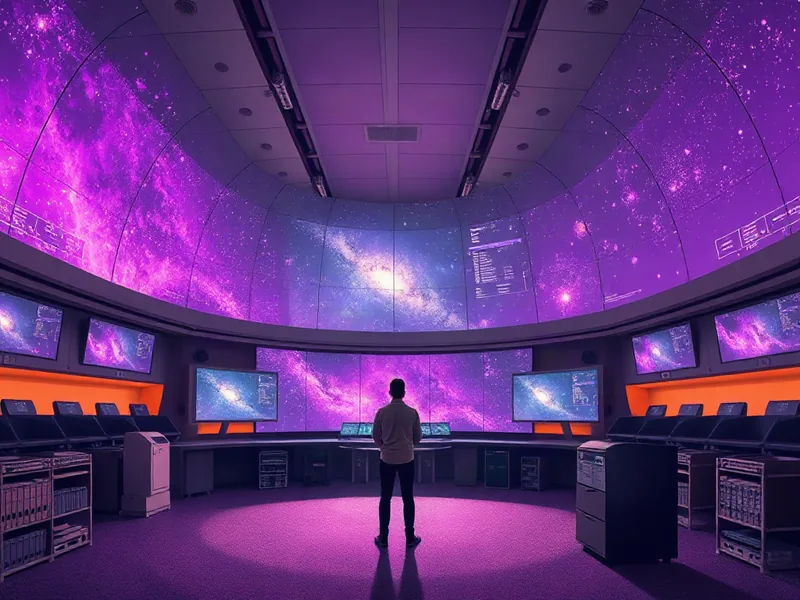
The center's structure leans heavily on frequent, low-friction touchpoints rather than big infrequent events. There's an Annual Conference that pulls in researchers across astrophysics, AI/ML, data science, and statistics to compare notes on what's working. Half-day Forums run each fall and winter, pairing broad talks on open astrophysics problems with outside speakers who use similar inference methods in unrelated fields, plus short talks and a poster session meant to spark unexpected connections.
Below that sit the weekly mechanics: a bi-weekly journal club, a monthly "Frontier Astro" meeting focused on frontier AI work, and an open co-working block every Monday from noon to 3pm in Stanford's Computing & Data Science building. It's a deliberately informal cadence, lunch and hangout first, structured session second, with a Zoom option for the journal club for anyone not on campus. The idea seems to be that interdisciplinary collaboration doesn't happen in one annual conference, it happens in the accumulated weight of weekly conversations between people who wouldn't otherwise cross paths.
C4DU is also explicit about an educational mission alongside the research one: strengthening astrophysicists' fluency with modern data science tools while keeping rigorous scientific reasoning central to how those tools get applied. That's a real tension worth naming. Foundation models and black-box anomaly detectors are powerful, but physical scientists have legitimate reasons to be wary of methods that produce confident-sounding outputs without clear uncertainty quantification or interpretability. Baking that skepticism into the training pipeline, rather than treating it as an afterthought, is probably the right instinct.
A few things worth watching as this center gets going:
The center is explicitly structured for rapid prototyping across domains rather than long single-discipline research tracks, which suggests C4DU is betting on speed and cross-pollination over deep specialization in any one subfield. Given how fast the ML tooling landscape is moving right now, that's probably the correct bet. Whether it pays off in actual cosmological discoveries is going to take a few survey cycles to find out.
Tags
Original Sources
Center for Decoding the Universe | Stanford HAI
↗ https://hai.stanford.edu/centers-labs/center-for-decoding-the-universe
About the author
Kai built ML infrastructure at a Bay Area startup before developing an obsession with transformer architectures and inference optimisation that eventually pulled him out of product work entirely. A stint at a compute research lab sharpened his instinct for what actually matters in a model release versus what is marketing. He writes from the inside — from the perspective of someone who has debugged the systems he is describing at three in the morning. He is allergic to hype and instinctively drawn to the unglamorous plumbing questions that everyone else skips over.
More from The Engineer →This Week's Edition
11 October 2026
17 articles
Related Articles
Related Articles
More Stories
© 2026 Cedar & Bloom. All rights reserved.