The Drum · Weekly AI news, freeSubscribe →
Share
A field-tested rundown of building sets, chess-playing hardware, and kinetic gadgets that survived real classrooms and real kids, not just marketing copy. Here's what engineering-minded parents should actually buy.
If you've ever watched a toddler dismantle a Tupperware drawer with the focus of a junior reverse engineer, you already know kids are wired for this stuff. The hard part isn't sparking curiosity, it's finding gear that survives contact with an actual 7-year-old and still teaches something. I've run a batch of this year's STEM (and STEAM, don't worry, art gets love too) toys through the gauntlet: my own kids, a few WIRED colleagues' households, and my wife's classroom, where she teaches 7- and 8-year-olds and has zero patience for gimmicks.
Four products stood out enough to recommend without hedging. Each hits a different part of the "hands-on learning" spectrum, from tactile building to embedded electronics to actual AI-assisted gameplay.
Plus Plus's interlocking building blocks ($44 for 600 pieces on Amazon, or $62 for a 1,200-piece set) solve a specific annoyance that Lego never quite fixed: every piece is identical, so there's no digging through a bin looking for that one specific connector. The blocks have a slightly squishy, tactile quality that makes them satisfying to snap together and pull apart, and because the pieces are interchangeable by nature, kids can go full freeform, building bracelets and headbands one minute, bridges and robots the next. In classroom testing, some kids improvised without a plan; others sketched out a build and executed it with real intent. Either way works. Rated for ages 5 and up.
Qubs' Qubitunes ($130, currently $73 on Amazon) is the closest thing to a screen replacement I've tested that doesn't feel like a consolation prize. It's a wooden play stage with a cartridge slot and a circular sound stage split into four zones. Drop a character figure onto a zone and it triggers different audio, which sounds simple until you see how many add-on packs build on that one mechanic: the Groblies ($20) for character-driven stories, Bernard's Kitchen ($20) for a cooking game, and the Little Maestro set ($20), which lets kids assemble a mini orchestra playing Mozart, Vivaldi, Beethoven, and Bach. The hardware itself is solid: decent stereo speakers, a headphone jack, USB-C charging good for six hours of play. It's currently living in the reward corner of my wife's classroom and is, by a clear margin, the most requested item with her 7- and 8-year-olds. Ages 3 and up.
Ambessa's DIY Kinetic Flashlight ($51) is a different kind of toy entirely: no batteries, no screen, just 10 components and a 16-step build process that ends with a working hand-crank flashlight. The pedagogical value here is obvious if you've ever tried to explain kinetic energy to an 8-year-old with words alone. Wind it for three minutes, get 30 minutes of light, and watch the abstraction become concrete. The kit is designed to be disassembled and rebuilt repeatedly, which makes it genuinely useful for a classroom where one set needs to survive multiple kids across multiple sessions. There's also a social angle worth mentioning: Ambessa donates one flashlight to a refugee child out of school for every kit sold. Recommended for ages 8 and up.
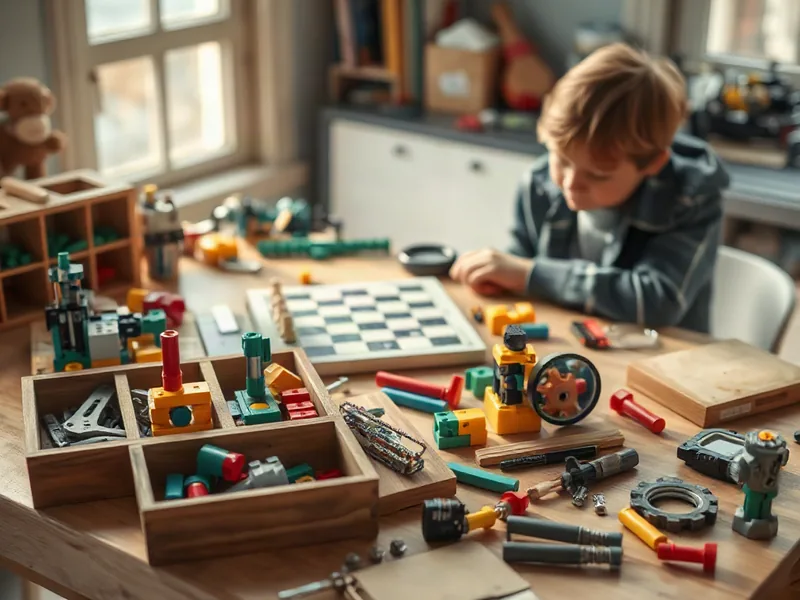
Then there's Particula's GoChess Mini ($250), which is the one I'd call a sleeper hit. WIRED's Adrienne So tested it after years of failing to get her 7- and 9-year-old interested in chess through conventional means, and it worked. The board is Bluetooth-enabled and pairs with an app that lets kids play remote opponents, play solo, or lean on AI-assisted move guidance that scales from a nudge to a full tutorial. Colored lights on the board itself indicate how good or bad a potential move is as you pick up each piece, which turns the abstract "think three moves ahead" problem into something visual and immediate. Battery life is strong too: one charge lasts weeks of regular play. So's kids now spend hours at a stretch debating moves, which is about as good an outcome as a parent can hope for from a board game. Ages 6 and up. Particula also makes a Harry Potter-themed version of the board for $350, for families who want their chess with a side of fandom.
What ties these four together isn't price point or even age range, it's that each one gives a kid a feedback loop they can actually see or feel. The building blocks reward experimentation immediately. The Qubitunes stage rewards curiosity about sound and music. The flashlight rewards patience and mechanical reasoning with literal light. The chess board rewards strategic thinking with real-time visual cues instead of just a parent saying "good move" in a slightly-too-encouraging voice. That immediacy is probably the actual secret to why STEM toys work when they work: kids don't need to understand kinetic energy or Bluetooth pairing to benefit, they just need to see cause and effect often enough that the underlying concept sinks in on its own.
Worth noting: this list leans toward products in the $44 to $250 range, which isn't nothing for a toy. If budget is the constraint, the Plus Plus blocks are the easiest entry point and arguably the most durable across different ages and interests, since they scale from toddler-level free play to more deliberate building as kids get older.
The strongest STEM toys this cycle aren't the ones with the most features, they're the ones that turn an abstract concept into something a kid can manipulate directly. Plus Plus blocks ($44 to $62) nail tactile, open-ended building. Qubs' Qubitunes ($73 to $130) replaces screen time with genuinely engaging audio play backed by a growing library of add-on packs. Ambessa's flashlight kit ($51) teaches kinetic energy through actual assembly, with a built-in charitable donation model. And Particula's GoChess Mini ($250) uses AI-assisted guidance and real-time visual feedback to make chess click for kids who'd otherwise bounce off it. None of these require a screen to deliver the "aha" moment, which, in 2026, might be the highest compliment a kids' toy can get.
Tags
Original Sources
We Tested These STEM Toys on Our Own Kids
↗ https://www.wired.com/gallery/best-stem-toys-for-kids
About the author
Kai built ML infrastructure at a Bay Area startup before developing an obsession with transformer architectures and inference optimisation that eventually pulled him out of product work entirely. A stint at a compute research lab sharpened his instinct for what actually matters in a model release versus what is marketing. He writes from the inside — from the perspective of someone who has debugged the systems he is describing at three in the morning. He is allergic to hype and instinctively drawn to the unglamorous plumbing questions that everyone else skips over.
More from The Engineer →This Week's Edition
4 October 2026
25 articles
Related Articles

DARPA's RSGS Program Aims to Put a Repair Robot in Geosynchronous Orbit
Products & Applications · 5 min

Text-Message AI Agents Multiply as Instinct's $10B Valuation Draws a Crowded Field
Products & Applications · 5 min

In a New York Times Songwriting Contest, AI Lost. The Details Explain Why
Products & Applications · 5 min
Related Articles
DARPA's RSGS Program Aims to Put a Repair Robot in Geosynchronous Orbit
Products & Applications · 5 min
Text-Message AI Agents Multiply as Instinct's $10B Valuation Draws a Crowded Field
Products & Applications · 5 min
In a New York Times Songwriting Contest, AI Lost. The Details Explain Why
Products & Applications · 5 min
More Stories
© 2026 Cedar & Bloom. All rights reserved.
