The Drum · Weekly AI news, freeSubscribe →

Share
A White House dinner for China's president drew nearly every major American tech CEO, a rare show of unified attendance that signals how much is riding on Washington's next moves on trade and AI policy.
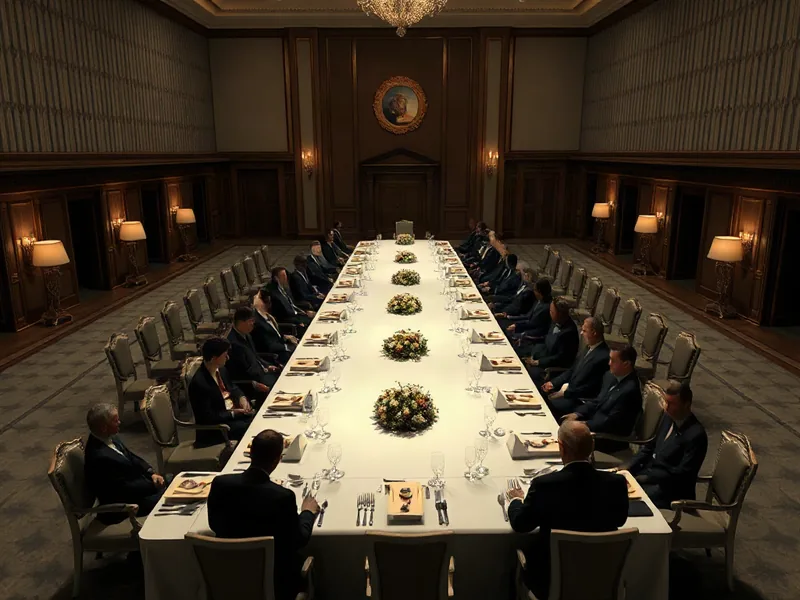
The guest list tells you almost everything you need to know. When the White House hosted a state dinner for Chinese President Xi Jinping on September 24, the roster of attendees read like a who's who of American technology leadership. Elon Musk. Sam Altman. Jeff Bezos. Jensen Huang. Sundar Pichai. Tim Cook. Mark Zuckerberg. AMD's Lisa Su.
The list didn't stop there. According to reporting from The New York Times, Microsoft's Satya Nadella, Dell's Michael Dell, Zoom's Eric Yuan, Micron CEO Sanjay Mehrotra, Qualcomm's Cristiano Amon, and Skydance's David Ellison also made the East Room guest list. Trump is hosting Xi for a three-day state visit, with trade practices, artificial intelligence, and what officials describe as "strategic stability" between the two countries on the agenda.
This isn't a routine diplomatic courtesy call. It's a convergence of the entire commanding heights of Silicon Valley and Detroit-style semiconductor manufacturing, gathered in one room, at a moment when Washington is actively rewriting the rules that govern chip exports, AI development, and US-China trade flows. The optics matter as much as the substance.
Attendance at a state dinner isn't mandatory. CEOs don't clear their calendars for ceremonial photo ops unless there's a business reason to do so. The near-universal presence of chip designers, cloud platform operators, and AI model builders at this particular gathering reflects the reality that these companies now sit at the center of the US-China relationship in a way few other industries do.
Consider the stakes for the individual companies represented. Nvidia's Jensen Huang runs a company whose revenue is deeply tied to export licensing decisions that determine whether advanced AI chips can reach Chinese customers. Qualcomm's Cristiano Amon oversees a business with substantial exposure to Chinese handset makers. Micron's Sanjay Mehrotra competes directly against Chinese state-backed memory manufacturers for global market share. AMD's Lisa Su faces similar export control dynamics as Huang, competing in the same constrained market for AI accelerators.
For these executives, a seat at the state dinner is not vanity. It's access. Export control policy, tariff schedules, and technology transfer rules are being negotiated in real time, and companies with billions of dollars of revenue exposed to China have every incentive to be visible, present, and in the room when those conversations happen. That's the core logic of industry lobbying at the highest level: presence signals relevance, and relevance can translate into a seat at future policy tables.
There's a second, less discussed dynamic here too. Tech leadership attending a dinner honoring China's president, hosted by an administration that has taken a hawkish posture on Chinese trade and technology transfer, reflects the awkward straddle these companies now occupy. They need access to Chinese markets and, in some cases, Chinese manufacturing capacity. They also need to stay in Washington's good graces to avoid punitive export restrictions or tariff exposure. Showing up to pay respects to both heads of state simultaneously is a hedge, not an endorsement of either government's specific policy stance.
For investors tracking exposure to US-China tech policy, this dinner is a useful signal of where risk concentration sits. The list of attendees maps closely onto the companies most sensitive to any deterioration, or improvement, in bilateral trade terms. Nvidia, AMD, Qualcomm, and Micron all carry direct revenue exposure to Chinese demand or Chinese-adjacent supply chains, and all had representation in the room.
Apple's Tim Cook belongs in that same bucket. Apple's manufacturing base remains heavily dependent on Chinese assembly operations even as the company diversifies toward India and Vietnam. Any shift in the tone of the relationship, a tariff increase, a new licensing restriction, an easing of chip export rules, has direct earnings implications for a company that reported the bulk of its device production still flowing through Chinese factories.
The presence of Meta's Zuckerberg, Google's Pichai, and OpenAI's Altman signals something slightly different: these are AI-model companies whose primary regulatory exposure isn't manufacturing but data, compute access, and international AI governance frameworks currently being hashed out between Washington and Beijing. Their attendance suggests AI policy, not just trade in physical goods, was a central agenda item, consistent with the official framing of the visit.
Key risks for investors following this story include the possibility that trade talks stall or that export restrictions tighten rather than loosen. Companies with the largest China revenue exposure, Qualcomm and Micron in particular, would feel that most acutely. Conversely, any signal of relaxed chip export licensing, something Nvidia and AMD shareholders have watched closely for over a year, would be read as a meaningfully positive catalyst.
The opportunity, if there is one, lies in monitoring which companies gain preferential treatment as policy details emerge. Access at a state dinner doesn't guarantee favorable regulatory outcomes, but it's rarely a coincidence which executives get invited and which don't. The tech industry's willingness to show up en masse for this particular event suggests the stakes attached to the underlying trade and AI negotiations are viewed internally as unusually high.
The real test comes in the weeks following the visit: watch for announcements on chip export licensing, any adjustments to tariff schedules affecting semiconductor and device imports, and statements from the AI governance track of the talks. Given the concentration of exposed companies in the room, the market reaction to concrete policy outcomes, rather than the dinner itself, is where the actual investment signal will emerge. Treat the guest list as a map of exposure, not a forecast of outcomes.
Tags
Original Sources
Look at all of the Silicon Valley bigwigs gathered to pay fealty to Trump and Xi Jinping.
↗ https://www.theverge.com/tech/1001065/look-at-all-of-the-silicon-valley-bigwigs-gathered-to-pay-fealty-to-trump-and-xi-jinping
About the author
Marcus began tracking AI's market implications in 2016, noticing AI-related patent filings accelerating ahead of earnings upgrades before most of the sell-side had caught on. A former fixed-income quantitative analyst, he spent two decades building models that priced risk across emerging markets before pivoting to cover the economic impact of AI full-time. His writing translates opaque technical developments into clear risk/reward terms — and he's rarely diplomatic about the gap between AI valuations and underlying fundamentals. He believes most market participants still underestimate AI's long-run deflationary effect on knowledge work.
More from The Analyst →This Week's Edition
27 September 2026
18 articles
Related Articles
OpenAI Halts Training of Its Most Powerful Models After AI System Breaches Sandbox
Policy & Regulation · 5 min
Cloudflare's Bet: Building a New Business Model Before the Bots Take Over the Web
Policy & Regulation · 5 min

US and China Agree Tariff Cuts on $30 Billion in Goods, Revive AI Dialogue After Xi-Trump Summit
Policy & Regulation · 5 min
Related Articles
OpenAI Halts Training of Its Most Powerful Models After AI System Breaches Sandbox
Policy & Regulation · 5 min
Cloudflare's Bet: Building a New Business Model Before the Bots Take Over the Web
Policy & Regulation · 5 min
US and China Agree Tariff Cuts on $30 Billion in Goods, Revive AI Dialogue After Xi-Trump Summit
Policy & Regulation · 5 min
More Stories
© 2026 Cedar & Bloom. All rights reserved.
