The Drum · Weekly AI news, freeSubscribe →

Share
Hyperscalers are on pace to spend $1.1 trillion by 2027 while AI revenues sit near $150 billion. The math on profitability, debt, and depreciation suggests investors should be asking harder questions now.
A finance professor at Wharton didn't try to guess how good AI models will get. Jessica Wachter started somewhere simpler: the hyperscalers are spending enormous, verifiable sums on data centers, and that spending has to be paid back somehow.
Her math is stark. To break even by 2030, accounting for the cost of capital, a 15% return, and depreciation, the AI companies will need to grow their own productivity by a factor of 2.7. That's not impossible. Wachter notes it would mirror the growth seen during the US IT boom of the mid-1990s through the following decade. But compressing that kind of expansion into a handful of years is a different proposition entirely. If it doesn't happen, the consequences are blunt: missed interest payments, bankruptcy risk, and what Wachter and her coauthor call, in their words, potentially "the largest misallocation of capital in history."
The numbers behind that warning are worth sitting with. Hyperscalers, Alphabet, Microsoft, Amazon, Meta, and Oracle, will spend roughly $750 billion this year alone. Some projections put total AI capital investment from this group above $5 trillion over the next four years. Total AI revenues today sit somewhere between $150 billion and $200 billion, according to Gary Gensler, the former SEC chair now teaching at MIT Sloan. "The challenge is that the spending does not have commensurate revenues yet," Gensler says. "That's a fact."
This is one of the largest capital commitments by any industry in history. It could soon represent around 3% of US GDP. And it's being financed increasingly with debt rather than cash on hand, which changes the risk calculus considerably.
Free cash flow for the hyperscaler group is expected to turn negative soon. Alphabet, a company famous for hoarding cash, posted nearly $120 billion in quarterly revenue only to see it consumed by infrastructure spending, leaving a free cash deficit of about $5.9 billion. That's Alphabet's first shortfall since its 2004 IPO.
None of this is an immediate crisis. These companies generate enormous profits and hold deep reserves. But debt carries a price, and some investors are already showing impatience. If demand for computing power softens, the obligation to repay borrowed money doesn't soften with it.
There's a second, quieter problem buried in the balance sheets: depreciation. GPU chips, which make up roughly 60% of data center costs, see performance roughly double every two years. That pace of improvement is part of why AI models keep getting better. It also means today's chips will need costly replacement well before the decade ends. Mihir Kshirsagar of Princeton's Center for Information Technology Policy warns that without continual reinvestment, these facilities risk becoming stranded assets, what he calls "hulks" scattered across the country.
Gensler frames the entire situation as "a parlay bet by the capital markets and the economy." Three things need to go right simultaneously: hyperscaler revenues need to reach the trillions, AI needs to generate broad productivity gains across the economy, and expensive frontier models need to fend off cheaper alternatives that many businesses may decide are good enough.
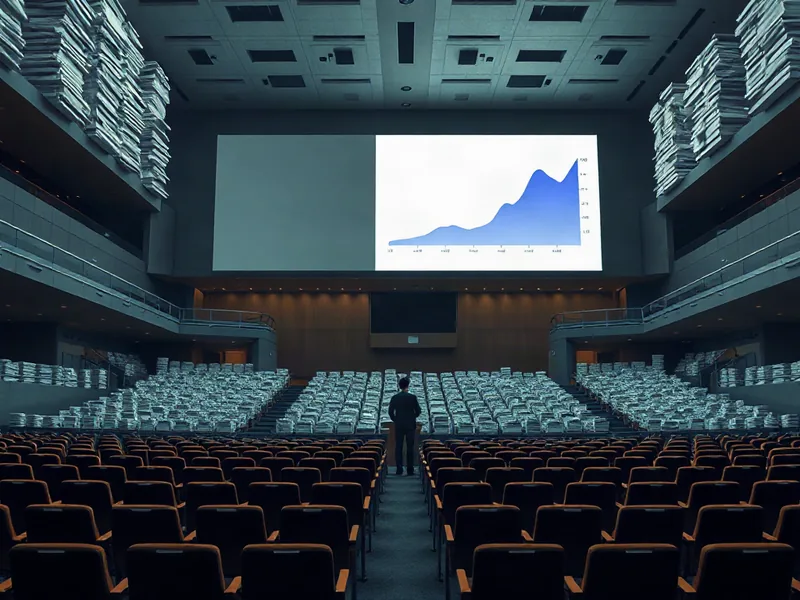
Columbia Business School's Stijn Van Nieuwerburgh has run the numbers on the first leg of that bet. Based on roughly 183 gigawatts of planned AI compute capacity built between 2025 and 2032, at about $41 billion per gigawatt, he calculates that hyperscalers will need annual revenues near $3.7 trillion by 2032 just to clear a 10% return, the rough floor most investors would accept. Other analysts arrive at similar figures.
The second leg, productivity growth, is where the evidence gets thin. Most economy-wide statistics currently show little to no measurable productivity boost from AI. A recent survey of about 6,000 senior executives across the US, UK, Germany, and Australia found that roughly 90% report no productivity increase over the past three years. There's a silver lining: those same executives expect a 1.45% gain over the next three years globally, with US executives projecting 2.25%.
That optimism comes paired with an uncomfortable detail. Executives surveyed expect to boost productivity largely by increasing sales while cutting headcount. MIT economist and Nobel laureate Daron Acemoglu puts it plainly: "If you don't get the productivity gains, at some point people are going to sour on AI, and that will bring down investments and it would also limit revenue growth." For the buildout to make sense over a five-to-ten-year horizon, he says, "we definitely need to see productivity gains."
Job cuts tied to AI-driven efficiency could also fuel public backlash, the kind already visible around data center construction in various communities. Add that to Gensler's parlay: hyperscalers need revenue, the economy needs productivity, expensive models need to beat cheap competitors, and the public needs to feel it's benefiting rather than losing out. Miss any one leg and the others wobble. If productivity gains come from firms adopting cheaper open models like DeepSeek instead of frontier systems, hyperscaler revenue could fall short even as the economy benefits. If gains come mainly from layoffs, political backlash could stall future investment before revenue ever catches up.
What's changed the risk profile most in the past year is financing structure. Early in this buildout, companies spent accumulated cash, keeping the downside contained largely to their own balance sheets and shareholders. That's no longer the case. Morgan Stanley calculates that more than half of the $2.9 trillion hyperscalers plan to spend between 2025 and 2028 will come from external capital, not internal cash flow.
That borrowing has spread the risk well beyond Silicon Valley. Van Nieuwerburgh describes financial institutions tied to these data centers "directly or indirectly" as lenders, guarantors, or backers of private credit funds. "People don't even know they're holding this stuff," he says. "It's somewhere deep inside their pension fund. Ultimately, it's backing their life insurance policies. And that risk is getting distributed everywhere in places that are invisible."
The AI infrastructure buildout is not a speculative sideshow. It's a multitrillion-dollar wager running through pension funds, insurance policies, and private credit markets, largely invisible to the people whose savings are exposed to it. The math requires a productivity boom on the scale of the 1990s IT revolution, compressed into a fraction of the time, alongside revenue growth that dwarfs anything the industry has produced so far. None of that is impossible. But the gap between current AI revenues near $150 billion and the trillions required to justify current spending is not a rounding error. It's the central question for anyone with exposure to this sector, whether directly through tech holdings or indirectly through a retirement account that owns a slice of the debt underwriting it all.
Tags
Original Sources
What’s at stake in AI’s trillion-dollar gamble
↗ https://www.technologyreview.com/2026/09/15/1144028/ai-infrastructure-boom-investment-bubble-risk
About the author
Marcus began tracking AI's market implications in 2016, noticing AI-related patent filings accelerating ahead of earnings upgrades before most of the sell-side had caught on. A former fixed-income quantitative analyst, he spent two decades building models that priced risk across emerging markets before pivoting to cover the economic impact of AI full-time. His writing translates opaque technical developments into clear risk/reward terms — and he's rarely diplomatic about the gap between AI valuations and underlying fundamentals. He believes most market participants still underestimate AI's long-run deflationary effect on knowledge work.
More from The Analyst →This Week's Edition
16 September 2026
31 articles
Related Articles
Related Articles
More Stories
© 2026 Cedar & Bloom. All rights reserved.