The Drum · Weekly AI news, freeSubscribe →

Share
From methane dependency disclosed in Anthropic's IPO filing to distressed CoreWeave debt and Texas regulators quietly ignoring a permitting pause, the AI buildout's infrastructure problems are compounding faster than anyone's solving them.
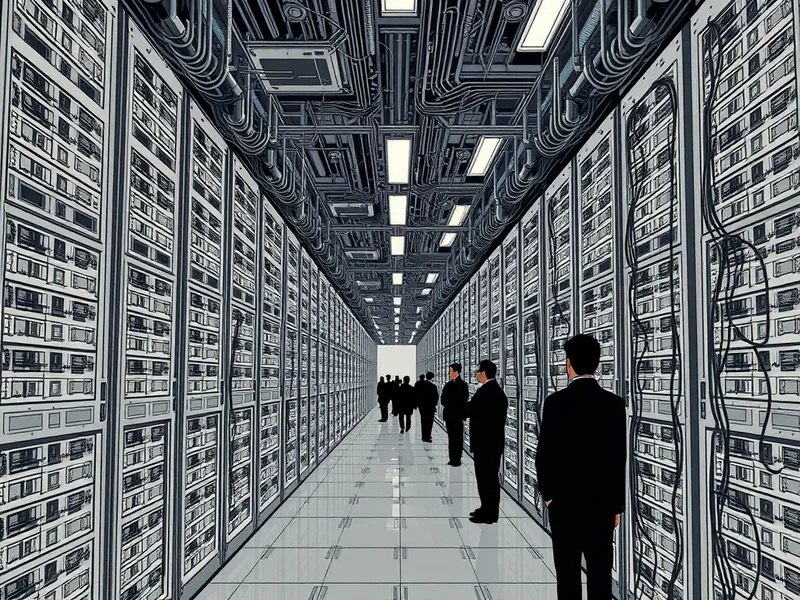
If you've been tracking the AI infrastructure story purely through chip shortages and model benchmarks, you're missing the half of it that's actually going to determine whether this buildout survives contact with reality. That half is physical: power grids, permitting offices, gas turbines, and increasingly, angry voters. And right now, nearly every layer of that stack is showing stress.
Start with the money. Anthropic's S-1 filing, submitted to the SEC as the company prepares to go public, quietly admits something practitioners have suspected for a while: generative AI's data center buildout is leaning hard on natural gas, which is industry-speak for methane. That's a supply chain risk in itself, since gas prices fluctuate and infrastructure constraints are real. But the filing also flags a nastier feedback loop. Rising global temperatures, which are partly a product of burning the fossil fuels powering these facilities, are expected to push Anthropic's own operating costs up. It's a catch-22 baked right into a public offering document.
Meanwhile the debt side of the ledger isn't looking great either. CoreWeave, the neocloud provider that's become something of a poster child for the AI infrastructure boom, has unsecured debt due in 2032 trading below 80 cents on the dollar, according to Bloomberg. That's distressed-debt territory. If CoreWeave is wobbling, the concern is that other debt-heavy neoclouds financing their GPU clusters with similar leverage could follow. The AI buildout has been financed on the assumption that demand keeps scaling indefinitely. Bond markets are starting to ask what happens if it doesn't.
Here's the part that should worry anyone doing capacity planning: the grid isn't keeping up, and the regulatory response is inconsistent at best.
Microsoft just walked away from what would have been the UK's largest data center project, a deal with British firm Nscale, after local grid officials told them the site wouldn't get power until the 2030s. Reuters and BBC both confirmed the pullout. Construction is reportedly continuing without Microsoft, and Nscale says its other partnerships with the company remain intact, but the signal is clear: even hyperscalers with enormous capital reserves are hitting hard constraints on grid interconnection timelines. You can build the building. Getting electrons to it is a different problem entirely.
In the US, the pattern is messier in a different way. Texas, which has become ground zero for AI data center construction, announced a permitting pause back in September under Governor Greg Abbott. But an analysis by advocacy groups Public Citizen and FracTracker found state agencies are still processing and issuing data center-related permits despite that announcement. The governor's office denies approving anything new. Whatever the truth of that dispute, it's a good example of how "moratorium" and "actual enforcement" can be two very different things on paper versus in practice.
That gap matters because the broader energy picture is already tilting toward fossil fuels. A new report from the Environmental Defense Fund found the US is building more fossil fuel power infrastructure than it has in a decade, while renewable energy growth slows. Electricity demand is climbing faster than it has in more than ten years, per the Energy Information Administration, driven by data centers, EVs, and reshored manufacturing. The Trump administration has been actively working against wind and solar buildout in favor of gas and other fossil sources, which, combined with slower renewables growth, means the marginal megawatt powering a new GPU cluster is increasingly likely to come from a gas turbine. Texas specifically is projected to see air pollution return to levels not seen since the 2000s, depending on how utilities and developers choose to meet demand.
On the nuclear side, there's at least one bet on cleaner baseload capacity. Amazon has signed an agreement with X-energy and American Electric Power to fund a nuclear facility in Indiana, replacing a defunct coal plant in Fairbanks, Sullivan County. The plan calls for 12 Xe-100 small modular reactors, an advanced but still-unproven reactor design currently going through licensing, targeting up to 960 megawatts for the regional grid and Amazon's own data centers. No construction timeline has been set. Amazon says the project "could" generate 1,000 construction jobs and 100 permanent roles, language that's doing a lot of hedging for a facility with no confirmed date.
The political fallout from all this is getting loud enough to show up in actual legislation and campaign spending. New York became the first state to enact a data center moratorium. Milwaukee joined a growing list of Wisconsin cities pausing projects. A woman was arrested protesting data centers at a Utah County meeting. Marana, Arizona approved new data center regulations specifically in response to community pushback. And in Texas, Abbott reportedly raked in $9 million from data center-related donors even as he publicly called for tighter regulation, according to the Texas Tribune, a contradiction that pretty much sums up the entire regulatory environment right now.
Money is pouring into the political fight from the AI industry itself. Leading the Future, a super PAC backed by Marc Andreessen and OpenAI President Greg Brockman, has spent $45 million over the past year. Public First Action, backed by Anthropic and positioned as pro-safeguards, says it's raised $80 million. Both are funding candidates across party lines. A newer PAC, Tomorrow Together, has put $4 million into battleground House race ads centered on data center development and AI safety messaging. Data centers aren't a side issue in the 2026 midterms anymore. They're a wedge issue with real budgets behind it.
The AI infrastructure boom now has disclosed financial risk tied directly to fossil fuel dependency, distressed debt in the neocloud sector, grid interconnection delays strong enough to kill hyperscaler projects, and a permitting environment where stated policy and actual agency behavior don't match. None of these are hypothetical risks anymore. They're showing up in SEC filings, bond prices, and ballot-adjacent political spending, which means the physical and financial constraints on AI scaling are becoming just as load-bearing as the compute constraints everyone's been talking about for years.
Tags
Original Sources
All the latest updates on AI data centers
↗ https://www.theverge.com/ai-artificial-intelligence/902546/data-centers-ai-energy-power-grids-controversy
About the author
Kai built ML infrastructure at a Bay Area startup before developing an obsession with transformer architectures and inference optimisation that eventually pulled him out of product work entirely. A stint at a compute research lab sharpened his instinct for what actually matters in a model release versus what is marketing. He writes from the inside — from the perspective of someone who has debugged the systems he is describing at three in the morning. He is allergic to hype and instinctively drawn to the unglamorous plumbing questions that everyone else skips over.
More from The Engineer →This Week's Edition
28 October 2026
30 articles
Related Articles

Opera Launches WebAI, a Browser Standard for Running Models Locally
Tools & Engineering · 5 min

UT Austin Launches UT Dell Medicine, Plans AI-Native Hospital From the Ground Up
Products & Applications · 6 min

Artiva Halts Cell Therapy Program After Two Patient Deaths in Autoimmune Trial
Health & Science · 6 min
Related Articles
Opera Launches WebAI, a Browser Standard for Running Models Locally
Tools & Engineering · 5 min
UT Austin Launches UT Dell Medicine, Plans AI-Native Hospital From the Ground Up
Products & Applications · 6 min
Artiva Halts Cell Therapy Program After Two Patient Deaths in Autoimmune Trial
Health & Science · 6 min
More Stories
© 2026 Cedar & Bloom. All rights reserved.
