The Drum · Weekly AI news, freeSubscribe →
Share
Space Invaders revolutionized arcade gaming with its powerful Z80 microprocessor and innovative design, setting new standards for graphics and sound that continue to influence developers today.
Space Invaders, released in 1978 by Taito Corporation, is a cornerstone of arcade gaming history. But beyond its cultural impact, the game's technical innovations and design choices offer valuable insights for modern developers. Let’s break down what made Space Invaders so groundbreaking from an engineering perspective.
At its core, Space Invaders ran on a Z80 microprocessor, which was a significant step up from earlier arcade games that often used simpler logic circuits. Here are the key technical details:
The Z80 was chosen for its balance of performance and cost-effectiveness. It provided enough processing power to manage the game’s logic, while keeping the overall system affordable.
Space Invaders used a state machine approach to manage game states, such as the main gameplay loop, start screen, and game over sequences. This is a common pattern in game development today, but it was innovative at the time. Here’s how it worked:
The graphics system in Space Invaders was a marvel of optimization. The custom hardware allowed for efficient rendering of sprites and background tiles:
The sound system in Space Invaders was rudimentary by today’s standards, but it effectively enhanced the gameplay experience:
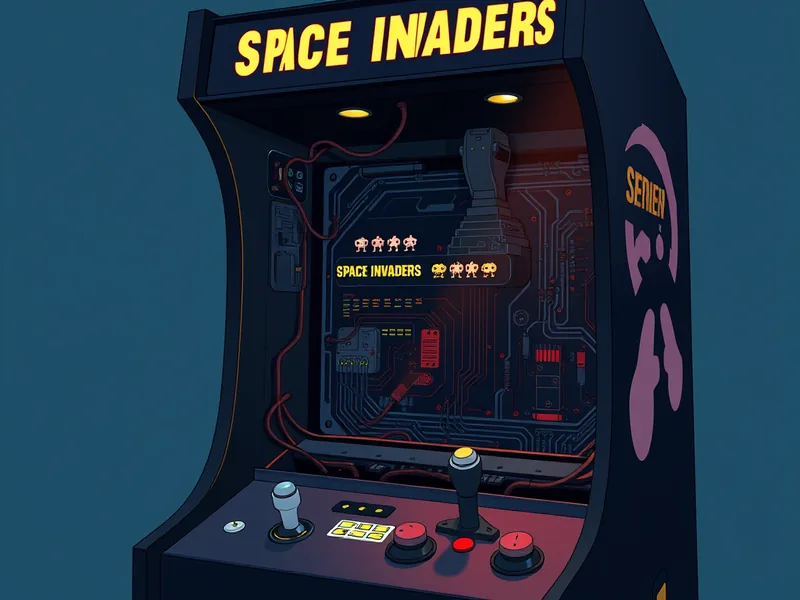
The enemies in Space Invaders followed pre-programmed movement patterns, which created a sense of predictability while still challenging players:
Given the limited memory available, efficient resource management was crucial:
Space Invaders’ influence extends beyond its initial release. Many modern game developers still draw inspiration from its design principles:
Space Invaders may be over 40 years old, but its technical innovations continue to resonate with game developers. From the choice of microprocessor to the implementation of state machines and efficient graphics rendering, the game’s legacy is a testament to the ingenuity of early arcade developers.
Tags
Original Sources
↗ https://spectrum.ieee.org/space-invaders/particle-1
About the author
Kai built ML infrastructure at a Bay Area startup before developing an obsession with transformer architectures and inference optimisation that eventually pulled him out of product work entirely. A stint at a compute research lab sharpened his instinct for what actually matters in a model release versus what is marketing. He writes from the inside — from the perspective of someone who has debugged the systems he is describing at three in the morning. He is allergic to hype and instinctively drawn to the unglamorous plumbing questions that everyone else skips over.
More from The Engineer →This Week's Edition
30 April 2026
29 articles
Related Articles
Related Articles
More Stories
© 2026 Cedar & Bloom. All rights reserved.