The Drum · Weekly AI news, freeSubscribe →
Share
As robots and digital humans get more realistic, that queasy feeling of "almost human, but not quite" persists. Here's why the uncanny valley remains one of the trickiest problems in human-computer interaction.
The uncanny valley isn't a bug in human perception. It's a feature, and it's proving stubbornly hard to design around.
For anyone who's spent time building avatars, chatbots with faces, or humanoid robots, the term needs no introduction. Coined by roboticist Masahiro Mori in 1970, the "uncanny valley" describes the dip in emotional comfort we feel when something looks almost, but not quite, human. A cartoon robot registers as cute. A photorealistic android that blinks a fraction of a second too slow registers as unsettling. The closer synthetic humans get to the real thing without fully crossing the line, the worse we tend to react to them.
That's the core tension for anyone working on AI-driven avatars, virtual assistants, or social robots today. Better rendering, better motion capture, and better neural rendering pipelines don't automatically buy you audience comfort. Sometimes they buy you the opposite.
The mechanism behind the uncanny valley isn't fully settled science, but researchers have converged on a few working theories worth knowing if you're shipping anything with a synthetic face.
None of these explanations are mutually exclusive, and most researchers in this space think the effect is likely a blend of all three. What matters practically is that the valley isn't a fixed obstacle you clear once you hit some realism threshold. It's a moving target that responds to context, motion, and the specific mismatch between what a system looks like and how it behaves.
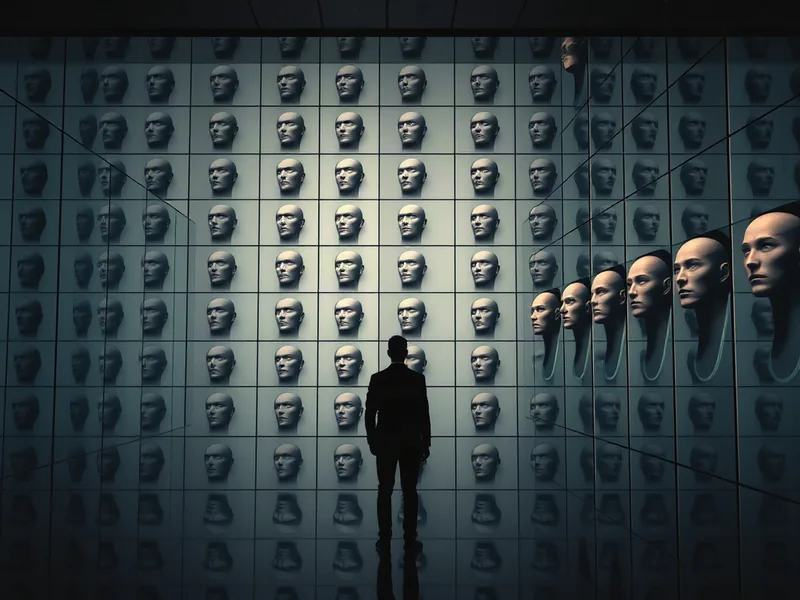
That's a real design constraint. Teams building humanoid robots or hyperrealistic virtual agents can't just optimize for photorealism and assume comfort follows. In practice, some of the most successful social robots, think Softbank's Pepper or Boston Dynamics-adjacent designs, deliberately stay on the cartoonish side of the valley rather than trying to cross it. Crossing the valley entirely, so a synthetic human is indistinguishable from a real one in both appearance and behavior, is a much higher bar than most current systems clear, and it may not even be the right goal depending on the application.
There's also a behavioral research angle that's easy to overlook: people don't just passively perceive uncanny stimuli, they actively adjust their trust and interaction patterns around it. Studies on human-robot interaction have repeatedly found that discomfort with a robot's appearance correlates with reduced willingness to follow its instructions or accept its recommendations, even when the underlying AI performs identically to a less uncanny counterpart. For anyone deploying AI systems with any kind of embodied or visual presence, whether that's a robot, an avatar, or a talking-head interface, this means the uncanny valley isn't just an aesthetics problem. It's a trust and usability problem with measurable downstream effects on how people engage with the system.
The rise of generative video and neural rendering models has made this more urgent, not less. Text-to-video and diffusion-based avatar systems can now generate faces and motion that are startlingly close to real footage, close enough that small artifacts, an eye blink that doesn't quite land, a mouth shape that lags the audio, become far more noticeable by contrast. Ironically, the better the baseline fidelity gets, the more glaring the remaining errors become, which is exactly the dynamic the uncanny valley predicts. A rough sketch of a face has nowhere to hide, but it also has nothing to betray. A near-perfect one has everywhere to hide, and one bad frame gives it all away.
The uncanny valley isn't a solved problem, and it's not going to be solved by rendering quality alone. It's a perceptual and behavioral phenomenon rooted in how brains categorize and evaluate other humans, and it responds to mismatches between appearance and behavior more than to raw fidelity.
For engineers and researchers working on anything with a synthetic face, whether that's a robot, an avatar, or a generative video model, the practical lesson is to think about consistency across appearance, motion, and response timing rather than chasing photorealism in isolation. Sometimes staying cartoonish on purpose is the better engineering call. Sometimes closing every last gap between synthetic and real is worth the effort. Knowing which situation you're in, and testing with real users rather than assuming realism equals comfort, is the difference between a product people trust and one that quietly creeps them out.
Tags
Original Sources
Ode to the Uncanny Valley
↗ https://spectrum.ieee.org/ode-to-the-uncanny-valley/particle-14
Ode to the Uncanny Valley - IEEE Spectrum
↗ https://spectrum.ieee.org/ode-to-the-uncanny-valley/particle-5
About the author
Kai built ML infrastructure at a Bay Area startup before developing an obsession with transformer architectures and inference optimisation that eventually pulled him out of product work entirely. A stint at a compute research lab sharpened his instinct for what actually matters in a model release versus what is marketing. He writes from the inside — from the perspective of someone who has debugged the systems he is describing at three in the morning. He is allergic to hype and instinctively drawn to the unglamorous plumbing questions that everyone else skips over.
More from The Engineer →This Week's Edition
20 September 2026
20 articles
Related Articles
Stanford HAI's Fall 2026 Seminar Lineup Zeroes In On World Models, AI Measurement, and Workforce Anxiety
Models & Research · 5 min

Why a Disney Roboticist Traded Academic Research for Theme Park Robots
Models & Research · 5 min
The "Journey, Not the Destination" Debate: What a MathOverflow Flame War Reveals About AI and Proof
Models & Research · 5 min
Related Articles
Stanford HAI's Fall 2026 Seminar Lineup Zeroes In On World Models, AI Measurement, and Workforce Anxiety
Models & Research · 5 min
Why a Disney Roboticist Traded Academic Research for Theme Park Robots
Models & Research · 5 min
The "Journey, Not the Destination" Debate: What a MathOverflow Flame War Reveals About AI and Proof
Models & Research · 5 min
More Stories
© 2026 Cedar & Bloom. All rights reserved.
