The Drum · Weekly AI news, freeSubscribe →
Share
That creeped-out feeling you get from almost-human robots isn't just a design flaw to engineer around. It's a window into how our brains classify agents, and it has real implications for anyone building human-facing AI systems.
If you've ever watched a humanoid robot move and felt a low-grade unease you couldn't quite name, you've experienced the uncanny valley firsthand. The term describes a weird dip in emotional response that happens when something looks almost human but not quite. Robots or animated characters that are clearly artificial tend to register as fine, even charming. Push the realism dial further toward actual human likeness and something strange happens: our comfort doesn't rise smoothly. It plunges.
The concept originated with Japanese roboticist Masahiro Mori back in the 1970s, and it's stuck around in robotics and animation circles ever since for good reason. It's not just a quirky aesthetic observation. It's a measurable, repeatable phenomenon that shows up across robotics, CGI, and increasingly in AI-generated avatars and synthetic media. And for engineers building anything that needs to interact with humans, whether that's a physical robot, a virtual assistant, or a generative video model, understanding why the valley exists matters a lot more than just knowing it's there.
The leading explanation ties back to how our perceptual systems categorize agents. Humans are fast, efficient classifiers. We sort what we see into buckets: human, not-human, animal, object. Most of the time this works seamlessly, because most of what we encounter falls cleanly into one category or another. The uncanny valley shows up specifically when something sits right at the boundary between categories, triggering what researchers describe as a kind of categorical ambiguity. Our brains don't like sitting on that fence. The mismatch between human-like surface cues and the "wrongness" we detect underneath, whether in movement, skin texture, or eye behavior, seems to register as a threat signal rather than a neutral oddity.
This has direct consequences for anyone designing robots or synthetic humans meant to operate alongside people. The instinct is often to push realism as far as possible, on the assumption that more human-like equals more acceptable. The uncanny valley research suggests that's a trap. Partial realism, the kind where a robot has humanlike proportions and expressions but still reads as clearly mechanical, tends to land better with people than something that's 95 percent convincingly human and 5 percent off.
That remaining 5 percent is where things go wrong, and it's often the subtlest cues that do the damage:
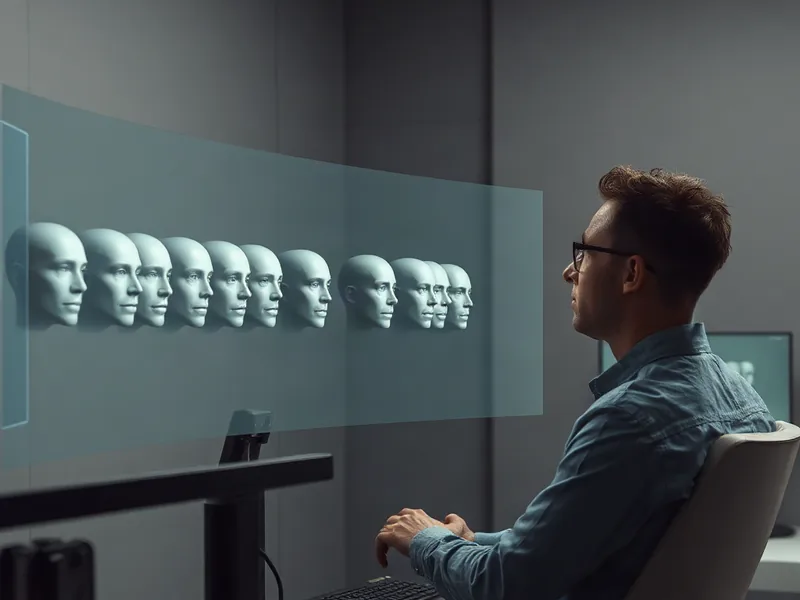
None of these are easy fixes. They're exactly the kind of fine-grained, high-dimensional details that are hardest to nail in animation pipelines, robotic actuator design, and generative video models alike. You can get the big structural stuff right, the proportions, the general motion, the overall silhouette, and still fall straight into the valley because of details most people couldn't consciously name but will absolutely notice.
This is relevant well beyond physical robotics. Generative AI systems producing synthetic faces, voices, and full video avatars are running into the exact same wall. A deepfake or AI avatar that's almost photorealistic but has slightly off eye contact or unnatural blinking patterns tends to feel more unsettling than a more obviously stylized or cartoonish one. The uncanny valley isn't a robotics-specific problem. It's a perception problem that applies to any system trying to simulate a human convincingly, and it scales with how much surface realism a system achieves relative to how well it nails the underlying behavioral and physical cues.
That has practical design implications. Teams building virtual assistants, synthetic avatars, or social robots have to decide where they want to sit relative to the valley rather than ignoring it. Some deliberately dial back realism, leaning into stylization to stay safely on the near side of the valley where audiences are comfortable. Others try to push all the way through to the far side, chasing full photorealism and natural motion so convincingly that the ambiguity disappears entirely. The risky zone is the middle, where a system is realistic enough to invite human-level scrutiny but not quite good enough to survive it.
The uncanny valley isn't a design bug to patch over. It's a signal about how human perceptual categorization works, and it tells engineers something useful: realism isn't a single dial you can simply turn up until things look good. It's a multidimensional target where visual fidelity, motion dynamics, and behavioral cues all have to clear the bar together, or the gaps between them will get noticed. For anyone building robots, avatars, or generative media meant to pass as human, or deliberately not pass as human, that's the design constraint worth taking seriously rather than treating as a punchline.
Tags
Original Sources
Ode to the Uncanny Valley
↗ https://spectrum.ieee.org/ode-to-the-uncanny-valley/particle-15
About the author
Kai built ML infrastructure at a Bay Area startup before developing an obsession with transformer architectures and inference optimisation that eventually pulled him out of product work entirely. A stint at a compute research lab sharpened his instinct for what actually matters in a model release versus what is marketing. He writes from the inside — from the perspective of someone who has debugged the systems he is describing at three in the morning. He is allergic to hype and instinctively drawn to the unglamorous plumbing questions that everyone else skips over.
More from The Engineer →This Week's Edition
2 October 2026
28 articles
Related Articles
The Chip That Let Hardware Be Rewritten Like Software: Xilinx's XC2064
Models & Research · 5 min

New Graphite Study Finds AI Models Still Have Distinctive Writing Tells, Even After Scrubbing Em-Dashes
Models & Research · 5 min

Payerset Bets on AI Research Assistant to Make Price Transparency Data Usable
Products & Applications · 6 min
Related Articles
The Chip That Let Hardware Be Rewritten Like Software: Xilinx's XC2064
Models & Research · 5 min
New Graphite Study Finds AI Models Still Have Distinctive Writing Tells, Even After Scrubbing Em-Dashes
Models & Research · 5 min
Payerset Bets on AI Research Assistant to Make Price Transparency Data Usable
Products & Applications · 6 min
More Stories
© 2026 Cedar & Bloom. All rights reserved.
