The Drum · Weekly AI news, freeSubscribe →
Share
This new benchmark standardizes perplexity scores across varying tokenizers, ensuring fair comparisons between language models and shedding light on the critical role of tokenization in evaluation metrics.
When it comes to evaluating language models, perplexity is a widely used metric. However, the choice of tokenizer can significantly influence perplexity scores, leading to misleading comparisons. A new benchmark called "Tokenizer-Normalized Perplexity" aims to address this issue by normalizing perplexity across different tokenizers. This article delves into the methodology, results, and implications of this approach.
Perplexity measures how well a model predicts a sample. It's calculated as (2^{-\frac{1}{N} \sum_{i=1}^{N} \log_2 P(x_i)}), where (P(x_i)) is the probability of the i-th token and (N) is the total number of tokens. Different tokenizers can split text into varying numbers of tokens, affecting perplexity scores.
Previous methods to normalize perplexity include adjusting for token length or using a common vocabulary. However, these approaches often fall short in capturing the nuances of different tokenizers.
The core idea is to weight each model's perplexity by the average number of tokens it generates per character. This is done using the formula: [ \text{Normalized Perplexity} = \text{Perplexity} \times \frac{\text{Average Tokens per Character (Model)}}{\text{Average Tokens per Character (Reference)}} ]
The evaluation protocol involves:
Empirical analysis shows significant variations in tokenization across different models. For example, some models generate twice as many tokens per character compared to others. This disparity can lead to substantial differences in raw perplexity scores.
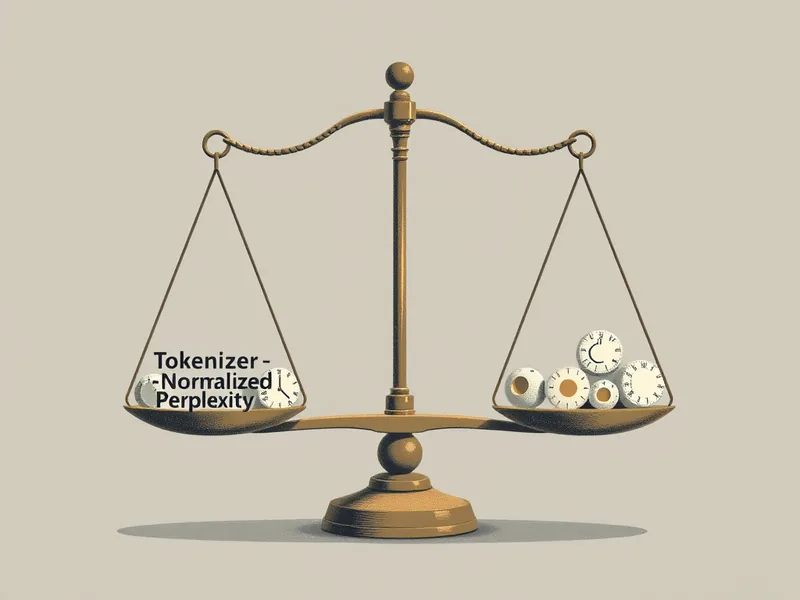
When normalized, the relative performance of models changes significantly. Some models that appeared superior based on raw perplexity are revealed to be less effective when tokenization is accounted for. Conversely, other models that were previously underrated show improved performance.
The study also delves into architectural differences. Models with more sophisticated tokenizers (e.g., byte-level tokenizers) tend to have higher average tokens per character but can achieve better normalized perplexity due to their fine-grained representation of text.
Llama Scout, a model with an unconventional architecture, stands out in the analysis. Despite generating fewer tokens per character, it achieves competitive normalized perplexity scores. This suggests that architectural innovations can mitigate the effects of tokenization biases.
The weighted perplexity benchmark provides a more accurate and fair way to compare language models. It highlights the importance of considering tokenizer differences when evaluating model performance. This approach can help researchers and practitioners make more informed decisions about which models to use in various applications.
This normalization method is straightforward and easy to implement, making it a valuable tool for the NLP community. However, it's important to note that while it addresses tokenization biases, other factors (e.g., dataset quality, model architecture) still play crucial roles in performance evaluation.
The weighted perplexity benchmark builds on previous normalization efforts but offers a more comprehensive solution. It aligns with the broader goal of making NLP research more transparent and reproducible.
The weighted perplexity benchmark is a significant step forward in fair language model comparison. By normalizing for tokenization differences, it provides a clearer picture of model performance, helping researchers and practitioners make better-informed decisions.
Tags
Original Sources
About the author
Kai built ML infrastructure at a Bay Area startup before developing an obsession with transformer architectures and inference optimisation that eventually pulled him out of product work entirely. A stint at a compute research lab sharpened his instinct for what actually matters in a model release versus what is marketing. He writes from the inside — from the perspective of someone who has debugged the systems he is describing at three in the morning. He is allergic to hype and instinctively drawn to the unglamorous plumbing questions that everyone else skips over.
More from The Engineer →This Week's Edition
18 July 2025
29 articles
Related Articles

Wharton's Fourth Annual AI Survey: Most Companies See Returns, Few See Big Ones
Models & Research · 6 min

Tensormesh Launches Enterprise KV Cache Platform to Cut Redundant LLM Compute
Models & Research · 6 min

Iambic Therapeutics Raises $150 Million in IPO to Fund AI-Designed Cancer Drugs
Finance & Markets · 5 min
Related Articles
Wharton's Fourth Annual AI Survey: Most Companies See Returns, Few See Big Ones
Models & Research · 6 min
Tensormesh Launches Enterprise KV Cache Platform to Cut Redundant LLM Compute
Models & Research · 6 min
Iambic Therapeutics Raises $150 Million in IPO to Fund AI-Designed Cancer Drugs
Finance & Markets · 5 min
More Stories
© 2026 Cedar & Bloom. All rights reserved.
