The Drum · Weekly AI news, freeSubscribe →

Share
A crowded field of strategic health investors just backed a bigger bet: that oncology navigation can be the foundation for a multi-business empire spanning biosimilars and clinical trials.
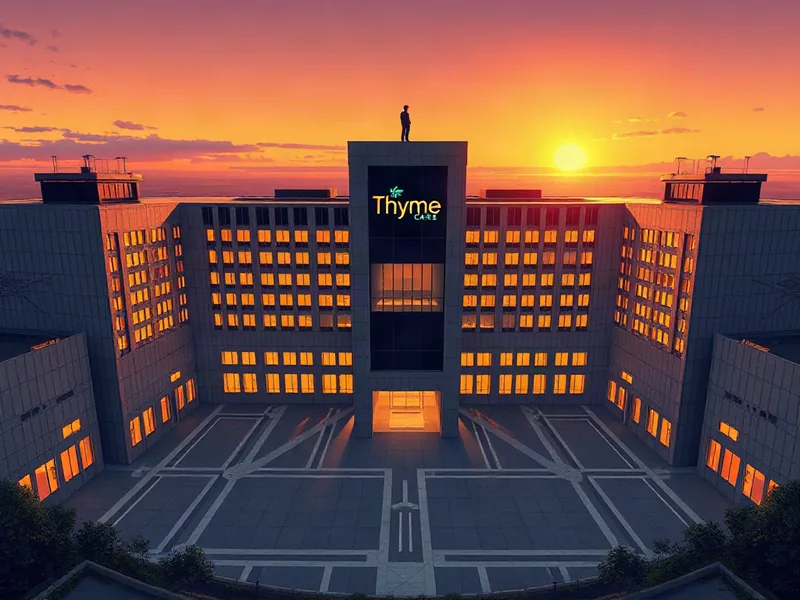
Thyme Care closed a Series E round of more than $125 million this week, pushing its valuation past $2 billion. The Nashville-based oncology company did not stop at a funding announcement. It also unveiled Thyme Companies, a new parent entity designed to house a portfolio of independent businesses across the oncology ecosystem.
That is a notable structural bet for a company founded just five years ago, in 2020. Thyme Care built its business by partnering with health plans, employers and risk-bearing providers to support cancer patients through diagnosis, treatment and follow-up care. Its model combines care navigation, technology-driven data insights and therapeutic interventions. Patients get help finding oncologists, understanding diagnoses and staying connected to a team of providers, nurses and resource specialists between appointments.
The reach is already substantial. Thyme Care's services now cover 10.5 million people across all 50 states, a scale that helps explain why strategic investors keep returning to the table.
Morgan Health led the round, with participation from Humana, CVS Health Ventures, AlleyCorp, HealthQuest Capital, Foresite Capital, Concord Health Partners, Frist Cressey Ventures, Town Hall Ventures and a16z Bio + Health. This is not a speculative crowd. Humana and CVS Health Ventures are strategic payers and pharmacy benefit players with direct exposure to oncology cost trends. Morgan Health, JPMorgan's health care investment arm, has now backed Thyme Care through multiple rounds, a pattern that suggests conviction rather than a one-time bet.
Dan Mendelson, CEO of Morgan Health, framed the investment in terms of a structural gap in cancer care. "People living with cancer have traditionally been left to coordinate care themselves and pay more along the way," he said in a statement. "Thyme Care is changing that experience and making it possible to improve cancer care while lowering costs." He added that Morgan Health is "confident they can continue to deliver value to patients and payers" as the company pursues "the next wave of cancer care innovation."
That language matters for how investors should read this deal. Cost control in oncology has become one of the hardest problems in health care. Cancer treatment costs continue to climb, and payers have limited tools to manage utilization without alienating patients or providers. A navigation company with proven scale and payer relationships offers a lever that plans have historically lacked.
The creation of Thyme Companies signals ambition beyond navigation services alone. The new parent entity will build a portfolio of independent oncology businesses, with an initial focus on accelerating adoption of lower-cost biosimilars and increasing clinical trial enrollment. The first business under this structure is expected to launch later this year.
Leadership changes accompany the corporate restructuring. Co-founder Robin Shah will step into the role of executive chairman at Thyme Companies, focusing on strategy and new business development. Thyme Care itself will continue under CEO Dr. Brad Diephuis, with co-founder Dr. Bobby Green serving as president and chief medical officer. The split allows the core navigation business to keep executing while a separate leadership track pursues adjacent opportunities.
Diephuis was direct about priorities in comments to MedCity News. "Our top priority is delivering for the members and partners we already serve, maintaining the high-value experience our members count on, and continuing to expand, including further into the commercial market," he said. He also offered a claim that deserves attention from anyone evaluating the deal: "Our core business is profitable and growing, and this capital lets us keep scaling it while pushing into more parts of the oncology journey than we touch today."
Profitability at this stage of growth is not the norm among venture-backed health tech companies, and if accurate, it changes the risk calculus meaningfully. A profitable core business funding expansion into adjacent markets is a fundamentally different story than a cash-burning startup betting on a pivot.
The oncology support space is not uncontested. Companies including OncoveryCare and Maia Oncology operate in similar territory, and payers evaluating navigation vendors have real alternatives. Thyme Care's scale advantage, 10.5 million covered lives, is meaningful but not insurmountable as competitors chase similar contracts.
The bigger risk sits with Thyme Companies itself. Building a portfolio of independent oncology businesses is a different discipline than running a single navigation platform well. Biosimilar adoption and clinical trial enrollment are both areas with established incumbents, regulatory complexity and long sales cycles. Launching a new business later this year is one thing. Making that business commercially viable at a scale that justifies a $2 billion valuation is another.
There is also concentration risk in the investor base. Having Humana and CVS Health Ventures as both investors and potential channel partners aligns incentives, but it also means Thyme Care's growth is partly tethered to the strategic priorities of a small number of large payers. If those priorities shift, so does Thyme Care's addressable opportunity.
The near-term signal to watch is the launch of the first Thyme Companies business later this year. Its reception, and whether it can demonstrate traction in biosimilar adoption or trial enrollment within a reasonable window, will tell investors whether this diversification strategy has legs or whether it dilutes management focus from a working core business.
Equally important is whether Thyme Care's claimed profitability holds up as it scales into the commercial market, a segment distinct from the payer and employer relationships it has built to date. A $2 billion valuation on a five-year-old company assumes continued execution on both fronts. The capital raised gives Thyme Care room to prove the thesis. It does not yet prove it.
Tags
Original Sources
Thyme Care Raises $125M, Launches New Oncology Parent Entity - MedCity News
↗ https://medcitynews.com/2026/09/thyme-care-raises-125m-launches-new-oncology-parent-entity
Thyme Care banks $125M series E, propelling valuation past $2B
↗ https://www.fiercehealthcare.com/health-tech/oncology-company-thyme-care-raises-125m-backed-morgan-health-humana-and-cvs-health
About the author
Marcus began tracking AI's market implications in 2016, noticing AI-related patent filings accelerating ahead of earnings upgrades before most of the sell-side had caught on. A former fixed-income quantitative analyst, he spent two decades building models that priced risk across emerging markets before pivoting to cover the economic impact of AI full-time. His writing translates opaque technical developments into clear risk/reward terms — and he's rarely diplomatic about the gap between AI valuations and underlying fundamentals. He believes most market participants still underestimate AI's long-run deflationary effect on knowledge work.
More from The Analyst →This Week's Edition
3 September 2026
24 articles
Related Articles
Related Articles
More Stories
© 2026 Cedar & Bloom. All rights reserved.