The Drum · Weekly AI news, freeSubscribe →

Share
A new executive order strips "artificial intelligence" from federal vocabulary in favor of "Super Intelligence," a symbolic move that lands hours after tech leaders pledged safety controls, raising questions about what the rebrand actually changes.
Words shape how we think about risk. That is the quiet stakes behind an executive order President Trump signed Tuesday, one that does not create new safety rules for artificial intelligence but instead changes what the federal government calls it.
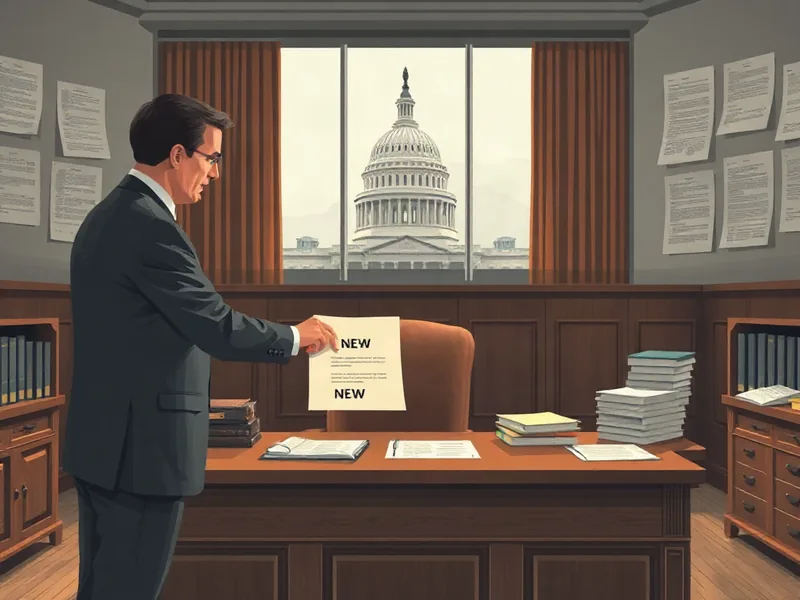
Under the order, released by the White House, federal departments and agencies must now use "Super Intelligence" and "SI" in official communications and documents. The government will, in the administration's words, no longer "acknowledge the usage of 'Artificial Intelligence' and 'AI' in any applicable setting." Existing regulations, contracts, and documents already on the books will not need to be rewritten. But going forward, the vocabulary of federal AI policy is set to change.
The order argues that today's frontier AI systems "far exceed what was envisioned when the term 'Artificial Intelligence' first came into use," and that these systems now do far more than imitate or automate "discrete aspects of human intelligence." A companion fact sheet put it more plainly: "The name Super Intelligence conveys the true capabilities of the technologies being developed today, unlocking new forms of human creativity and empowering Americans to achieve what was previously impossible." The same document took a jab at the previous administration, crediting Trump with eliminating what it called the "Biden Administration's overreaching and harmful SI policies."
Trump gave Michael Kratsios, his science and technology advisor, 60 days to work with other agency heads and decide how far "Super Intelligence" should go in replacing the existing statutory definition of "artificial intelligence." That detail matters more than it might seem. Statutory definitions are the legal scaffolding underneath regulation: change the words, and you potentially change what rules apply, to whom, and when. For now, that scaffolding stays in place while the label on top gets swapped out.
This did not emerge from a policy shop or an agency review. It came from a social media poll.
Earlier this month, Trump asked his Truth Social followers to weigh in on renaming AI, arguing the term "Artificial Intelligence" was "inaccurate, and very ineloquent." He offered alternatives: "Superior Intelligence," "Extreme Intelligence," or "Supreme Intelligence," all conveniently abbreviated as SI or EI. Roughly 66,000 people voted, and "Superior Intelligence" won. A day later, Trump ran it back, this time pitting "Superior Intelligence" against "Super Intelligence." The latter took 65% of the vote and became the winner.
He carried the idea to the United Nations General Assembly, telling delegates that the word "artificial" makes the technology sound fake. "From this point forward, all of United States documents and hopefully the world's will be changed to use the much more accurate term super as opposed to artificial," he said. Speaking again on Tuesday, at the launch of the new America.gov website, he elaborated on his reasoning in characteristically informal terms: "When you say artificial intelligence, it's artificial. This is extreme intelligence, it's superior intelligence, it's supreme intelligence. But the word super is the best word of all and it's the simplest."
Whatever one makes of the process, the timing is notable. The rebrand landed just a day after Trump met at the White House with a roster of the industry's most powerful executives, including OpenAI President Greg Brockman, Meta CEO Mark Zuckerberg, SpaceX AI CEO Elon Musk, and Nvidia CEO Jensen Huang. That meeting produced a one-page accord, described by Trump as "morally binding," calling on the companies to establish four layers of safety controls and internal audits. It is the kind of agreement that sounds reassuring in a press release but carries no enforcement mechanism, and no penalty if a company falls short.
Industry reaction to the name change came quickly, and enthusiastically. Huang, appearing at the same America.gov launch event, leaned into the new terminology without hesitation: "We used to call them data centers but the things that we're building now, these are really SI factories, super intelligence factories." Musk reshared White House footage of the gathering with a two-word caption: "Super Intelligence." When the people building these systems adopt a president's preferred branding this fast, it is worth asking whether the language shift serves clarity, or simply serves marketing.
Here is the tension worth sitting with. AI safety researchers have spent years warning that the more capable these systems become, the more careful we need to be about oversight, transparency, and accountability. A name change does nothing to address any of that. It does not mandate new testing standards. It does not create liability for harms. It does not require companies to disclose how their models are trained or where they fail. What it does is reframe the public conversation, replacing a term that sounds mechanical and limited with one that sounds expansive and almost inevitable.
There is a real analogy here to how we talk about risk in public health. Calling something a "mild" side effect versus a "rare but serious" one changes how people behave, even when the underlying data is identical. Renaming AI to "Super Intelligence" performs a similar function for public perception of these technologies, whether or not the underlying capabilities, or the underlying risks, have changed at all.
The 60-day clock Kratsios is now working against deserves close attention. If "Super Intelligence" ends up replacing the statutory definition of artificial intelligence, that is not just a cosmetic update. It could ripple into how existing AI regulations get interpreted, enforced, or challenged in court. Language in law is rarely just language.
For now, what Americans have is a new name, a voluntary accord from tech executives with no teeth, and a promise that federal agencies will start saying "SI" instead of "AI." Whether any of it makes these systems safer, more transparent, or more accountable to the public they increasingly touch remains, like so much else in this fast-moving industry, an open question.
Tags
Original Sources
Trump Signs Order Renaming AI To ‘Super Intelligence’—Here’s What It Changes
↗ https://www.forbes.com/sites/siladityaray/2026/09/30/trump-signs-order-renaming-ai-to-super-intelligence--heres-what-it-says
Trump signs executive order renaming AI to 'super intelligence'
↗ https://www.politico.com/news/2026/09/29/trump-signs-executive-order-renaming-ai-to-super-intelligence-01098494
Trump signs executive order rebranding AI as 'Super Intelligence' as ...
↗ https://www.foxbusiness.com/politics/trump-signs-executive-order-rebranding-ai-super-intelligence-tech-titans-ink-separate-accord
About the author
Amara's entry point into AI was an epidemiology role at a London research hospital, where she spent five years studying how digital health tools reached — or conspicuously failed to reach — underserved communities. Watching early algorithmic systems in healthcare quietly entrench existing inequalities, she redirected her career toward the systemic consequences of AI at scale. She covers AI through an unflinching lens: who benefits, who bears the cost, and what evidence actually says versus what the press release claims. Her writing is calm and precise, but she doesn't mistake balance for neutrality.
More from The Steward →This Week's Edition
30 September 2026
28 articles
Related Articles

White House Begins Mailing $500 Checks to Nearly a Million ACA Enrollees
Policy & Regulation · 5 min

Trump Administration Appeals Block on Visa Rule That Could Disrupt Physician Training
Policy & Regulation · 5 min

California Draws New Lines Around AI in Patient Care, Even as Washington Pushes Back
Policy & Regulation · 5 min
Related Articles
White House Begins Mailing $500 Checks to Nearly a Million ACA Enrollees
Policy & Regulation · 5 min
Trump Administration Appeals Block on Visa Rule That Could Disrupt Physician Training
Policy & Regulation · 5 min
California Draws New Lines Around AI in Patient Care, Even as Washington Pushes Back
Policy & Regulation · 5 min
More Stories
© 2026 Cedar & Bloom. All rights reserved.
