The Drum · Weekly AI news, freeSubscribe →

Share
A possible three-way summit in Shenzhen has Washington eyeing arms control and Moscow pushing to settle Ukraine on its terms, while Beijing hesitates and smaller nations worry they'll be left out of the room.
Imagine three people deciding the fate of your neighborhood while you wait outside, unable to speak, unsure what's being traded away. That's roughly how officials in Kyiv, Taipei, and Tokyo are describing their mood right now, as word spreads that the leaders of the United States, China, and Russia might sit down together next week for the first meeting of its kind.
The venue would be Shenzhen, on the sidelines of the Asia-Pacific Economic Cooperation forum. Negotiations over who says what, and in what order, are still unresolved. Two people familiar with the planning told Reuters that no agenda or format has been locked in, even as the clock runs down. A meeting is still expected to happen.
What makes this moment unusual isn't just the venue. It's that the three men arrive with almost nothing in common, goal-wise. President Vladimir Putin wants to end the four-year war in Ukraine on favorable terms, treating the summit as a potential finish line. President Donald Trump, fresh off bruising Republican losses at the polls, is chasing something closer to a legacy moment: movement toward a three-way nuclear arms agreement that would put his name in the history books. President Xi Jinping, meanwhile, is simply trying to get through the week without being cornered.
Think of it like hosting a dinner party where your two guests each want to use the evening to settle a score, and you just want everyone to leave without breaking the china. Xi's scripted, choreographed approach to diplomacy sits awkwardly next to Trump's improvisational style. And the arms control idea that excites Trump is, by Beijing's own accounting, a trap. China holds roughly 500 nuclear warheads, compared to more than 5,000 each for the US and Russia, even as it works to expand that arsenal. Being pulled into arms talks alongside the two nuclear superpowers would mean accepting a label China has spent years trying to avoid.
"This is something the Chinese hate," said Edgard Kagan, a former senior Biden White House official for East Asia now with the Center for Strategic and International Studies. "I think it's fair to say the Chinese do not want arms control discussions with the United States. And they certainly don't want to do it with the United States and Russia, because it suggests that they accept the framing that they are now a major nuclear power that should be subject to similar restrictions."
A senior Trump administration official acknowledged as much on Friday, saying "we do not expect to get to any kind of agreement" on nuclear issues, while still pressing the point that "it's time for China to sort of step up" and engage on the topic. Beijing's embassy in Washington offered only a careful non-answer: "China is in communication with relevant parties regarding a meeting between the three heads of state. We have nothing to share at the moment." Russia's embassy did not respond to a request for comment.
There's a reason the word "Yalta" keeps coming up, and it's not a flattering one. In 1945, the US, Britain, and the Soviet Union met in Crimea and effectively carved up the postwar world between themselves, setting spheres of influence that smaller nations had no say in. The phrase has become diplomatic shorthand for powerful countries making decisions over the heads of everyone else.
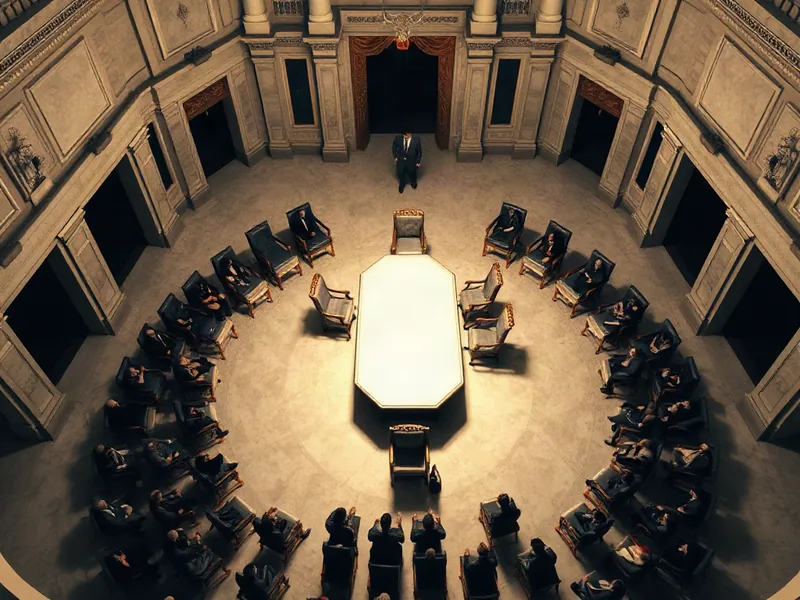
For Russian nationalists, that comparison is a feature, not a bug. Alexander Dugin, a prominent nationalist ideologue, told Radio Sputnik this week that simply holding the meeting "shows who is important in the world: We are, China and the West. It's deeply symbolic, it's a confirmation of a multi-polar world that the West denies." In other words, just getting a seat at this table is treated as a geopolitical win in itself, regardless of what's actually decided there.
That symbolism cuts the other way for everyone not invited. Ukrainian President Volodymyr Zelenskiy put it bluntly last month: "We really don't want this to turn into 'Yalta 2, 3, 4,' with a redistribution of influence." Taiwan, never mentioned by name in these discussions but never far from anyone's mind given its disputed status with Beijing, faces a similar anxiety. People briefed on reactions in Kyiv and Tokyo describe real unease, the kind that comes from watching decisions about your security get made somewhere you're not in the room.
It's an especially uncomfortable position for China, which wasn't invited to the original Yalta Conference and has spent decades positioning itself as a champion for smaller, non-aligned nations. Hosting a modern echo of that exact dynamic undercuts a narrative Beijing has worked hard to build.
The two countries co-hosting, in effect, don't even agree on what should be discussed. Moscow wants Ukraine on the agenda. Beijing has resisted that, according to one person briefed on the meeting and a European diplomat, both speaking anonymously. A US official said Friday that Trump likely won't raise the war either, arguing a three-way format isn't the right venue for it. China and Russia have grown closer in recent years, trading oil, gas, and military technology, but that partnership clearly has limits when it comes to what gets said at the table.
Whatever comes out of Shenzhen, if the meeting happens at all, history suggests the odds of a real breakthrough are low. Trump's prior summits with Putin and North Korea's Kim Jong Un generated headlines but little in the way of lasting agreements. Kurt Tong, a former senior State Department official now at the Asia Group consultancy, framed the stakes for Trump plainly: "The president will undoubtedly be seeking to use this trip to reassert leadership, authority, demonstrate his statesmanship capabilities, and essentially show off on the international stage."
That may be the most honest way to think about what's at risk here. Even a symbolic photo of the three leaders together reshapes how the rest of the world sees the balance of power, regardless of what gets signed. For Ukraine, Taiwan, and other nations watching from outside, that symbolism isn't abstract. It's a preview of how much say they'll have in decisions that shape their own futures, and right now, the answer looks like not much at all.
Tags
Original Sources
A new 'Yalta'? Trump and Putin push for a meeting that Xi is wary of hosting
↗ https://www.reuters.com/world/china/new-yalta-trump-putin-push-meeting-that-xi-is-wary-hosting-2026-11-14
About the author
Amara's entry point into AI was an epidemiology role at a London research hospital, where she spent five years studying how digital health tools reached — or conspicuously failed to reach — underserved communities. Watching early algorithmic systems in healthcare quietly entrench existing inequalities, she redirected her career toward the systemic consequences of AI at scale. She covers AI through an unflinching lens: who benefits, who bears the cost, and what evidence actually says versus what the press release claims. Her writing is calm and precise, but she doesn't mistake balance for neutrality.
More from The Steward →This Week's Edition
15 November 2026
14 articles
Related Articles

Europe's Digital ID Push Tests a New Privacy Tool: Zero-Knowledge Proofs
Policy & Regulation · 5 min

Why the Woman Who Fired Sam Altman Still Doesn't Trust AI's Boardrooms
Policy & Regulation · 5 min

Pakistan to Send Climate Minister to India for First High-Level Visit in Three Years
Policy & Regulation · 5 min
Related Articles
Europe's Digital ID Push Tests a New Privacy Tool: Zero-Knowledge Proofs
Policy & Regulation · 5 min
Why the Woman Who Fired Sam Altman Still Doesn't Trust AI's Boardrooms
Policy & Regulation · 5 min
Pakistan to Send Climate Minister to India for First High-Level Visit in Three Years
Policy & Regulation · 5 min
More Stories
© 2026 Cedar & Bloom. All rights reserved.
