The Drum · Weekly AI news, freeSubscribe →
Share
A UC Riverside simulation suggests Venus didn't need a violent collision to lose a moon. Its sluggish 243-day rotation alone may have dragged a satellite inward until gravity tore it apart.
Venus is often called Earth's twin. Same rough size, same mass, similar rocky structure. Yet it has no moon, and that absence has puzzled astronomers for decades. If a planet so similar to ours could plausibly have formed a satellite, why isn't one still there?
A new study from researchers at the University of California, Riverside offers an answer that doesn't require any cosmic violence. Earlier theories imagined a massive impact, some catastrophic collision that shattered a Venusian moon into rubble. The new research, published in The Astrophysical Journal, suggests something quieter and, in its way, more unsettling: Venus may have simply pulled its moon in over time, like a slow-motion whirlpool, until the satellite broke apart and was absorbed into the planet.
"Venus didn't require a catastrophe to arrive at what we can see today," said Steven Kane, the astrophysicist who led the study, in a press release. "It turns out the gravity of the planet itself combined with the rate at which it spins naturally caused the moon to collapse on top of it."
To understand why, think about how a planet's spin interacts with a moon's orbit. A planet's rotation creates small variations in gravitational pull that either nudge a moon farther away or drag it closer, depending on how fast that planet spins relative to its moon's orbit. Earth spins quickly, once every 24 hours, and that speed is part of why our moon is safe. In fact, it's drifting away from us right now, at a rate of about 1.5 inches per year, roughly the length your fingernail grows in twelve months.
Venus tells a different story entirely. It takes 243 Earth days to complete a single rotation, longer than its own year, making it the slowest spinning planet in the solar system. That kind of sluggishness changes the physics of the relationship between planet and satellite. Instead of pushing a moon outward the way Earth does, Venus' gravity would have tugged inward, drawing any moon closer and closer over time.
Kane's team didn't just theorize. They built a computer model to simulate gravitational interactions between Venus and a hypothetical moon, first testing the model's accuracy by recreating the known history of Earth's own moon. Once satisfied it worked, they ran the simulation again and again, varying two key factors: how fast Venus rotates and how massive the hypothetical moon might be, testing masses ranging from a hundredth to ten times that of our own moon.
The results were strikingly consistent. Across a wide range of rotation speeds and lunar masses, the outcome kept pointing the same direction: the moon spiraled inward, eventually fragmenting and getting consumed by the planet's gravity. "When I made this discovery, I was shocked," Kane said. "I thought surely the broad range of scenarios I was exploring would lead to a variety of results. But it all went pretty much in the same direction."
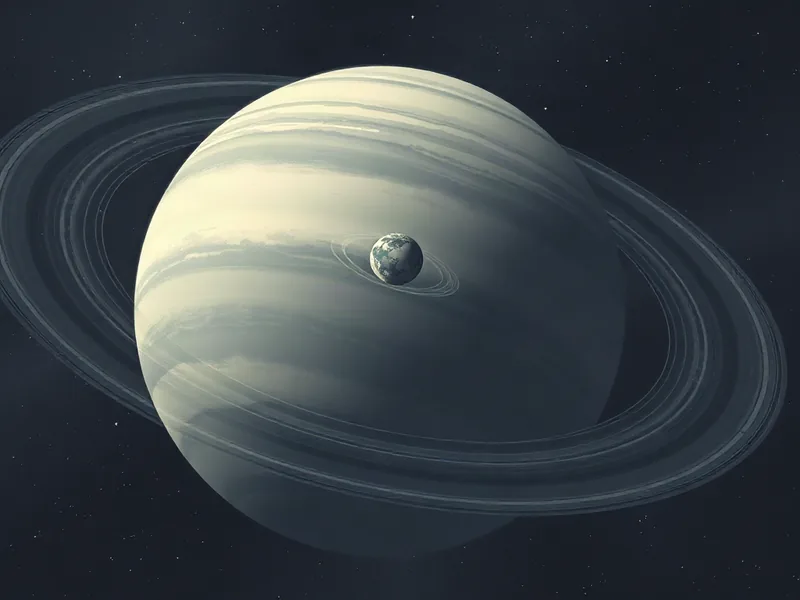
There were exceptions, but they were revealing rather than reassuring. When the researchers artificially sped Venus' rotation up to somewhere between 10 and 12 hours, similar to Earth's own day length, and gave the hypothetical moon a mass close to our moon's, the simulation showed the satellite could survive for up to 4.5 billion years, essentially the age of the solar system. But that scenario bears no resemblance to the Venus we actually observe today. It's a useful check on the model's logic, not a realistic alternate history.
Proving this happened is a different challenge than modeling how it could have happened. Venus' surface looks geologically young: the pattern of impact craters suggests the top layer of rock is only a few hundred million years old, even though the planet itself formed alongside the rest of the solar system some 4.6 billion years ago. Relentless volcanic and tectonic activity has resurfaced the planet again and again, erasing whatever record might have existed of an ancient moon.
If evidence survives anywhere, it's likely buried deep, not visible on the surface. Scientists have used seismological surveys, essentially listening to how shockwaves travel through Earth's interior, to find structural clues pointing to the giant impact that formed our own moon billions of years ago. A similar kind of deep survey on Venus, if one is ever conducted, might reveal comparable traces of a moon that got pulled apart and swallowed rather than blasted away.
This isn't just a curiosity about Venus' past. It touches something bigger: what it takes for a planet to remain habitable, and how astronomers should think about searching for life beyond our solar system.
Swallowing a moon wouldn't have been a gentle event for Venus. That process would have dumped enormous energy and angular momentum into the planet, potentially reshaping its rotation, its geology, and its climate in ways that could have shifted its entire evolutionary trajectory. Some scientists have wondered whether Venus once had conditions capable of supporting life before its current hellish, sulfuric atmosphere took hold. A lost moon could be part of that story.
The implications reach outward to the broader search for habitable exoplanets, too. Researchers have often treated the presence of a large moon as a point in favor of a planet's habitability, reasoning that our own moon has stabilized Earth's climate and tides over billions of years. But Kane is careful not to overstate that link. "My feeling is there are benefits to having a moon, but it isn't required for habitability," he said. "The moon has definitely changed the way Earth has evolved through time, but we don't fully know how important that role is."
What this study does add is a new variable worth checking: rotation speed. Even a planet that looks remarkably Earth-like in size and composition might not hold onto a moon if it spins too slowly. For scientists scanning distant star systems for the next habitable world, that's a subtle but important reminder that appearances, and even mass and orbit, don't tell the whole story. Sometimes the tempo of a planet's spin decides whether it keeps its moon or eventually eats it.
Tags
Original Sources
Venus May Have Devoured Its Moon
↗ https://www.wired.com/story/venus-may-have-devoured-its-moon
About the author
Amara's entry point into AI was an epidemiology role at a London research hospital, where she spent five years studying how digital health tools reached — or conspicuously failed to reach — underserved communities. Watching early algorithmic systems in healthcare quietly entrench existing inequalities, she redirected her career toward the systemic consequences of AI at scale. She covers AI through an unflinching lens: who benefits, who bears the cost, and what evidence actually says versus what the press release claims. Her writing is calm and precise, but she doesn't mistake balance for neutrality.
More from The Steward →This Week's Edition
25 September 2026
31 articles
Related Articles

Medicare Advantage Covers Most Seniors Now. Can It Be Trusted to Serve Them Well?
Health & Science · 6 min

Patients Are Building Their Own Medical Records With AI, and Doctors Should Pay Attention
Health & Science · 6 min
Australian GP Trainees to Help Shape Clinical AI Tools Through New Lyrebird Health Partnership
Health & Science · 5 min
Related Articles
Medicare Advantage Covers Most Seniors Now. Can It Be Trusted to Serve Them Well?
Health & Science · 6 min
Patients Are Building Their Own Medical Records With AI, and Doctors Should Pay Attention
Health & Science · 6 min
Australian GP Trainees to Help Shape Clinical AI Tools Through New Lyrebird Health Partnership
Health & Science · 5 min
More Stories
© 2026 Cedar & Bloom. All rights reserved.
