The Drum · Weekly AI news, freeSubscribe →

Share
XAI's move to cut its data annotation team signals a strategic pivot towards more specialized AI development, leaving hundreds of workers uncertain about their futures in a rapidly changing tech landscape.
Elon Musk’s AI startup, xAI, has reportedly laid off 500 workers from its data annotation team, according to internal messages viewed by Business Insider. This significant workforce reduction highlights the ongoing shifts in the tech industry as companies adapt to evolving market demands and technological advancements.
For many of the 500 individuals affected by this layoff, the news likely came as a shock. Data annotation is a crucial but often underappreciated role in the AI sector. These workers are responsible for labeling and categorizing data, which is essential for training machine learning models to perform tasks accurately. The sudden loss of these jobs can have far-reaching consequences for both the employees and their families, particularly if they were relying on this income as a primary source.
The layoff at xAI underscores a broader trend in the tech industry: the transition from generalist AI models to more specialized ones. Generalist AI systems aim to handle a wide range of tasks but often lack the depth and precision needed for specific applications. By contrast, specialist AI models are designed to excel in particular domains, such as healthcare, finance, or autonomous vehicles. This shift can lead to more efficient and effective AI solutions but also raises questions about job security and the future of work.
Data annotation involves adding labels or tags to raw data (like images, text, or audio) so that machine learning algorithms can learn from it. For example, annotators might label objects in a photograph to help an autonomous vehicle recognize different elements in its environment. This process is labor-intensive and requires a human touch, especially for complex tasks.
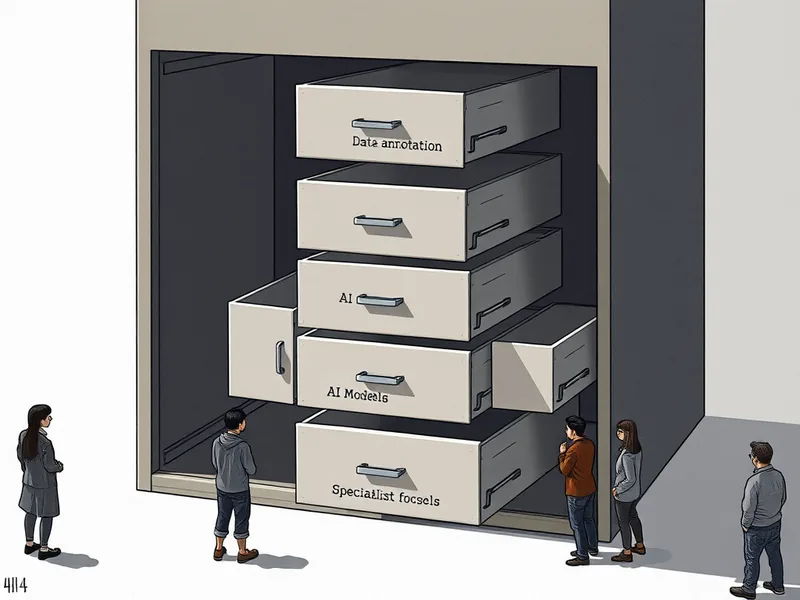
As xAI moves towards more specialized AI models, the need for large-scale data annotation may decrease. Advanced algorithms and automated tools can now perform some of these tasks with greater accuracy and speed, reducing the reliance on manual labor. However, this doesn't mean that data annotation will become obsolete; it simply means that the nature of the work and the skills required may change.
The layoff at xAI is a stark reminder of the rapid changes in the tech industry. While technological advancements can bring significant benefits, they also pose challenges for workers whose roles are being redefined or eliminated. This situation raises important questions about how companies can support their employees during such transitions and what steps society should take to ensure that workers are not left behind.
One potential solution is reskilling programs that help displaced workers acquire new skills relevant to the evolving job market. Companies like xAI could invest in these initiatives, providing training and resources to help their former employees transition into new roles within the company or in other sectors.
It's important to recognize both the benefits and risks of this shift. On one hand, specialized AI models can lead to more precise and reliable outcomes, driving innovation and efficiency. On the other hand, the displacement of workers highlights the need for responsible practices that consider the human impact of technological changes.
As we move forward, it will be crucial for tech companies, policymakers, and society as a whole to work together to ensure that the benefits of AI are shared equitably and that no one is left behind in the race towards progress.
Tags
Original Sources
About the author
Amara's entry point into AI was an epidemiology role at a London research hospital, where she spent five years studying how digital health tools reached — or conspicuously failed to reach — underserved communities. Watching early algorithmic systems in healthcare quietly entrench existing inequalities, she redirected her career toward the systemic consequences of AI at scale. She covers AI through an unflinching lens: who benefits, who bears the cost, and what evidence actually says versus what the press release claims. Her writing is calm and precise, but she doesn't mistake balance for neutrality.
More from The Steward →This Week's Edition
15 September 2025
29 articles
Related Articles

Ottawa Expands AI Funding for Northern Ontario Businesses, Aims to Close the Regional Tech Gap
Job Market & Society · 6 min

AI Is Lowering the Cost of Starting a Business. It's Not Lowering the Cost of Running One.
Job Market & Society · 6 min

Iambic Therapeutics Raises $150 Million in IPO to Fund AI-Designed Cancer Drugs
Finance & Markets · 5 min
Related Articles
Ottawa Expands AI Funding for Northern Ontario Businesses, Aims to Close the Regional Tech Gap
Job Market & Society · 6 min
AI Is Lowering the Cost of Starting a Business. It's Not Lowering the Cost of Running One.
Job Market & Society · 6 min
Iambic Therapeutics Raises $150 Million in IPO to Fund AI-Designed Cancer Drugs
Finance & Markets · 5 min
More Stories
© 2026 Cedar & Bloom. All rights reserved.
