The Drum · Weekly AI news, freeSubscribe →

Share
From Paris to Liège to Dublin, students are walking out over crowded classrooms and shrinking budgets. As governments tighten belts under debt pressure, education is becoming the flashpoint for a generation's frustration.
A teenager went to a protest and came home without a hand. That single, brutal image, a 15-year-old boy maimed by a police-fired stun grenade in France, has become the grim symbol of a continent-wide reckoning over how much governments are willing to invest in their young people.
What started in mid-September as a localized demonstration by Paris high schoolers has grown into something much bigger. More than 6,500 people, most of them minors, have been arrested in France since the protests began. The unrest has now spread into Belgium, where riot police fired tear gas at students gathered outside schools in Liège on Wednesday, part of a wave that has produced at least 139 arrests there since October 1.
For readers trying to make sense of the chaos, it helps to think of it like a pressure cooker that's been building for years. Crowded classrooms, teacher shortages, crumbling university buildings, rising tuition and living costs: these are the kinds of grievances that simmer quietly until something, or someone, forces them into the open. In this case, it was a 15-year-old's catastrophic injury, and the sense among students that their basic educational needs are being treated as optional line items in a budget spreadsheet.
France has already responded to the violence by suspending police use of stun grenades at student protests, according to Reuters. But the policy reversal hasn't stopped the broader movement. Students, parents and teachers' unions are still demanding more education funding, not just an end to the crackdown.
Belgium's clashes didn't happen in isolation. They're echoing what's unfolding in France, but the roots of this unrest run deeper than one country's budget fight.
In Greece, students called for nationwide school actions on Thursday, including assemblies, walkouts, demonstrations and potentially building occupations, according to Euronews. In Italy, high school occupations began Monday in Turin and Rome under a slogan that says it plainly: "Let's do as in France." Italian students point to underfunded schools, deteriorating buildings and rising living costs, the same complaints driving their French peers, and a delegation even traveled to Paris in solidarity, per ANSA.
Ireland's version of this story played out in Dublin earlier this month, where thousands of university students demonstrated for lower fees, more higher-education funding and affordable housing, RTÉ reported. Germany saw its own rally in September, with students, teachers, parents and unions demanding greater investment, more teachers and a fairer school system, according to Tagesschau. Austria is bracing for fresh demonstrations in mid-October after the country's university association warned that roughly €1 billion could be cut from the next three-year university budget, ORF reports.
None of these movements were planned together. There's no single coordinating body, no shared manifesto passed between capitals. What connects them is simpler and more human: a generation looking at its schools and universities and concluding that the people in charge have stopped prioritizing them.
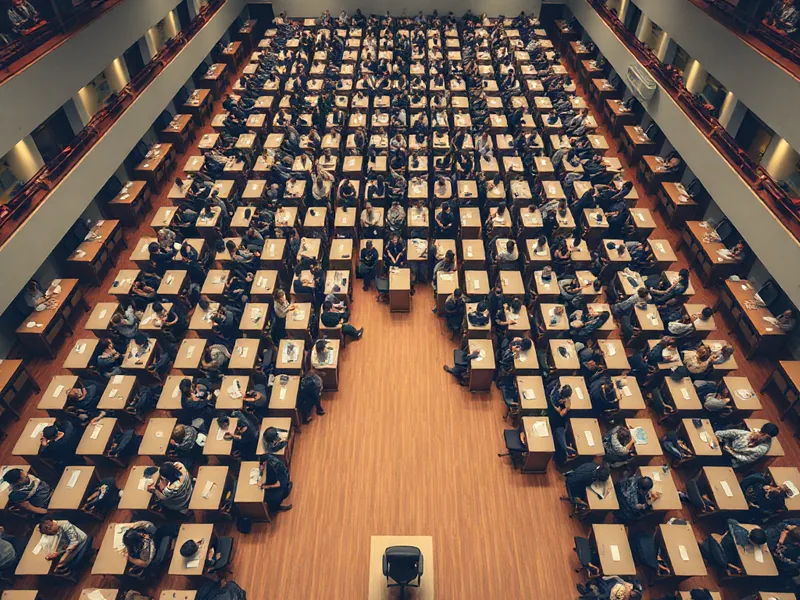
That's worth sitting with for a moment. When students in five or six different countries independently arrive at the same protest, using some of the same language, it tells you something about the scale of underinvestment that's been building across European education systems. This isn't a coincidence. It's a pattern.
The timing matters just as much as the geography. These protests are erupting right as several European governments face intense pressure to shrink their deficits, and borrowing costs climb higher, making existing debt more expensive to carry. France and Belgium are each running budget deficits above 5% of GDP this year, while Austria's sits above 4%, according to European Commission forecasts.
Governments squeezed by those numbers face brutal tradeoffs. Money spent on new teachers or renovated classrooms is money not spent somewhere else, and in a tightening fiscal environment, education budgets are often among the first places officials look to trim. Students and families are watching that math play out in real time, in the form of crowded classrooms and buildings that haven't seen meaningful investment in years.
It's a bit like a household trying to pay down a mortgage while the roof leaks. You can defer the repair for a while. Eventually, though, the leak becomes a flood, and the people living under that roof start demanding answers.
Set aside the politics for a second and think about what's actually at stake here. Education systems are supposed to be the mechanism by which societies invest in their own future, the infrastructure that turns children into capable, informed adults who can sustain an economy and a democracy. When that infrastructure visibly erodes, when students themselves are the ones sounding the alarm, it suggests the gap between what governments promise and what they deliver has grown too wide to ignore.
The human cost here isn't abstract. It's a teenager without a hand. It's thousands of minors swept up in arrests, many of them simply demonstrating for better-funded schools. It's university students in Dublin and Vienna worried about whether they'll be able to afford rent and tuition at the same time. These are real young people navigating real consequences of policy choices made in finance ministries far removed from their classrooms.
There's also a longer-term risk worth naming plainly. Governments that respond to education protests primarily with riot police and tear gas, rather than with budget reforms, risk deepening the very distrust that fuels further unrest. Suspending stun grenades, as France has now done, is a start. It's not a substitute for addressing the underlying funding gaps that brought students into the streets in the first place.
None of this guarantees a coordinated European youth movement is about to reshape education policy across the continent. The protests remain distinct, driven by local grievances and local politics. But the shared grammar of complaint, crowded classrooms, underfunded universities, rising costs, suggests these governments are facing a common structural problem that budget tightening alone won't solve. If the fiscal squeeze continues without real investment in schools and universities, this autumn's unrest may be remembered as the opening chapter, not the conclusion.
Tags
Original Sources
Student protest unrest spreads across Europe
↗ https://www.axios.com/2026/10/07/europe-student-protests-france-belgium
About the author
Amara's entry point into AI was an epidemiology role at a London research hospital, where she spent five years studying how digital health tools reached — or conspicuously failed to reach — underserved communities. Watching early algorithmic systems in healthcare quietly entrench existing inequalities, she redirected her career toward the systemic consequences of AI at scale. She covers AI through an unflinching lens: who benefits, who bears the cost, and what evidence actually says versus what the press release claims. Her writing is calm and precise, but she doesn't mistake balance for neutrality.
More from The Steward →This Week's Edition
9 October 2026
34 articles
Related Articles

Why Nurses Leave: It's Career Stage, Not Generation, Hospitals Need to Address
Job Market & Society · 5 min

New Survey Finds Women Far More Skeptical of AI Than Men, and the Gap Is Widening
Job Market & Society · 5 min

India's AI Data Centre Boom Runs Into Resistance From the Communities Living Beside It
Job Market & Society · 6 min
Related Articles
Why Nurses Leave: It's Career Stage, Not Generation, Hospitals Need to Address
Job Market & Society · 5 min
New Survey Finds Women Far More Skeptical of AI Than Men, and the Gap Is Widening
Job Market & Society · 5 min
India's AI Data Centre Boom Runs Into Resistance From the Communities Living Beside It
Job Market & Society · 6 min
More Stories
© 2026 Cedar & Bloom. All rights reserved.
