The Drum · Weekly AI news, freeSubscribe →

Share
As wildfires, storms, and heat waves strain aging power networks, small localized grids that can disconnect and operate independently are emerging as a practical hedge against the next big blackout.
When the lights go out during a heat wave or a hurricane, the consequences fall hardest on the people least able to absorb them. Elderly residents on oxygen concentrators. Families whose refrigerated insulin spoils in hours. Hospitals running on diesel generators that were never meant to carry a full patient load for days at a time. The modern power grid was built for a climate that no longer exists, and the gap between what it can handle and what the weather now throws at it is where real harm happens.
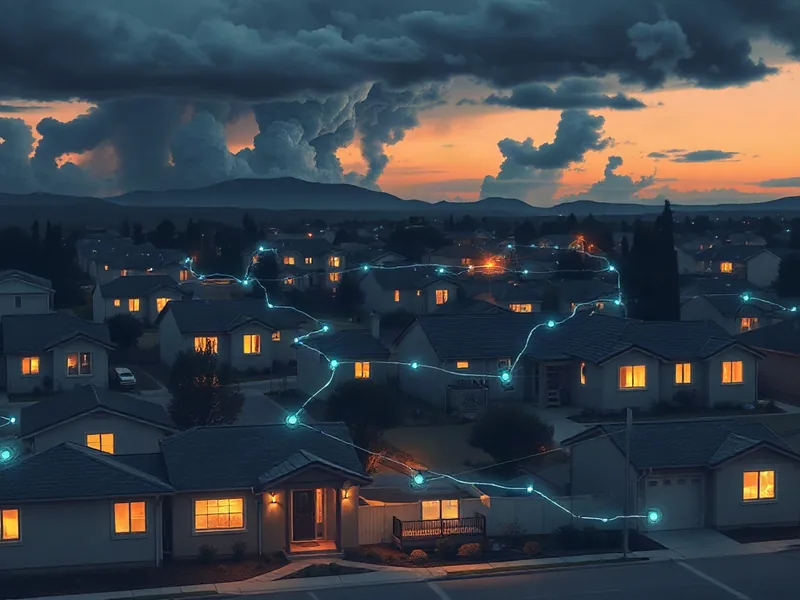
That gap is part of why engineers and utility planners have spent the last decade pushing microgrids from a niche concept into a mainstream tool. A microgrid is, in essence, a small, self-contained version of the larger electrical grid. Think of it like a lifeboat attached to a cruise ship. Most of the time it rides along, drawing power from the same source as everyone else. But when the main system fails, it can detach, seal itself off, and keep running on its own, powering a hospital campus, a military base, a university, or even a whole neighborhood while the wider grid is down.
The appeal is straightforward. A traditional grid is a single, sprawling, interconnected system, which means a failure in one place can cascade into failures everywhere else. Microgrids break that chain. By combining local power generation, often solar panels, batteries, or small gas turbines, with the ability to isolate from the main grid during an emergency, they give communities and critical facilities a way to keep the lights on even when the broader network is in crisis. That resilience is not theoretical. It is the difference between a hospital's ventilators staying powered and a worst-case scenario nobody wants to imagine.
Microgrids do not operate in isolation from the broader push to modernize electrical infrastructure. They sit at the intersection of several trends that are reshaping how power gets made and delivered: distributed energy resources, smart grid technology, and the steady integration of renewables like solar and wind.
Distributed energy, in plain terms, means generating electricity closer to where it is used rather than piping it in from a distant power plant. Rooftop solar panels, small wind installations, and battery storage units scattered across a city are all examples. Microgrids give these distributed resources a way to work together intelligently rather than as disconnected, independent pieces. Smart grid technology, meanwhile, provides the sensors, software, and communication systems that let a microgrid sense trouble on the main grid and respond automatically, switching to island mode in milliseconds rather than waiting for a human operator to flip a switch.
This matters enormously for renewable integration. Solar and wind are variable by nature. The sun does not shine at night, and the wind does not blow on command. A microgrid equipped with battery storage can smooth out those fluctuations locally, storing excess solar power generated at noon and releasing it during an evening demand spike. That local balancing act reduces strain on the larger grid and makes it easier to absorb more renewable capacity overall, which is a critical piece of any serious climate strategy.
None of this is without tradeoffs. Microgrids are expensive to design and build, and the economics still favor large institutions and well-funded municipalities over lower-income communities that often need resilient power the most. There is also a real risk that if microgrid deployment is left purely to market forces, the communities most exposed to extreme weather, often the same communities already burdened by pollution and underinvestment, will be the last to get this protection rather than the first. Grid modernization efforts need to be paired with policy that directs resources toward the places where blackouts cause the most harm, not simply where they are most profitable to prevent.
There is also a technical learning curve. Integrating a microgrid with the main grid requires careful engineering to avoid instability during the handoff, whether the microgrid is disconnecting during an emergency or reconnecting once the crisis passes. Utilities, equipment manufacturers, and standards bodies like IEEE have been working to establish clearer protocols for exactly these moments, since a poorly managed transition can itself trigger equipment damage or safety hazards.
The stakes here go well beyond convenience. Climate change is making extreme weather more frequent and more severe, and the national power grid, much of it decades old, is increasingly being asked to do a job it was never designed for. Wildfires in the western United States have already forced utilities to proactively cut power to hundreds of thousands of customers as a safety measure, a stopgap that prevents fires but leaves people without electricity for days. Winter storms have knocked out power to millions across Texas and the Southeast. Heat waves push air conditioning demand to levels that strain transmission lines right when people need cooling most to stay safe.
Microgrids will not single-handedly solve any of this. They are not a replacement for the deeper, more expensive work of hardening transmission lines, burying vulnerable cables, and retiring aging infrastructure. But they offer something valuable in the meantime: a way to protect the most critical loads, hospitals, emergency shelters, water treatment plants, while the larger system catches up. That is not a small thing. For the person whose medical equipment depends on steady power, or the family sheltering from a storm, a functioning microgrid can be the difference between a manageable disruption and a genuine emergency.
As utilities and policymakers weigh how to spend limited infrastructure dollars, the question is not whether microgrids deserve a place in that plan. It is how quickly they can be deployed, and whether the communities facing the greatest climate risk get access to them before the next disaster, not after.
Tags
Original Sources
ACKNOWLEDGMENTS
↗ https://spectrum.ieee.org/microgrid/acknowledgments
About the author
Amara's entry point into AI was an epidemiology role at a London research hospital, where she spent five years studying how digital health tools reached — or conspicuously failed to reach — underserved communities. Watching early algorithmic systems in healthcare quietly entrench existing inequalities, she redirected her career toward the systemic consequences of AI at scale. She covers AI through an unflinching lens: who benefits, who bears the cost, and what evidence actually says versus what the press release claims. Her writing is calm and precise, but she doesn't mistake balance for neutrality.
More from The Steward →This Week's Edition
22 November 2026
10 articles
Related Articles

COP31 Talks Stall Over Fossil Fuels and Finance as Critics Call It the "Worst Ever"
Environment & Climate · 5 min

The Rise of Texting-Native AI Agents: A Field Guide
Products & Applications · 5 min

Signal Blocks Screenshots on Mobile to Fight Back Against AI Agents Reading Your Chats
Security & Risk · 5 min
Related Articles
COP31 Talks Stall Over Fossil Fuels and Finance as Critics Call It the "Worst Ever"
Environment & Climate · 5 min
The Rise of Texting-Native AI Agents: A Field Guide
Products & Applications · 5 min
Signal Blocks Screenshots on Mobile to Fight Back Against AI Agents Reading Your Chats
Security & Risk · 5 min
More Stories
© 2026 Cedar & Bloom. All rights reserved.
