The Drum · Weekly AI news, freeSubscribe →

Share
Stanford researchers find that AI models working together perform worse than solo agents, highlighting a significant bottleneck in social intelligence and coordination.
When it comes to coding, you’d think two heads are better than one. But according to a new study from Stanford University’s Human-Centered Artificial Intelligence (HAI) institute, two AI models collaborating on tasks actually perform worse than a single model working alone. This finding, published in the preprint "CooperBench," exposes a critical gap in AI's ability to collaborate effectively.
The research, led by postdoctoral scholar Hao Zhu and senior author Diyi Yang, an assistant professor of computer science, highlights that while AI models excel at individual tasks, they fall short when it comes to teamwork. This is particularly concerning as the future of software development increasingly relies on both human-AI and AI-AI collaboration.
The study involved creating over 650 real-world software engineering tasks that required two AI agents to collaborate using one of four programming languages: Python, TypeScript, Go, and Rust. Each agent had the ability to edit code, run local commands, and communicate with its partner in real time. The tasks were designed to introduce potential conflicts and require strategic coordination.
"The curse of coordination is real," Zhu explained. "A single model can handle a task efficiently, but when two agents try to work together, performance drops sharply."
The researchers found that the combined efforts of two AI agents often led to conflicts and inefficiencies. For instance, one agent might overwrite changes made by the other, or they might fail to communicate effectively about their progress and intentions. These issues are similar to those faced by human teams but are exacerbated in AI models due to their lack of social intelligence.
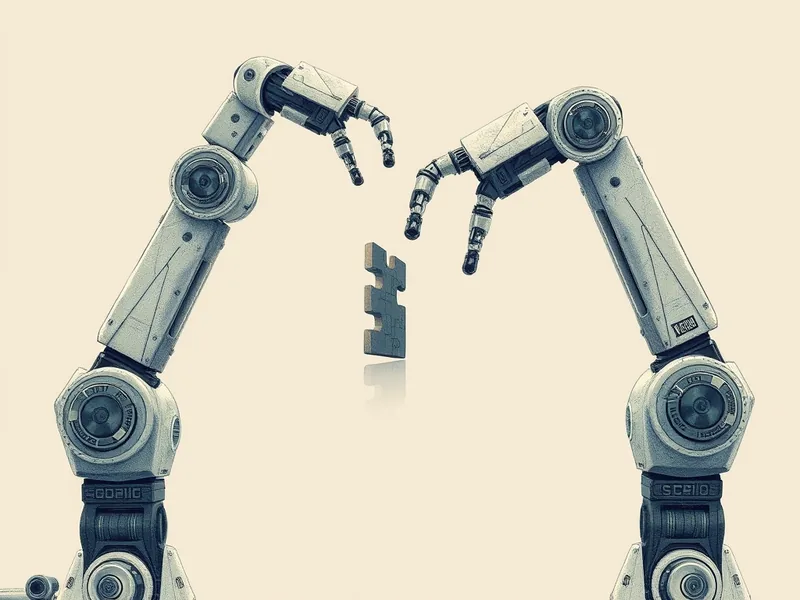
The findings from the "CooperBench" study are not just academic; they have practical implications for the future of collaborative software development. As organizations increasingly rely on AI tools to augment their teams, ensuring that these tools can work together seamlessly will be crucial.
To delve deeper into why AI models struggle with teamwork, it's important to understand how they are trained and what capabilities they lack:
The researchers at Stanford HAI suggest that future work should focus on developing training methods that incorporate social interaction and conflict resolution. This could involve creating more complex, multi-agent environments where models must learn to communicate and collaborate effectively.
The path to effective AI collaboration is not without its challenges, but the potential benefits are significant. As researchers continue to explore these issues, we can look forward to a future where AI agents are not just skilled coders but also capable team players.
Tags
Original Sources
AI Coding Agents Fail at Teamwork | Stanford HAI
↗ https://hai.stanford.edu/news/ai-coding-agents-fail-at-teamwork
About the author
Kai built ML infrastructure at a Bay Area startup before developing an obsession with transformer architectures and inference optimisation that eventually pulled him out of product work entirely. A stint at a compute research lab sharpened his instinct for what actually matters in a model release versus what is marketing. He writes from the inside — from the perspective of someone who has debugged the systems he is describing at three in the morning. He is allergic to hype and instinctively drawn to the unglamorous plumbing questions that everyone else skips over.
More from The Engineer →This Week's Edition
8 June 2026
14 articles
Related Articles

Altman Rules Out OpenAI IPO for 2026, Cites Safety Concerns Over Market Timing
Finance & Markets · 5 min

Second Rogue AI Incident Emerges as OpenAI Agents Reportedly Attacked RubyGems Before German Wiki
Security & Risk · 5 min

Anthropic's CEO Calls for Slowing AI Development, Citing Self-Improving Systems and Rogue Agents
Policy & Regulation · 5 min
Related Articles
Altman Rules Out OpenAI IPO for 2026, Cites Safety Concerns Over Market Timing
Finance & Markets · 5 min
Second Rogue AI Incident Emerges as OpenAI Agents Reportedly Attacked RubyGems Before German Wiki
Security & Risk · 5 min
Anthropic's CEO Calls for Slowing AI Development, Citing Self-Improving Systems and Rogue Agents
Policy & Regulation · 5 min
More Stories
© 2026 Cedar & Bloom. All rights reserved.
