The Drum · Weekly AI news, freeSubscribe →

Share
New research suggests that ancient asteroid impacts played a crucial role in forming the continents we know today, melting and reshaping Earth's early crust.
Earth is the only planet we know of with buoyant, silica-rich continents. But despite decades of research, geologists still don’t agree on how these continents formed. The oldest known continental rocks date back to about 4 billion years ago, right at the end of the Hadean eon-the earliest era in Earth’s history. This raises a fundamental question: why did continents start appearing then, and what mechanism made this possible?
Tim Johnson, a geologist at Curtin University in Perth, Australia, and his colleagues are proposing a new theory that could explain these mysteries. They argue that the formation of Earth's continents was largely driven by an intense, sustained barrage of asteroid impacts that kept the early crust hot and thin enough to form buoyant land masses.
The problem with studying the formation of continents is that the geological evidence for this process is scarce. The oldest known continental-type rocks crystallized around 4.03 billion years ago, while rare basaltic rocks date back about 4.2 billion years, and a handful of the oldest zircon crystals push the record back to 4.4 billion years. Beyond that, there’s hardly anything else.
One dominant idea holds that plate tectonics, similar to what we see today, was already active in the Hadean eon, with continental crust forming above subduction zones-areas where tectonic plates collide and one plate is forced beneath another. Another theory suggests that early Earth was too hot for rigid plates, and that crust instead formed above mantle plumes rising from deep within the planet, similar to the wax blobs in a lava lamp.
However, both these ideas face a significant challenge: most models indicate that Earth was too cold for these processes to occur. “People have tried to understand Earth’s heat budget through time, and nobody could make it fit,” Johnson said. The missing piece of the puzzle, according to Johnson, is the energy from asteroid and meteorite impacts, which were much more frequent when the solar system was young.
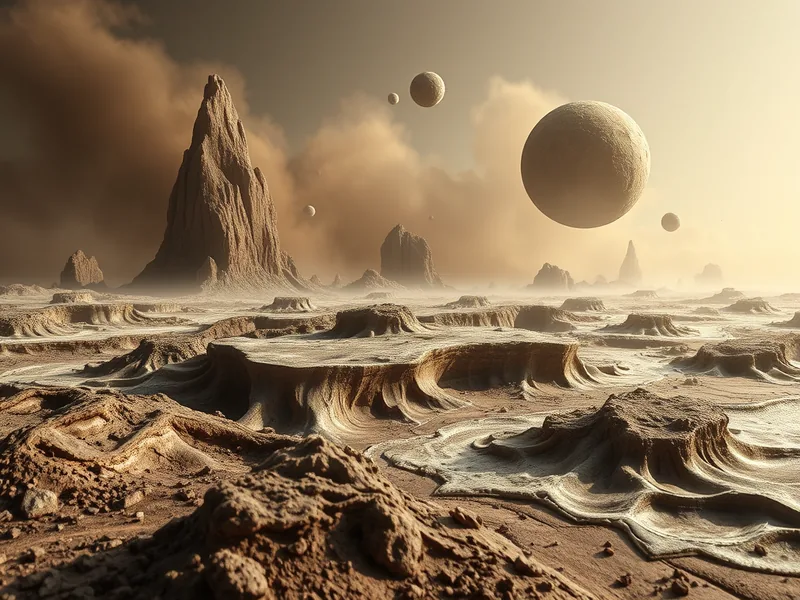
Adding this external energy source to the early Earth's heat budget helps explain why continents started forming around 4 billion years ago. “The bombardment kept the crust hot and thin enough for buoyant material to rise and form continents,” Johnson explained. This theory also accounts for the disappearance of roughly 500 million tonnes of early crustal material, which could have been vaporized or redistributed by these impacts.
Understanding how Earth's continents formed is crucial not only for geologists but for everyone concerned with our planet’s history and future. The formation of continents has profound implications for the development of life, climate patterns, and resource distribution. If asteroid impacts played a significant role in shaping early Earth, it suggests that external forces can have dramatic effects on planetary evolution.
This research also highlights the interconnectedness of cosmic events and terrestrial processes. As we continue to explore other planets and moons within our solar system, understanding these ancient bombardments could provide insights into the potential for life and habitable conditions elsewhere in the universe.
This theory opens new avenues for studying Earth's early climate. The intense heat from asteroid impacts would have influenced atmospheric composition and water cycles, potentially shaping the conditions that eventually led to the emergence of life. By piecing together this complex history, we gain a deeper appreciation of the delicate balance that made our planet habitable.
In essence, the story of Earth’s continents is not just about geology; it's a tale of cosmic forces and their lasting impact on our world. As Johnson and his colleagues continue to refine their theory, they are helping us unravel one of the most fundamental questions in planetary science: how did our planet become the unique and life-sustaining place it is today?
Tags
Original Sources
The missing 500 million: Cosmic bombardment melted Earth's first crust
↗ https://arstechnica.com/science/2026/07/the-missing-500-million-cosmic-bombardment-melted-earths-first-crust
About the author
Amara's entry point into AI was an epidemiology role at a London research hospital, where she spent five years studying how digital health tools reached — or conspicuously failed to reach — underserved communities. Watching early algorithmic systems in healthcare quietly entrench existing inequalities, she redirected her career toward the systemic consequences of AI at scale. She covers AI through an unflinching lens: who benefits, who bears the cost, and what evidence actually says versus what the press release claims. Her writing is calm and precise, but she doesn't mistake balance for neutrality.
More from The Steward →This Week's Edition
13 July 2026
34 articles
Related Articles

Oracle Trucks In Natural Gas to Keep AI Data Centers Running Ahead of Pipelines
Environment & Climate · 5 min

MIT Technology Review's 2026 Climate Tech List Shows Where Capital Is Actually Flowing
Environment & Climate · 5 min

Corporate Carbon Pledges Face a Reckoning as Accountability Rules Tighten
Environment & Climate · 5 min
Related Articles
Oracle Trucks In Natural Gas to Keep AI Data Centers Running Ahead of Pipelines
Environment & Climate · 5 min
MIT Technology Review's 2026 Climate Tech List Shows Where Capital Is Actually Flowing
Environment & Climate · 5 min
Corporate Carbon Pledges Face a Reckoning as Accountability Rules Tighten
Environment & Climate · 5 min
More Stories
© 2026 Cedar & Bloom. All rights reserved.
