The Drum · Weekly AI news, freeSubscribe →

Share
A behind-the-scenes look at Digi-Key's Thief River Falls operation shows why electronics distribution has become a logistics arms race, and what that means for component makers and buyers alike.
Electronics distribution rarely makes headlines. It should. The margins are thin, the inventory is enormous, and the operational complexity rivals any consumer logistics business. A recent IEEE Spectrum feature pulling back the curtain on Digi-Key's day-to-day operations underscores just how much infrastructure sits between a chip designer's schematic and a working prototype.
Digi-Key, based in Thief River Falls, Minnesota, is one of the largest electronic component distributors in the world. The company stocks millions of parts from thousands of manufacturers, and its business model depends on being able to ship even single-unit orders quickly and accurately. That sounds simple. It is not.
The scale involved is the real story here. Warehousing, sorting, and shipping components that range from tiny passive resistors to bulky industrial modules requires a level of automation and precision that few outside the supply chain world appreciate. Engineers building prototypes or scaling production runs rely on this infrastructure without ever seeing it, and that invisibility is precisely why it matters.
Component distributors sit at a critical chokepoint in the electronics supply chain. When semiconductor shortages hit in 2021 and 2022, the world got a crash course in how fragile this chokepoint can be. Lead times stretched from weeks to over a year for some parts, and companies that had never thought about distributor relationships suddenly found themselves rationing chips or redesigning products around whatever was available.
Digi-Key's operational model, built around massive on-hand inventory and rapid fulfillment, is a direct response to that fragility. Holding broad stock across thousands of SKUs is expensive. It ties up working capital and requires forecasting demand across product categories that can shift overnight based on a single design win at a major OEM. But the alternative, just-in-time ordering with minimal buffer, proved catastrophically brittle during the pandemic-era shortages.
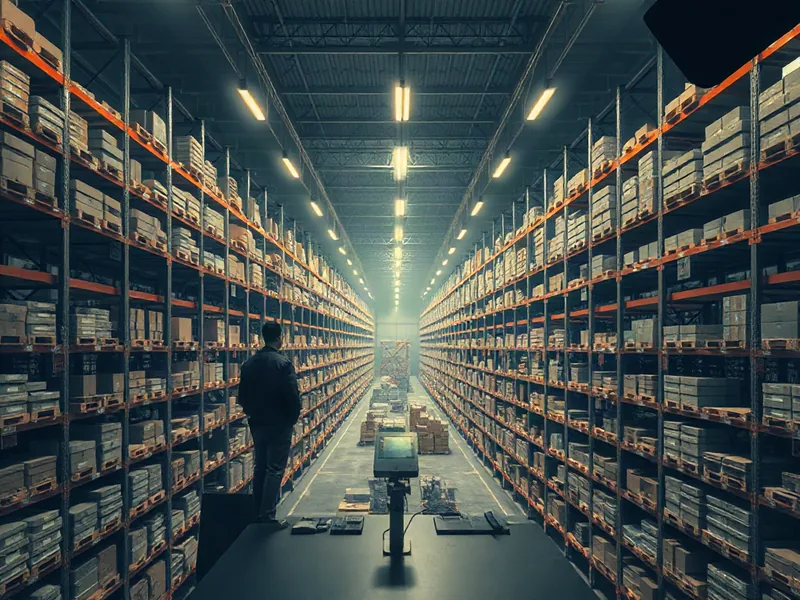
The company's approach reflects a broader shift in how distributors think about risk. Rather than optimizing purely for cost efficiency, firms like Digi-Key are increasingly optimizing for resilience: diversified supplier relationships, deep inventory buffers, and automated fulfillment systems that can scale with demand spikes. That shift has real cost implications, and those costs eventually flow through to component pricing and availability for the engineers and companies that depend on this network.
Industrial automation plays a central role in making this model viable. Sorting and shipping millions of discrete parts by hand would be impossibly slow and error-prone at Digi-Key's scale. Automated picking systems, conveyor networks, and inventory tracking software are what allow the company to promise same-day shipping on orders that might include a handful of resistors alongside a specialized sensor module. This is not glamorous technology, but it is foundational to keeping the broader electronics industry moving.
The lesson from Digi-Key's operations is one that applies well beyond one company's warehouse floor. Supply chain resilience is not free, and it is not automatic. It requires sustained investment in inventory, automation, and logistics infrastructure that pays off precisely when things go wrong elsewhere in the chain.
For investors and industry watchers, the takeaway is straightforward. Distribution and logistics capacity in electronics is a competitive moat, not a commodity function. Companies that under-invest in this layer of the supply chain are the ones that get caught flat-footed during the next shortage cycle, whatever triggers it. Those that treat distribution infrastructure as a strategic asset, the way Digi-Key appears to, are better positioned to weather volatility and capture demand when competitors cannot deliver.
The semiconductor shortage taught the industry a hard lesson about fragility. Digi-Key's operational model is a reminder that the fix is not glamorous. It is inventory discipline, automation investment, and operational rigor applied consistently over years, not a single clever fix. That is a less exciting story than the next chip architecture breakthrough, but it is arguably just as important to whether new hardware actually ships on time.
Tags
Original Sources
Slideshow: A Day in the Life of Digi-Key
↗ https://spectrum.ieee.org/slideshow-a-day-in-the-life-of-digikey/particle-5?itm_source=summaries&itm_medium=ieee-spectrum&itm_campaign=summary-particle-5&itm_content=summary-challenges
About the author
Marcus began tracking AI's market implications in 2016, noticing AI-related patent filings accelerating ahead of earnings upgrades before most of the sell-side had caught on. A former fixed-income quantitative analyst, he spent two decades building models that priced risk across emerging markets before pivoting to cover the economic impact of AI full-time. His writing translates opaque technical developments into clear risk/reward terms — and he's rarely diplomatic about the gap between AI valuations and underlying fundamentals. He believes most market participants still underestimate AI's long-run deflationary effect on knowledge work.
More from The Analyst →This Week's Edition
5 September 2026
24 articles
Related Articles

xAI Launches Grok Bot, an Autonomous Agent That Logs Into Your Tools and Does the Work
Products & Applications · 5 min

Robotics Experts Pour Cold Water on Tesla's Optimus Debut
Products & Applications · 5 min

Replit Swaps Anthropic for OpenAI as Default Model, Muddying a Lucrative Partnership
Products & Applications · 5 min
Related Articles
xAI Launches Grok Bot, an Autonomous Agent That Logs Into Your Tools and Does the Work
Products & Applications · 5 min
Robotics Experts Pour Cold Water on Tesla's Optimus Debut
Products & Applications · 5 min
Replit Swaps Anthropic for OpenAI as Default Model, Muddying a Lucrative Partnership
Products & Applications · 5 min
More Stories
© 2026 Cedar & Bloom. All rights reserved.
