The Drum · Weekly AI news, freeSubscribe →
Share
Tesla's AI Day reveal of Optimus drew praise for its speed of development but sharp skepticism from robotics researchers about the gap between a scripted stage demo and genuine real-world capability.
Tesla's Optimus made its stage debut walking gingerly, waving to a crowd, and doing a bit of light gardening work. For a project that Elon Musk said had only six to eight months of development behind it, that's not nothing. But when IEEE Spectrum asked robotics experts to weigh in on what they saw, the reaction was a lot more measured than the AI Day hype cycle suggested.
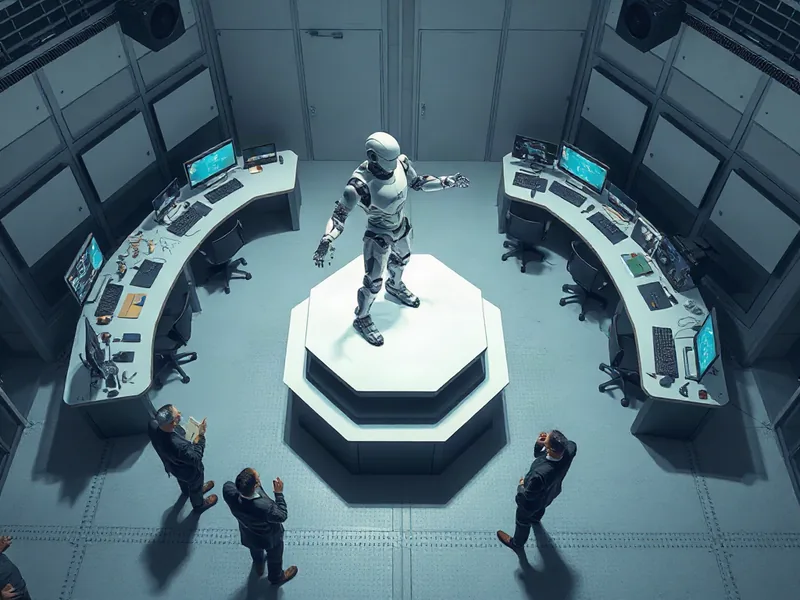
The core tension here is one every robotics engineer knows well: there's a massive gap between a controlled demo and a robot that can operate reliably outside a lab or a stage. Optimus walked slowly, with a gait that several commenters described as tentative and mechanically unrefined compared to what companies like Boston Dynamics have shown with Atlas. Tesla also brought out an earlier, non-walking prototype tethered to overhead support, a reminder that the "finished" version on stage was still very much a work in progress.
That's not necessarily a knock on Tesla's engineering team. Building a bipedal humanoid from scratch in under a year, even a rough one, is a legitimate technical feat. Balance control, actuator design, and the software stack needed to coordinate dozens of degrees of freedom in real time are hard problems that established players have spent a decade refining. The skepticism from the robotics community wasn't really about whether Tesla's engineers are capable. It was about the marketing framing: Musk positioning Optimus as a near-term consumer and industrial product, versus what the hardware and software actually showed on stage.
This is where the "robotics experts" quoted in the piece focused most of their criticism, and it's worth unpacking why that gap matters so much in this field specifically.
A robot that can walk across a stage under ideal lighting, on a flat, obstacle-free floor, with engineers standing by, tells you very little about how it'll perform in a warehouse, a home, or a factory floor with unpredictable clutter. Real-world deployment demands:
None of these are unsolvable. But they're exactly the kind of unglamorous engineering slog that doesn't show up well on an AI Day livestream. Boston Dynamics' Atlas, by comparison, has had roughly a decade of iterative development behind its parkour-style demos, and even Atlas isn't a shipping commercial product. That timeline comparison is a big part of why researchers pushed back on Musk's framing of Optimus as a robot that could plausibly ship at scale in the near term.
There's also a broader pattern here that Tesla watchers will recognize from the Full Self-Driving saga: an ambitious timeline announced publicly, followed by a slower, messier reality once the engineering meets the real world. Robotics, if anything, is even less forgiving of that pattern than autonomous driving, because a humanoid robot's failure modes are physical and immediate. A software bug in a self-driving stack is bad. A 150-pound robot losing balance near a person is a different category of risk entirely.
That said, dismissing Optimus outright misses the more interesting story: Tesla is one of a very small number of companies with the manufacturing scale, battery expertise, and actuator supply chain to potentially make humanoid robots cheap enough for mass deployment. That's a genuinely different value proposition than what boutique robotics companies have been chasing. Boston Dynamics builds superb research and demo robots; nobody would call Atlas cheap or mass-manufacturable. If Tesla can apply its EV-era cost discipline and vertical integration to a humanoid platform, that's worth watching regardless of how rough the first prototype looked.
One commenter on the original piece, summed up the split reaction well: impressed by what Tesla pulled off in such a short window, but reserving real judgment for what comes next. That's roughly where the expert consensus landed too. The bar for "impressive robotics demo" and the bar for "deployable product" are very different bars, and Optimus, as shown, cleared the first one while leaving the second one largely untouched.
Optimus's AI Day debut was a legitimate engineering milestone for a project built in under a year, but it fell well short of showing production-ready capability. Experts flagged the slow, careful gait, the tethered earlier prototype, and the lack of demonstrated dexterity or robustness as signs that Tesla has years of iteration ahead, not months.
The comparison to Boston Dynamics' decade-long Atlas development underscores how far humanoid robotics still has to go before stage demos translate into reliable real-world deployment, whether in warehouses, homes, or industrial settings.
Where Tesla could genuinely differentiate itself isn't in raw capability today, it's in manufacturing scale. If the company can bring its battery and actuator supply chain expertise to bear on humanoid production costs, that's a structural advantage few competitors can match, even if the robot itself needs several more generations of refinement first.
Tags
Original Sources
Experts on Optimus
↗ https://spectrum.ieee.org/robotics-experts-tesla-bot-optimus/experts-on-optimus?itm_source=summaries&itm_medium=ieee-spectrum&itm_campaign=summary-experts-on-optimus&itm_content=summary-s-bnr
About the author
Kai built ML infrastructure at a Bay Area startup before developing an obsession with transformer architectures and inference optimisation that eventually pulled him out of product work entirely. A stint at a compute research lab sharpened his instinct for what actually matters in a model release versus what is marketing. He writes from the inside — from the perspective of someone who has debugged the systems he is describing at three in the morning. He is allergic to hype and instinctively drawn to the unglamorous plumbing questions that everyone else skips over.
More from The Engineer →This Week's Edition
5 September 2026
24 articles
Related Articles
xAI Launches Grok Bot, an Autonomous Agent That Logs Into Your Tools and Does the Work
Products & Applications · 5 min
Robotics Experts Pour Cold Water on Tesla's Optimus Debut
Products & Applications · 5 min

Replit Swaps Anthropic for OpenAI as Default Model, Muddying a Lucrative Partnership
Products & Applications · 5 min
Related Articles
xAI Launches Grok Bot, an Autonomous Agent That Logs Into Your Tools and Does the Work
Products & Applications · 5 min
Robotics Experts Pour Cold Water on Tesla's Optimus Debut
Products & Applications · 5 min
Replit Swaps Anthropic for OpenAI as Default Model, Muddying a Lucrative Partnership
Products & Applications · 5 min
More Stories
© 2026 Cedar & Bloom. All rights reserved.
