The Drum · Weekly AI news, freeSubscribe →

Share
Project Suncatcher's debut inference run cost fractions of a cent in compute, but the satellite itself is a multimillion-dollar bet on whether orbital datacenters can ever make economic sense.
Google's first experimental orbital AI datacenter satellite just hit a milestone that's equal parts adorable and absurd: it wrote a haiku from space.
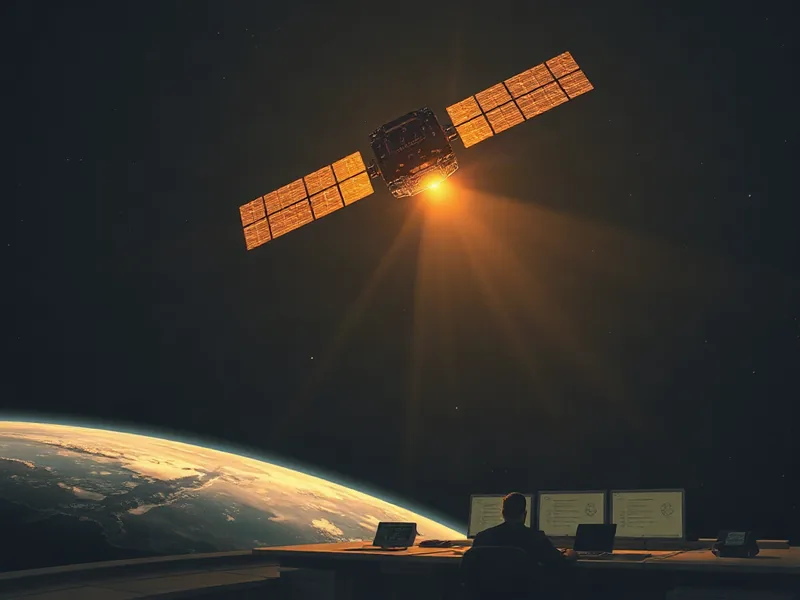
The satellite, part of Google's Project Suncatcher, launched at the start of October and settled into low Earth orbit. Engineers uplinked a prompt during a ground-station pass, asking the onboard Gemma 4 model to "write a haiku from the perspective of a TPU orbiting Earth, with the wonderful world spinning beneath you." As the satellite passed over Svalbard, Norway, it beamed back a response over the downlink:
Blue marble below, Data streams in silent grace, Starlight feeds my core.
Travis Beals, senior director of Google's Paradigms of Intelligence research team, called it a "Hello World" moment for the project. Suncatcher's host and TPU trays were powered up, the machine learning tests were done, and the model successfully ran inference in orbit. That's the headline achievement here: running a real TPU workload on hardware that's currently circling the planet at orbital velocity.
Here's the fun part. That haiku, roughly 20 tokens, would cost about $0.000012 if generated through Google Cloud's API, based on Gemma 4 26B's published pricing of $0.15 per million input tokens and $0.60 per million output tokens (ignoring input costs for the prompt itself). Tack on a satellite weighing somewhere around 500 kg, going by the mass of SpaceX's Starlink satellites, and a retail launch price of roughly $7,000 per kg, and you've got what might be the most expensive haiku ever written. Somewhere between a few bucks and several million dollars, depending on how you want to amortize the hardware.
That gap between token cost and launch cost is exactly the problem Project Suncatcher is trying to solve. Google isn't doing this for the poetry. It's testing whether space-based compute could ever be economically competitive with terrestrial datacenters, and whether solar power in orbit (constant sunlight, no atmosphere, no weather) could offset the brutal cost of getting hardware up there in the first place.
Google laid out its reasoning in a paper published this month. The company's math: if launch costs can be driven down to $200/kg, the amortized launch cost over a satellite's useful life works out to roughly $810 to $7,500 per kW per year. That's comparable to what US terrestrial datacenters currently spend on electricity, somewhere in the $570 to $3,000 per kW per year range.
The catch is that $200/kg launch pricing doesn't exist yet. Google is betting SpaceX gets there by around 2035, following the trajectory of reusable rocket costs over the past decade. That's a long runway, and Google is explicit that the point of flying hardware now is to get ahead of the curve, not to wait until the economics pencil out and then scramble to catch up.
Beyond the cost curve, there's the radiation problem. Space is a genuinely hostile environment for silicon, and Google has been running its Trillium Cloud TPU and an AMD host server through ground-based radiation testing to see how they hold up. They fired a 67 MeV proton beam at the hardware to simulate the kind of ionizing radiation and single-event effects (SEEs, basically random bit flips caused by a stray particle hitting a transistor) that chips experience in orbit.
The weak point turned out to be high-bandwidth memory (HBM). It starts showing irregularities after a cumulative total ionizing dose of 2 krad(Si), which sounds fine until you realize that's only about 3x Google's minimum requirement for surviving at 750 rad(Si). Not an enormous safety margin, but workable.
For inference workloads specifically, the numbers look encouraging. Google's researchers found a silent data corruption rate of about one event per 17 rad. At an estimated orbital dose of 150 rad(Si) per year, that works out to a failure probability of roughly 1 in 3 million inferences, assuming one inference per second. For a model just spitting out haikus and status pings, that's a perfectly tolerable error rate.
Training is a different story. Google's own paper flags that the impact of radiation-induced errors on training jobs, and whether system-level mitigations can catch and correct them, "requires further study." Inference is forgiving: get one token wrong and the output is still mostly fine. Training is not; a corrupted gradient can quietly poison a model over thousands of steps, and catching that kind of error in orbit, with no easy hardware swap, is a much harder engineering problem than radiation-hardening a chip for occasional inference.
After the haiku, the team moved on to testing space-themed limericks and telemetry prompts that report on the payload's technical status, according to Beals. Next on the roadmap: more rigorous thermal stress and radiation testing, plus a 2027 plan to fly a pair of interconnected satellites to test inter-satellite communication. Google's longer-term vision isn't a handful of massive orbital datacenters, it's a constellation of smaller satellites that talk to each other, spreading the compute load across many nodes rather than concentrating it in one expensive, hard-to-service package.
Project Suncatcher's haiku moment is a genuine technical milestone: a TPU running real inference workloads in orbit for the first time. But the economics still don't work, not even close, at current launch prices. Google's bet hinges on SpaceX hitting $200/kg launch costs by around 2035, and on radiation-hardened hardware proving reliable enough for sustained use. The inference error rate (roughly 1 in 3 million) looks solid. Training in orbit remains an open question, and probably the harder problem to solve. For now, Google is flying hardware years ahead of the economics catching up, treating the whole project as a long-term hedge rather than a near-term product.
Tags
Original Sources
Google's AI satellite sends a very expensive haiku to Earth
↗ https://www.theregister.com/ai-and-ml/2026/10/31/googles-ai-satellite-sends-a-very-expensive-haiku-to-earth/5306818
About the author
Kai built ML infrastructure at a Bay Area startup before developing an obsession with transformer architectures and inference optimisation that eventually pulled him out of product work entirely. A stint at a compute research lab sharpened his instinct for what actually matters in a model release versus what is marketing. He writes from the inside — from the perspective of someone who has debugged the systems he is describing at three in the morning. He is allergic to hype and instinctively drawn to the unglamorous plumbing questions that everyone else skips over.
More from The Engineer →This Week's Edition
1 November 2026
21 articles
Related Articles
Related Articles
More Stories
© 2026 Cedar & Bloom. All rights reserved.