The Drum · Weekly AI news, freeSubscribe →

Share
Meta is quietly prototyping humanoid hardware with Fourier Intelligence, a Shanghai-based robotics startup, according to a new report. If confirmed, it signals a notable shift in how US tech giants are sourcing robot bodies.
Meta has built a prototype humanoid robot in partnership with Chinese startup Fourier Intelligence and is already working on a second version, according to a report from The Information published Saturday, which cited people familiar with the initiative. Reuters said it could not independently verify the report.
Details are thin so far. Neither Meta nor Fourier has issued a public statement confirming the partnership, the scope of the work, or a timeline for when any resulting hardware might see daylight. But the core claim is notable on its own: one of the world's largest AI labs is reportedly leaning on a Chinese robotics manufacturer to build physical hardware, at a moment when the US and China are locked in an increasingly tense tech rivalry.
Fourier Intelligence isn't a household name outside robotics circles, but it's been building a track record. The company has shipped humanoid platforms like its GR-1 and GR-2 models, pitched largely at research institutions, rehabilitation, and industrial pilot programs. It's one of a wave of Chinese firms, alongside names like Unitree and UBTech, that have moved fast on humanoid form factors while US competitors have mostly stuck to software and simulation.
That's the interesting wrinkle here. Meta has poured enormous resources into AI research, from large language models to its Reality Labs hardware division, but it hasn't historically been known as a robotics hardware player. Building a humanoid robot from scratch, actuators, joints, sensors, balance control, is a different discipline than training a model. It makes sense that a company looking to move quickly would partner with someone who's already solved a lot of those mechanical problems.
Humanoid robotics has split into two camps over the last couple of years. One camp, dominated by US firms like Figure and Tesla's Optimus team, is building both the body and the brain in-house, betting that vertical integration pays off in tighter iteration loops. The other camp treats the physical robot more like commodity hardware, something you can source externally while focusing your own R&D on the control software, perception stack, and foundation models that actually make the thing useful.
If the report is accurate, Meta appears to be leaning toward the second camp, at least for now.
That's a pragmatic bet. Building a reliable humanoid chassis, one that can walk, balance, grip objects, and survive repeated testing, takes years of mechanical engineering most AI labs simply haven't done. Sourcing that from a specialist lets Meta focus its own engineering effort on what it's presumably better at: the software layer that turns a walking frame into something that can actually follow instructions, navigate a room, or manipulate objects.
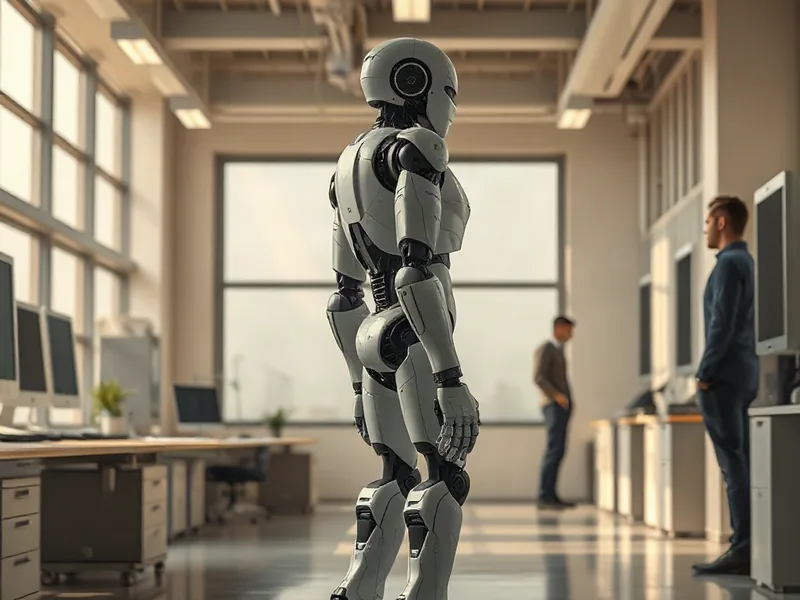
That last point isn't trivial. Washington has tightened export controls on AI chips and some robotics components heading into China, and there's been growing political scrutiny of US tech firms' ties to Chinese manufacturers. A reported hardware partnership with a Chinese robotics company, even one framed purely as R&D, is the kind of detail that tends to draw attention from lawmakers and competitors alike.
It's also worth remembering this is still prototype-stage work, based on a single report citing anonymous sources. The Information's story doesn't specify what the robot is meant to do, whether it's aimed at consumer applications, research, or something tied to Meta's broader AI agent ambitions. Meta has talked up "world models" and embodied AI research before, including work out of its FAIR research group, so a humanoid testbed wouldn't be a huge departure from where its research priorities have been heading. But a prototype built with an outside manufacturer is a long way from a shipping product.
Context matters here too. Humanoid robotics has become one of the most crowded and well-funded corners of the AI hardware world over the past two years. Companies ranging from Boston Dynamics to newer entrants like Figure AI and 1X have all pushed out demo videos showing robots folding laundry, sorting packages, or walking through warehouses. Investors have piled billions into the space, partly on the bet that general-purpose humanoid robots, rather than task-specific industrial arms, will end up being the dominant form factor for physical AI.
Meta entering that race, even quietly and through a partnership rather than a from-scratch build, would be a meaningful signal. The company has the AI research depth, the compute, and the capital to move fast if it decides humanoid robotics is a strategic priority rather than a side experiment.
The report, if confirmed, would mark Meta's first known move into physical humanoid hardware, and a notable one given the partner involved. A few things worth watching:
For now, there's a single report and no confirmation from either party. But the shape of the story, a major US AI lab reportedly turning to Chinese hardware expertise to build its first robot, is exactly the kind of development that's likely to get louder, not quieter, in the months ahead.
Tags
Original Sources
Meta builds humanoid robot with Chinese startup Fourier, The Information says
↗ https://www.reuters.com/world/china/meta-builds-humanoid-robot-with-chinese-startup-fourier-information-says-2026-10-31
About the author
Kai built ML infrastructure at a Bay Area startup before developing an obsession with transformer architectures and inference optimisation that eventually pulled him out of product work entirely. A stint at a compute research lab sharpened his instinct for what actually matters in a model release versus what is marketing. He writes from the inside — from the perspective of someone who has debugged the systems he is describing at three in the morning. He is allergic to hype and instinctively drawn to the unglamorous plumbing questions that everyone else skips over.
More from The Engineer →This Week's Edition
1 November 2026
21 articles
Related Articles
Related Articles
More Stories
© 2026 Cedar & Bloom. All rights reserved.