The Drum · Weekly AI news, freeSubscribe →

Share
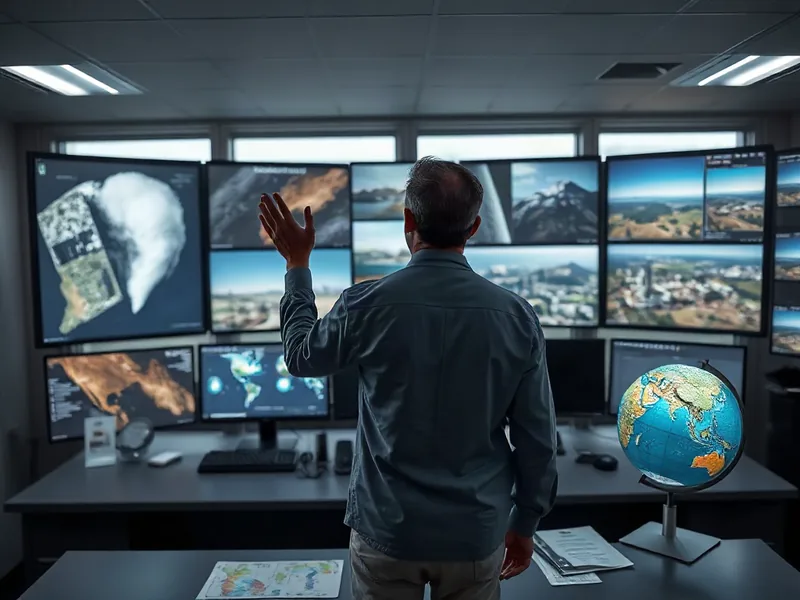
From forecasting hurricanes to spotting methane leaks from space, artificial intelligence is reshaping climate science. Ten experts told Carbon Brief where the technology delivers, and where it risks misleading the very people trying to understand a warming planet.
If you've checked a weather app in the last year, you've probably already relied on artificial intelligence without knowing it. That quiet shift, happening inside supercomputers and research labs around the world, is now reaching into some of the hardest questions in climate science: how fast will the Arctic melt, where is methane leaking unseen, and how do we keep the power grid stable as it fills up with wind and solar.
Climate change can feel like an abstraction until you remember it's made of very concrete things: flood maps, crop yields, insurance premiums, the air your kids breathe. Getting those details right matters enormously, and increasingly, AI is part of how scientists get there. But the tool comes with real tradeoffs, and the researchers using it are the first to say so.
Think of AI weather models like a student who has memorized thousands of past exams. Feed them enough historical weather data, and they get remarkably good at predicting what comes next, sometimes for up to two weeks. Dr Doug McNeall, science lead in data-driven climate modelling at the UK Met Office, says these models have proven they can match the accuracy of traditional physics-based forecasts while using far less computing power.
That's a genuine breakthrough. The European Centre for Medium-Range Weather Forecasts has already made an AI forecast system part of its official public forecasting, running it alongside the traditional numerical model. Prof William Collins, professor of AI for climate science at the University of East Anglia, calls the AI systems "absolutely competitive" with the world's leading weather prediction tools, a result he describes as "quite remarkable."
Here is the catch, and it's a big one. Weather forecasting works because we have decades of observational data to train the models on. Climate prediction asks a fundamentally different question: what will the world look like in a future we have never observed?
"Climate represents a future for which we do not have data," Collins explains. "We're literally trying to predict the future. We don't have observations of it." That's the central challenge the climate research community is wrestling with right now.
One proposed fix is a hybrid approach: use AI not to replace physics-based models outright, but to speed them up or fill in gaps, while keeping the scientific grounding that gives climate projections their credibility. McNeall argues this blended method could make climate risk information "far more accessible and affordable to produce" without sacrificing the trust built into traditional modelling.
There's also a gap when it comes to extremes. Dr Amirpasha Mozaffari, a researcher in Earth artificial intelligence at the Barcelona Supercomputing Centre, notes that AI forecasting models perform well on typical weather but underperform physics-based models on record-breaking events, which happen to be exactly the scenarios that matter most for adaptation planning. Solving that, he says, through hybrid models, physics-based constraints, or new ways of testing models against the unknown, is "the central open problem for the field."
Beyond forecasting, AI is proving useful wherever there's too much data for humans to sort through alone. Dr Stefano Materia, a researcher in climate variability and change at the Barcelona Supercomputing Centre, points to the explosion of satellite imagery now flowing in from Earth-observation missions. Methane, a greenhouse gas far more potent than carbon dioxide in the short term, is notoriously hard to track because leaks are invisible to the naked eye. AI algorithms now scan hyperspectral satellite imagery, which captures data across the electromagnetic spectrum, to pinpoint industrial methane leaks globally and alert operators in near real-time. The same approach helps machine-learning models flag illegal logging, land-use changes, and glacier retreat, processing thousands of images a day, far faster than any team of analysts could manage by hand.
Polar science has its own success story. Dr Clare Eayrs, a polar research scientist at New York University, says machine learning now touches nearly every step of sea ice research, from extracting fine detail out of ship radar data to classifying snow layers in field measurements. IceNet, an early sea ice forecasting system, demonstrated that a deep-learning approach could actually outperform a leading physics-based model in seasonal Arctic forecasts, a notable moment for a field long dominated by traditional modelling.
The pace of change is itself remarkable. Mozaffari says new machine-learning techniques used to take two or three years to migrate from the broader AI research community into weather and climate science. Now it happens in months. Diffusion models, foundation models, and generative ensembles, tools developed elsewhere in the AI world, are landing in climate labs almost as soon as they're invented. Meanwhile, the cost of running a global forecast has dropped by orders of magnitude, which, as Mozaffari puts it, "changes who can produce weather and climate information at all."
AI is also starting to shape energy policy on the ground. Prof Priya Donti, an assistant professor at MIT and co-founder of Climate Change AI, explains that as more solar and wind power flow onto electricity grids, operators need better tools to manage that variability. AI helps in two main ways: improving predictions of solar and wind output to reduce uncertainty, and optimizing how grid components, generators, batteries, electric vehicle charging, and heating and cooling systems, all work together in real time.
The scientific establishment is taking notice. Prof Cristiana Stan, vice-chair of the World Climate Research Programme, says AI now touches every major part of the organization's work, including a new project comparing physics-based, hybrid, and AI weather models side by side to help speed up deployment of next-generation forecasting systems. For the first time, the IPCC's upcoming seventh assessment report will include a model intercomparison project dedicated specifically to AI-based climate and weather models, a milestone Collins calls "a real milestone" and "the harbinger of many more developments of this kind to come."
None of this means AI is a silver bullet. The same researchers celebrating these advances are clear-eyed about the risks: overreliance on results that haven't been properly checked, the steep energy costs of training and running these models, and the danger that AI tools could deepen existing inequalities between well-resourced labs and those without access to supercomputers or clean data. Getting climate forecasts and risk assessments right isn't an academic exercise. It shapes how cities plan for floods, how farmers decide what to plant, and how communities prepare for the next disaster. The promise of faster, cheaper climate science is real, but so is the responsibility to make sure speed doesn't come at the cost of accuracy, or at the cost of who gets left out.
Tags
Original Sources
Experts: How are climate scientists using artificial intelligence? - Carbon Brief
↗ https://www.carbonbrief.org/experts-how-are-climate-scientists-using-artificial-intelligence
About the author
Amara's entry point into AI was an epidemiology role at a London research hospital, where she spent five years studying how digital health tools reached — or conspicuously failed to reach — underserved communities. Watching early algorithmic systems in healthcare quietly entrench existing inequalities, she redirected her career toward the systemic consequences of AI at scale. She covers AI through an unflinching lens: who benefits, who bears the cost, and what evidence actually says versus what the press release claims. Her writing is calm and precise, but she doesn't mistake balance for neutrality.
More from The Steward →This Week's Edition
23 October 2026
29 articles
Related Articles

What Alaska's Burning Forests Reveal About the Planet's Frozen Carbon Vault
Environment & Climate · 5 min

FDA Finalizes Guidance on Drug-Related Apps as Telehealth Outpaces Oversight
Policy & Regulation · 5 min

xAI Formalizes Its Ecosystem Play With SpaceX Super Intelligence Partner Network
Products & Applications · 5 min
Related Articles
What Alaska's Burning Forests Reveal About the Planet's Frozen Carbon Vault
Environment & Climate · 5 min
FDA Finalizes Guidance on Drug-Related Apps as Telehealth Outpaces Oversight
Policy & Regulation · 5 min
xAI Formalizes Its Ecosystem Play With SpaceX Super Intelligence Partner Network
Products & Applications · 5 min
More Stories
© 2026 Cedar & Bloom. All rights reserved.
