The Drum · Weekly AI news, freeSubscribe →
Share
Wildfires are racing through Alaska's forests and into the permafrost below, threatening to release carbon locked away for millennia. Here's what that frozen layer actually does, and why its thaw matters far beyond the Arctic.
If you're like most people, your knowledge of permafrost probably stops at "it's frozen ground that's thawing, and that's bad." That's a fair starting point. But the fuller picture, one that MIT Technology Review's James Temple reported firsthand after traveling into Alaska's forests, is more unsettling and more complicated than most of us realize.
Permafrost is soil, rock, and sediment that has stayed frozen for at least two consecutive years, though much of it has actually been frozen for thousands. Think of it less like your freezer and more like a vault. Inside that vault sits an enormous amount of organic carbon: dead plants, animals, and microbes that never fully decomposed because the cold kept them in a kind of suspended animation. When permafrost thaws, that vault opens, and microbes get to work breaking down the material, releasing carbon dioxide and methane in the process.
Here's the part that should worry anyone who cares about the pace of climate change: permafrost holds roughly twice as much carbon as is currently in Earth's atmosphere. We're not talking about a minor contributor to emissions. We're talking about a reservoir so large that even partial release could meaningfully accelerate warming, independent of anything we do with fossil fuels.
For decades, scientists have treated permafrost thaw as a slow-motion process, one driven mainly by gradually rising air temperatures. That's still true in many places. But Temple's reporting from Alaska points to a faster, more dramatic pathway: wildfire.
When fire burns through boreal forest, it strips away the insulating layer of moss, soil organic matter, and vegetation that normally shields permafrost from the sun. Without that buffer, the ground underneath can thaw far more quickly than it would through ambient warming alone. It's a bit like removing the lid from that frozen vault and leaving it exposed to direct heat. Researchers are now racing to understand just how much carbon this fire-driven thaw could unlock, and how fast.
That urgency explains why Temple didn't just read studies from his office. He helicoptered into Alaska's backcountry to see the fires and their aftermath up close, and to talk with the scientists trying to quantify a threat that doesn't fit neatly into existing climate models. Studying a landscape that's melting out from under you, in real time, is its own scientific challenge. Measurements taken one season can be outdated by the next.
The climate effects here aren't simple, either. Fire itself releases carbon immediately, through combustion. But the slower, secondary release from permafrost thaw, potentially playing out over years or decades, could end up being the larger long-term concern. Separating those two effects, and figuring out how they interact with regrowing vegetation, changing snow cover, and shifting soil moisture, is exactly the kind of messy, multi-variable problem that makes climate science hard to communicate but essential to get right.
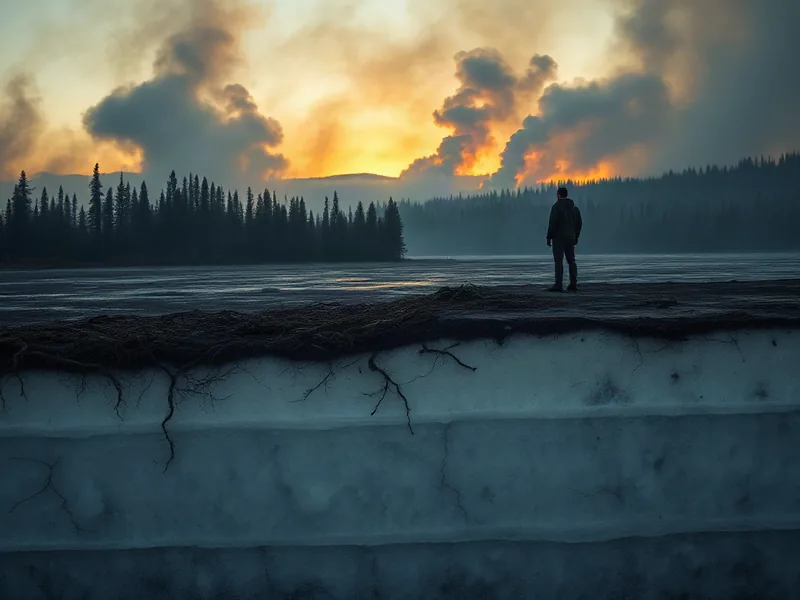
There's also a feedback loop worth sitting with. Warmer temperatures make wildfires more frequent and intense. More frequent, intense wildfires strip the insulation that protects permafrost. More permafrost thaw releases greenhouse gases that contribute to further warming. It's not a one-time event. It's a cycle that, once started, can be very difficult to interrupt.
None of this is reason for fatalism, but it is reason for urgency. The people studying this aren't abstractly worried about a distant future; they're watching changes happen on timescales of single fire seasons. That's a meaningfully different kind of climate threat than the gradual, decades-long shifts most of us have learned to associate with global warming.
It's also worth remembering that this isn't an isolated Arctic curiosity. Communities across the circumpolar north, including Indigenous communities in Alaska and Siberia, depend on stable permafrost for building foundations, transportation routes, and traditional food systems. As the ground beneath them becomes less predictable, the consequences show up in collapsed roads, damaged homes, and disrupted hunting and fishing patterns long before they show up in a global emissions ledger.
The permafrost story is a reminder that climate change doesn't always move at the pace we've planned for. Models built around steady, predictable warming can miss sudden amplifiers like wildfire, which can compress decades of gradual thaw into a handful of destructive seasons.
That matters for policy, too. If permafrost carbon release accelerates faster than current projections assume, then emissions targets calibrated to those projections may already be insufficient. Governments setting climate goals for 2030 or 2050 are implicitly betting on the permafrost vault staying mostly shut. Alaska's burning forests suggest that bet is shakier than many realize.
There's a broader lesson here about the limits of studying a crisis that keeps changing shape while you're trying to measure it. Scientists chasing this problem are, in a very real sense, trying to characterize a moving target, one that's melting, burning, and recalibrating the planet's carbon budget in real time. That's not a comfortable position for researchers or policymakers. But understanding it clearly, without either minimizing the risk or overstating what we know for certain, is the only honest way forward. The alternative, treating permafrost as a settled, slow-moving background variable, risks leaving us unprepared for a feedback loop that's already underway.
Tags
Original Sources
The Download: computing’s next leap and permafrost’s climate threat
↗ https://www.technologyreview.com/2026/10/22/1147612/the-download-computing-next-leap-permafrost-climate-threat
About the author
Amara's entry point into AI was an epidemiology role at a London research hospital, where she spent five years studying how digital health tools reached — or conspicuously failed to reach — underserved communities. Watching early algorithmic systems in healthcare quietly entrench existing inequalities, she redirected her career toward the systemic consequences of AI at scale. She covers AI through an unflinching lens: who benefits, who bears the cost, and what evidence actually says versus what the press release claims. Her writing is calm and precise, but she doesn't mistake balance for neutrality.
More from The Steward →This Week's Edition
23 October 2026
29 articles
Related Articles

How Climate Scientists Are Putting AI to Work, and Where It Still Falls Short
Environment & Climate · 6 min
FDA Finalizes Guidance on Drug-Related Apps as Telehealth Outpaces Oversight
Policy & Regulation · 5 min

xAI Formalizes Its Ecosystem Play With SpaceX Super Intelligence Partner Network
Products & Applications · 5 min
Related Articles
How Climate Scientists Are Putting AI to Work, and Where It Still Falls Short
Environment & Climate · 6 min
FDA Finalizes Guidance on Drug-Related Apps as Telehealth Outpaces Oversight
Policy & Regulation · 5 min
xAI Formalizes Its Ecosystem Play With SpaceX Super Intelligence Partner Network
Products & Applications · 5 min
More Stories
© 2026 Cedar & Bloom. All rights reserved.
