The Drum · Weekly AI news, freeSubscribe →

Share
Modi wants India to become the storage hub for the world's data. Near Mumbai, residents watching trees fall and towers rise outside their windows are asking who actually pays the price.
Tushar Shetty bought his 21st-floor Mumbai apartment five months ago for the view: a stretch of lush greenery stretching out toward the horizon. Today that view is a scar of red earth, cleared of trees to make room for an Amazon data centre.
"I would not have bought the house if I had known," he said.
His regret captures something bigger than one bad real estate decision. It's the same tension now playing out from the suburbs of Virginia to the outskirts of Amsterdam and Dublin, where the artificial intelligence boom has triggered an unprecedented data centre building spree, and where the people living closest to these facilities are increasingly saying no.
Think of a data centre as a city's power-hungry, water-thirsty cousin that nobody consulted before it moved in next door. These windowless warehouses full of servers run around the clock, generating heat that must be constantly cooled, drawing electricity at industrial scale, and often humming loud enough to disturb sleep. For the companies building them, they're the physical infrastructure the AI economy runs on. For the neighbors, they can feel like an uninvited, resource-draining tenant with no landlord to complain to.
Prime Minister Narendra Modi wants India to become exactly this kind of host, at scale, for "the whole world's data." Unable to match the frontier AI models coming out of the US and China, India is betting that owning the physical backbone of artificial intelligence, the data centres, the cooling systems, the server farms, can be just as valuable as owning the algorithms themselves. Amazon, Google and Microsoft are pouring billions into that bet. Amazon alone has committed to a planned $21 billion investment in Indian AI infrastructure by 2030. Microsoft has unveiled a separate four-year, $20.5 billion plan, most of it earmarked for AI data centres.
The pitch makes sense on paper. As the world's back office loses some of its old shine, physical infrastructure offers India a different kind of relevance in the AI era. But that ambition is now colliding with a harder truth: these facilities need enormous amounts of water and electricity, and they're landing in places where both are already scarce.
India holds just 4% of the world's freshwater while supporting 18% of its people. Data centres are clustering precisely in the cities already short on both. S&P Global estimates that 60% to 80% of Indian data centres could face high water stress sometime this decade. In 2025 alone, data centres across the country used about 150 billion litres of water, according to research firm Mordor Intelligence, a figure projected to more than double by 2030.
The Amazon project in Thane, outside Mumbai, has become one of the country's most visible fights over this strategy. Reuters interviews with more than two dozen residents, along with a review of official correspondence, found growing fears that the 54-acre facility will strain local power and water supplies and generate noise harmful to children and the elderly.
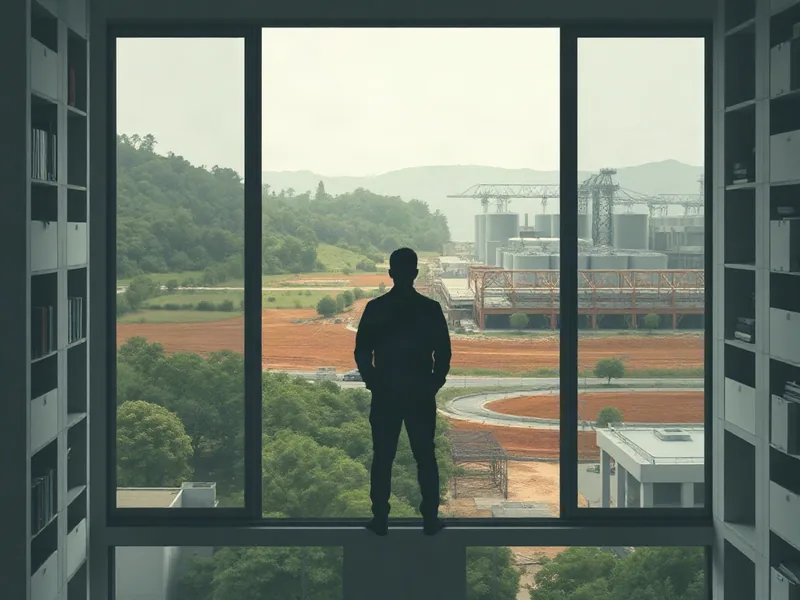
More than 1,000 residents living near the site say the project moved forward without meaningful consultation. On September 8, hundreds gathered beside the construction site, some elderly, holding placards reading "Data centres are energy vampires." Their ask is simple: move it somewhere else.
Vasudha Shetty, 62, bought a flat near the site hoping for a quiet retirement. Her position is a kind of ultimatum. "If the data centre stops, we will stay," she said. "If it goes ahead, we will move." Vidya Kadam, 68, who has lived in the area for 30 years, put it more bluntly: "We will come out on the roads and do whatever it takes to stop it."
Amazon and local authorities have pushed back firmly. The company says the facility will not burden public utilities because its water and power will come from dedicated sources, not shared municipal supplies. It told Reuters the site will use water-free cooling technology, a separate power supply disconnected from residential grids, and noise-mitigation measures, adding that more saplings have been planted than trees removed. Modi's government has mounted its own defence, promoting data centres online as "the invisible engines powering India's digital life" and arguing that modern facilities use water and electricity more efficiently than older designs.
Yet internally, according to a person familiar with Amazon's planning, the company isn't overly worried, because government officials have signaled the protests will eventually fade. The company is still drawing up community outreach plans to address the noise, water and power concerns. "Building data centres comes at a cost," the person said. "For now there is no other option but to live with protests."
That confidence contrasts sharply with how Amazon has handled similar objections elsewhere. In Virginia, home to the largest concentration of data centres anywhere in the world, the company paused a 2024 proposal for three facilities over concerns about noise and proximity to homes, saying it needed more time for community engagement. Mumbai residents say they were never offered that same pause.
Even some industry insiders are uneasy about where these facilities are being sited. Sharad Agarwal, CEO of Sify Infinit Spaces, which operates 14 data centres, said bluntly at an industry event in September: "I will never set up a data centre in a residential area. Centres need abundant, uninterrupted power and water, and near homes they risk being starved of both in a shortage."
The Thane dispute isn't isolated. In Andhra Pradesh, environmentalists are fighting a separate $15 billion Google data centre project, citing risks to wildlife, water and power supplies, and alleging that land belonging to a temple was used without permission. Google and the state government deny any wrongdoing. The backlash has also turned political: opposition legislator Aaditya Thackeray joined Mumbai protesters in September, demanding the Amazon project be relocated and pledging his party would move it if returned to power. Property broker Atul Jadhav says buyer anxiety over the project may already be dragging down resale values nearby.
This isn't simply a local zoning dispute. It's a preview of the trade-offs every country chasing the AI infrastructure boom will eventually have to make. The servers that power chatbots and AI models don't float in some abstract cloud. They sit on real land, draw from real rivers and real power grids, and generate real noise outside real bedroom windows. India's push to become the world's data host could bring investment and jobs, but if it tramples the water security and quality of life of the people living beside these facilities, the backlash will only grow louder, not quieter, no matter what officials predict.
Tags
Original Sources
Modi wants India to power the AI age. Residents are pushing back
↗ https://www.reuters.com/world/india/modi-wants-india-power-ai-age-residents-are-pushing-back-2026-10-09
About the author
Amara's entry point into AI was an epidemiology role at a London research hospital, where she spent five years studying how digital health tools reached — or conspicuously failed to reach — underserved communities. Watching early algorithmic systems in healthcare quietly entrench existing inequalities, she redirected her career toward the systemic consequences of AI at scale. She covers AI through an unflinching lens: who benefits, who bears the cost, and what evidence actually says versus what the press release claims. Her writing is calm and precise, but she doesn't mistake balance for neutrality.
More from The Steward →This Week's Edition
9 October 2026
34 articles
Related Articles

Why Nurses Leave: It's Career Stage, Not Generation, Hospitals Need to Address
Job Market & Society · 5 min

New Survey Finds Women Far More Skeptical of AI Than Men, and the Gap Is Widening
Job Market & Society · 5 min

A 15-Year-Old Lost a Hand. Now Europe's Students Are in the Streets Over School Funding
Job Market & Society · 6 min
Related Articles
Why Nurses Leave: It's Career Stage, Not Generation, Hospitals Need to Address
Job Market & Society · 5 min
New Survey Finds Women Far More Skeptical of AI Than Men, and the Gap Is Widening
Job Market & Society · 5 min
A 15-Year-Old Lost a Hand. Now Europe's Students Are in the Streets Over School Funding
Job Market & Society · 6 min
More Stories
© 2026 Cedar & Bloom. All rights reserved.
