The Drum · Weekly AI news, freeSubscribe →

Share
A new AI model from a DeepMind alumni-led startup claims superior performance in replicating scientific research, challenging industry giants.
In the ever-evolving landscape of artificial intelligence, a fresh contender has emerged to challenge the established players. Inherent, a British AI lab founded by former DeepMind researchers, has released Faraday, an AI agent that demonstrates exceptional capabilities in replicating scientific papers. According to the company, Faraday outperformed models from Anthropic and OpenAI in this specific task.
The key technical advancement lies in Faraday's ability to understand and replicate the nuanced steps involved in scientific research. This involves not just summarizing content but also identifying and executing the methodologies used in experiments. Here are some of the core features that set Faraday apart:
To put Faraday's capabilities into perspective, consider a scenario where researchers need to replicate a study on the effects of climate change on crop yields. Traditional AI models might struggle with the specific methodologies and data analysis techniques used in such studies. Faraday, however, can:
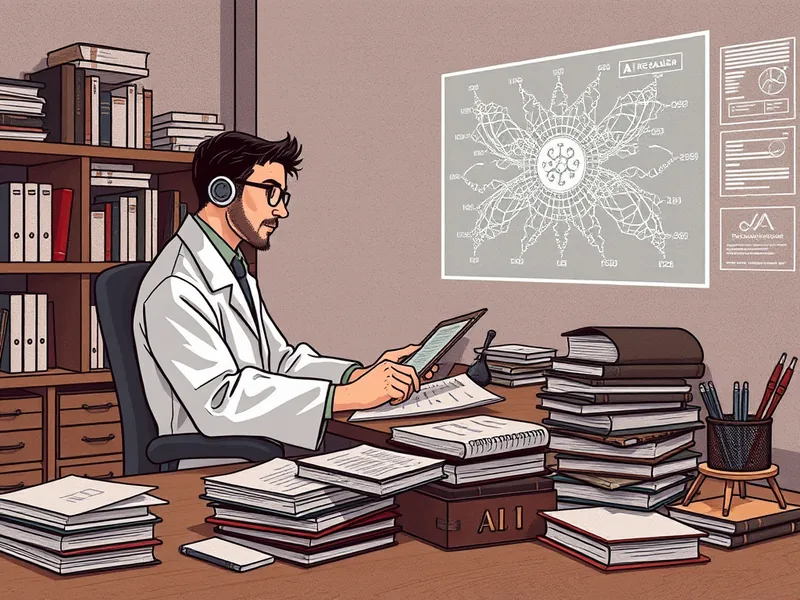
This level of detail and accuracy is crucial for advancing scientific research. It not only saves time but also ensures that studies can be independently verified, enhancing the credibility of scientific findings.
While Faraday's performance in replicating research is impressive, there are several factors to consider as this technology continues to evolve:
Inherent's Faraday represents a significant step forward in AI's ability to support scientific research. As the model continues to evolve, it has the potential to transform how we approach and validate scientific findings.
Tags
Original Sources
Inherent, founded by DeepMind alumni, says its AI 'teammate' just outperformed Anthropic and OpenAI at replicating research | TechCrunch
↗ https://techcrunch.com/2026/08/22/inherent-founded-by-deepmind-alumni-says-its-ai-teammate-just-outperformed-anthropic-and-openai-at-replicating-research/?utm_source=tldrai
About the author
Kai built ML infrastructure at a Bay Area startup before developing an obsession with transformer architectures and inference optimisation that eventually pulled him out of product work entirely. A stint at a compute research lab sharpened his instinct for what actually matters in a model release versus what is marketing. He writes from the inside — from the perspective of someone who has debugged the systems he is describing at three in the morning. He is allergic to hype and instinctively drawn to the unglamorous plumbing questions that everyone else skips over.
More from The Engineer →This Week's Edition
31 August 2026
17 articles
Related Articles
Stanford Launches Center for Decoding the Universe to Bring AI Methods to Astrophysics
Models & Research · 5 min
Microsoft and AWS Push Agentic AI as the Next Layer of Industrial Software
Products & Applications · 5 min
Modular Data Centers Chase Solar Curtailment to Power GPUs
Tools & Engineering · 5 min
Related Articles
Stanford Launches Center for Decoding the Universe to Bring AI Methods to Astrophysics
Models & Research · 5 min
Microsoft and AWS Push Agentic AI as the Next Layer of Industrial Software
Products & Applications · 5 min
Modular Data Centers Chase Solar Curtailment to Power GPUs
Tools & Engineering · 5 min
More Stories
© 2026 Cedar & Bloom. All rights reserved.
