The Drum · Weekly AI news, freeSubscribe →
Share
Colin Angle envisions a next-gen robot that acts as a personal assistant and companion, learning from its environment and adapting to user needs, marking a significant leap beyond current home automation technology.
iRobot, best known for its Roomba robotic vacuums, is looking to take home automation to the next level. Colin Angle, the founder and CEO of iRobot, has set his sights on developing a new kind of household robot-a "familiar" that can assist with daily tasks and interact more naturally with humans. This vision goes beyond just cleaning; it’s about creating a companion that can learn from its environment and adapt to user needs.
The concept of a robotic familiar isn’t entirely new, but recent advancements in AI and robotics have made it more feasible than ever. Angle believes that by integrating advanced sensors, machine learning algorithms, and natural language processing (NLP), these robots can become intuitive helpers rather than just another gadget on the shelf.
To achieve this ambitious goal, iRobot is leveraging several key technologies:
Advanced Sensors: The familiar will be equipped with a suite of sensors including LIDAR (Light Detection and Ranging), cameras, and microphones. These sensors will allow the robot to navigate complex home environments, recognize objects, and understand spoken commands.
Machine Learning: Deep learning models will enable the robot to learn from its interactions and improve over time. This includes object recognition, path planning, and task execution. For instance, the familiar could learn to fetch items based on user preferences and past behavior.
Natural Language Processing (NLP): NLP will allow the robot to understand and respond to natural language commands. This is crucial for making the interaction feel more human-like and reducing the learning curve for users.
Cloud Integration: The robot will be connected to the cloud, allowing it to access vast amounts of data and computational resources. This can enhance its capabilities in areas like speech recognition and decision-making.
The architecture of the robotic familiar is designed to balance autonomy with user control:
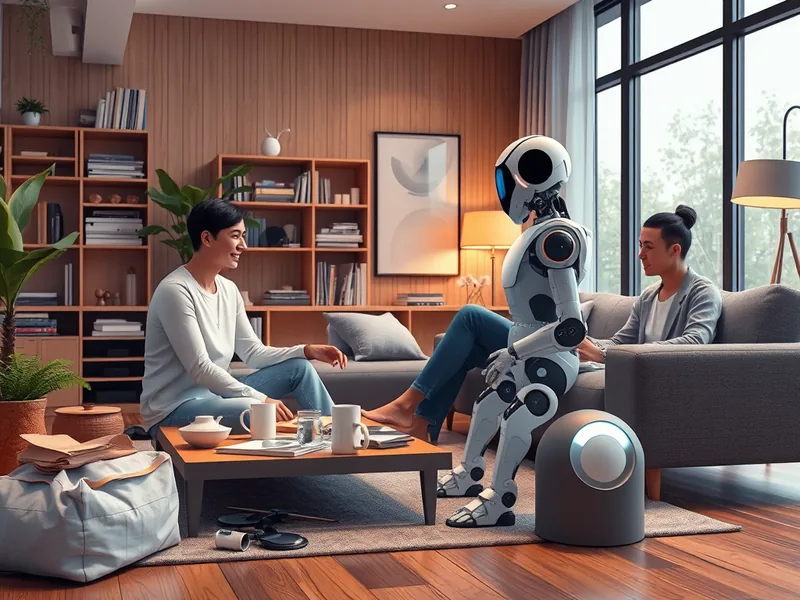
Modular Design: The familiar’s hardware and software are modular, meaning components can be updated or replaced as technology advances. This ensures that the robot remains relevant and functional over time.
Edge Computing: To reduce latency and ensure privacy, much of the processing will occur on the device itself. However, for more complex tasks, the robot can offload computations to the cloud.
User Interface: The familiar will have a user-friendly interface that includes both voice commands and a mobile app. The app will allow users to set preferences, monitor the robot’s activities, and troubleshoot issues.
Security and Privacy: iRobot is prioritizing security and privacy in the design of the familiar. This includes end-to-end encryption for data transmitted between the robot and the cloud, as well as robust measures to prevent unauthorized access.
The development of a robotic familiar represents a significant step forward in home automation. Here are some key takeaways:
Integrated Technology: The familiar combines advanced sensors, machine learning, NLP, and cloud integration to create a more intelligent and adaptive household robot.
User-Centric Design: By focusing on user needs and preferences, iRobot aims to make the familiar a seamless addition to daily life. This includes a modular design for longevity and a user-friendly interface.
Privacy and Security: Addressing concerns about data privacy and security is a top priority. The robot will use encryption and other measures to protect user information.
Future Potential: While the initial focus is on tasks like fetching items and providing companionship, the familiar has the potential to evolve into a more sophisticated helper as technology advances.
iRobot’s vision of a robotic familiar is not just about creating a new product; it’s about reimagining how we interact with technology in our homes. As the company continues to develop this concept, it will be interesting to see how these robots integrate into daily life and what new possibilities they bring.
Tags
Original Sources
Meet the AI Familiar That Wants to Fix Your Daily Routine
↗ https://spectrum.ieee.org/familiar-machines-and-magic
About the author
Kai built ML infrastructure at a Bay Area startup before developing an obsession with transformer architectures and inference optimisation that eventually pulled him out of product work entirely. A stint at a compute research lab sharpened his instinct for what actually matters in a model release versus what is marketing. He writes from the inside — from the perspective of someone who has debugged the systems he is describing at three in the morning. He is allergic to hype and instinctively drawn to the unglamorous plumbing questions that everyone else skips over.
More from The Engineer →This Week's Edition
7 May 2026
29 articles
Related Articles

Rosarium Health Partners With Anthem Medi-Cal to Fund Home Modifications for Older Californians
Products & Applications · 5 min
Meta's new open-weight model runs on Macs, if you have 1TB of RAM to spare
Products & Applications · 5 min

Persona AI Bets on Calm Execution in a Noisy Humanoid Robotics Market
Products & Applications · 5 min
Related Articles
Rosarium Health Partners With Anthem Medi-Cal to Fund Home Modifications for Older Californians
Products & Applications · 5 min
Meta's new open-weight model runs on Macs, if you have 1TB of RAM to spare
Products & Applications · 5 min
Persona AI Bets on Calm Execution in a Noisy Humanoid Robotics Market
Products & Applications · 5 min
More Stories
© 2026 Cedar & Bloom. All rights reserved.
