The Drum · Weekly AI news, freeSubscribe →

Share
When a patient asked to record his exam room conversation, a physician's first instinct was defensive. That reflex, and what it reveals about who AI tools actually serve, deserves closer scrutiny than most healthcare institutions have given it.
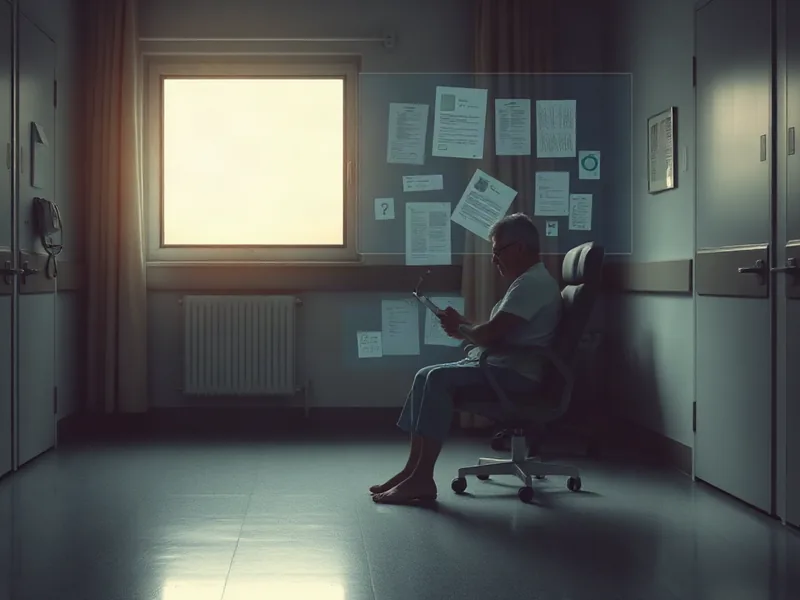
Picture a hospital room at four in the morning. A patient has been awake for hours, turning over questions for the care team, rehearsing how to ask them. Then the team arrives, talks for a few minutes, makes its decisions, and moves on. The questions never get asked. By the time the patient finds the right words, the doctors are two doors down.
This is not a hypothetical. It is what one physician noticed repeatedly as a medical student, and it led him to propose something almost embarrassingly low-tech: a notebook at every bedside, where patients could write down their overnight questions for the team to review each morning. No software. No budget. Just paper.
The idea moved through hospital committees warmly, by his account, and then stalled in what he calls "the Bermuda Triangle of legal, compliance, and operations." Nobody rejected it outright. Nobody was against patients asking questions. It simply never found anyone whose job it was to carry it forward. That distinction, between an idea nobody opposes and an idea nobody owns, turns out to matter a great deal for understanding what is happening in exam rooms right now.
Because patients have stopped waiting for the notebook. They are building it themselves, and they are using AI to do it.
Sachin H. Jain, a physician and CEO of SCAN Group and SCAN Health Plan, describes a moment that reframed his own instincts. A patient asked, at the end of a visit, whether they could record the conversation. Jain said yes. But he noticed what came up in him first: a flicker of paranoia. Where would the recording end up? What might one sentence, pulled out of context, look like somewhere he could not see?
Only afterward did he register the obvious part. The patient was doing something entirely reasonable. They wanted to remember what mattered about their own care, because most patients, as anyone in medicine knows, simply do not retain what is said to them in a fifteen-minute visit. Jain had once tried to solve exactly this problem with his bedside notebook. When a patient solved it themselves, phone in hand, his first instinct was self-protection. His second, and more honest, was recognition.
That pattern is becoming common. Patients now bring tools like ChatGPT or Claude into appointments, record the conversation, and spend the evening asking follow-up questions they were too rattled or too rushed to ask in the room. It is the same instinct that has always driven patients to reconstruct a hard appointment afterward, just with better tools. The reconstruction is now searchable, nearly verbatim, and interactive. It answers back, and it keeps answering for as long as the patient wants.
Newer tools go further still. Rather than simply holding onto questions, they prompt refills, flag missed follow-ups, and check in days later on whether a prescribed medication was ever picked up. This is the kind of patient activation that health policy advocates have promised for three decades and mostly delivered in small pilot programs. Now it is arriving unbidden, built by companies with no connection to the hospital at all.
The natural question is why the doctor's documentation tool and the patient's AI tool should not simply be the same system. If an ambient scribe is already recording the visit, why does the patient need a second tool to understand what happened in the first one?
The answer traces back to why nobody ever proposed merging the bedside notebook with the medical chart. A clinical note is written for communication among providers, for billing, for compliance, for audit. Those purposes shape the document even when a patient is allowed to read it. OpenNotes, the initiative that established patients' right to read their doctors' notes, changed who could see the record. It did not change what the record was built to do. Federal information-blocking rules have since made that access close to automatic. And patients still ask to record the conversation anyway, because access to a document was never the actual constraint.
Access lets a patient see what a doctor wrote. Agency lets them question it, compare it against what they remember, and keep probing until they understand. Those are different things, and AI tools are supplying something closer to the second.
There is also the matter of candor. Patients tell an AI assistant things they will not tell their doctor: what they are actually afraid of, what medication they quietly stopped taking, what a copay costs relative to rent, what a daughter said in the car afterward. Merge the patient's tool with the clinician's system, and that candor tends to vanish, replaced by a clinical interface with a friendlier font.
None of this is free of risk. Bharat Anand, a Harvard professor, has described generative AI tools as "often wrong but never in doubt." A patient often cannot tell a confident right answer from a confident wrong one. Neither, honestly, can most physicians on a busy day. Consent laws around recording vary by state, and there are legitimate reasons for doctors to be cautious about being taped without warning. But that caution gets tangled up with something less flattering: a discomfort with being accountable for what was actually said, rather than what ended up documented.
The deeper question is not whether these tools work. It is who they work for. A system that nudges a patient toward "the next best action" is making a judgment about what counts as best. If a health plan builds that system, does it push the action that improves the patient's health, or the one that closes a quality metric? If a hospital builds it, does it recommend the right specialist, or the one on staff? The health plan's AI, the hospital's AI, and the patient's AI can draw on much of the same data while quietly optimizing for very different outcomes. If the tool in a patient's pocket ultimately answers to the institution rather than the person holding the phone, it is not really the patient's tool at all, whatever it is called.
Healthcare has lived through a version of this before. Electronic health records arrived promising better coordination of care. Ask most physicians today what those systems actually serve, and coordination is rarely the first word that comes up.
The bedside notebook needed institutional permission and never received it. OpenNotes needed permission too, and eventually got it, because the institution chose to move. The AI tools now in patients' pockets needed no permission from anyone, which is precisely why they exist and precisely why they should give the medical profession pause. What doctors owe patients now is not blanket enthusiasm for these tools, but honesty about whose interests they actually serve, and a willingness to insist that whatever replaces the notebook still belongs to the patient.
Tags
Original Sources
From OpenNotes to “Doc Can I Record You?” Why Physicians Should Embrace Era of Accountability - MedCity News
↗ https://medcitynews.com/2026/09/from-opennotes-to-doc-can-i-record-you-why-physicians-should-embrace-era-of-accountability
About the author
Amara's entry point into AI was an epidemiology role at a London research hospital, where she spent five years studying how digital health tools reached — or conspicuously failed to reach — underserved communities. Watching early algorithmic systems in healthcare quietly entrench existing inequalities, she redirected her career toward the systemic consequences of AI at scale. She covers AI through an unflinching lens: who benefits, who bears the cost, and what evidence actually says versus what the press release claims. Her writing is calm and precise, but she doesn't mistake balance for neutrality.
More from The Steward →This Week's Edition
25 September 2026
31 articles
Related Articles

Medicare Advantage Covers Most Seniors Now. Can It Be Trusted to Serve Them Well?
Health & Science · 6 min

Australian GP Trainees to Help Shape Clinical AI Tools Through New Lyrebird Health Partnership
Health & Science · 5 min

Why Venus Has No Moon: A New Study Suggests the Planet Slowly Swallowed Its Own
Health & Science · 6 min
Related Articles
Medicare Advantage Covers Most Seniors Now. Can It Be Trusted to Serve Them Well?
Health & Science · 6 min
Australian GP Trainees to Help Shape Clinical AI Tools Through New Lyrebird Health Partnership
Health & Science · 5 min
Why Venus Has No Moon: A New Study Suggests the Planet Slowly Swallowed Its Own
Health & Science · 6 min
More Stories
© 2026 Cedar & Bloom. All rights reserved.
