The Drum · Weekly AI news, freeSubscribe →

Share
From microgrids that stop wasting fuel to satellites beaming power from orbit, military engineers are quietly testing ideas that could reshape how remote communities, not just troops, keep the lights on.
Imagine running a small town off a handful of generators that were never designed to talk to each other. That's roughly the challenge facing soldiers stationed in remote outposts, where environmental control units, laundry machines and tactical operations centers all draw power from equipment made by different manufacturers, often with no shared language between them. This week, the Pentagon put a spotlight on the people trying to solve that problem, and dozens of others like it, at its Energy Sentry - Pentagon: DoW's Energy Innovation Expo.
More than 100 exhibits filled the building on September 22, organized around six focus areas: mobility across land, air and sea; energy resilience for temporary bases; battery storage and power generation; nuclear energy; cybersecurity for energy systems; and unmanned systems. It's a sprawling agenda, but three projects in particular show how military energy research often mirrors, and sometimes leads, civilian efforts to build cleaner, more reliable power systems.
Pablo Ruiz, an electrical engineer with Command, Control, Communications, Computers, Cyber Intelligence, Surveillance and Reconnaissance at Aberdeen Proving Ground, Maryland, walked visitors through the Tactical Microgrid Standard program. Think of it as a universal translator for generators. Right now, equipment from different manufacturers often can't work together efficiently, forcing units to rely on whatever brand they started with, a problem engineers call vendor lock. Ruiz said the program's real breakthrough is an algorithm that lets generators with different voltages and frequencies operate side by side, adjusting power output only when it's actually needed.
That last detail matters more than it might sound. Wasted energy in a combat zone isn't just an inefficiency, it's a supply chain risk, since every gallon of fuel not used is one less convoy that has to drive it in. The algorithm also improves what engineers call load shedding and load priority, essentially deciding in real time which systems get power first if supply runs short. It's the same logic increasingly used in civilian smart grids trying to balance solar, wind and battery storage without blackouts.
A few booths over, Chris Rodenbeck offered a vision that sounds like science fiction but is inching toward reality. Rodenbeck heads the Advanced Concepts Group in the Radar Division at the Naval Research Laboratory in Washington, and he's working on microwave power beaming, a method of collecting solar energy in space and transmitting it wirelessly to Earth.
The pitch is straightforward: space has abundant, uninterrupted sunlight, while remote military outposts often have very little reliable power at all. Satellites equipped with solar panels could convert sunlight into microwave energy and beam it down to wherever it's needed, without a single fuel truck or power line. For troops stationed in isolated or hostile terrain, that could mean an end to relying on resupply convoys just to keep the lights on.
The technology isn't ready yet. Rodenbeck said researchers plan ground experiments between now and 2028, with an actual space-based test of the sunlight-to-microwave conversion process targeted for that year. It's a long runway, and plenty of engineering hurdles remain, from transmission efficiency to safety concerns about beaming concentrated energy through the atmosphere. But if it works, the implications reach well beyond the battlefield. Disaster response teams, remote research stations and off-grid communities all face versions of the same problem Rodenbeck is trying to solve: how do you deliver power to places the grid doesn't reach?
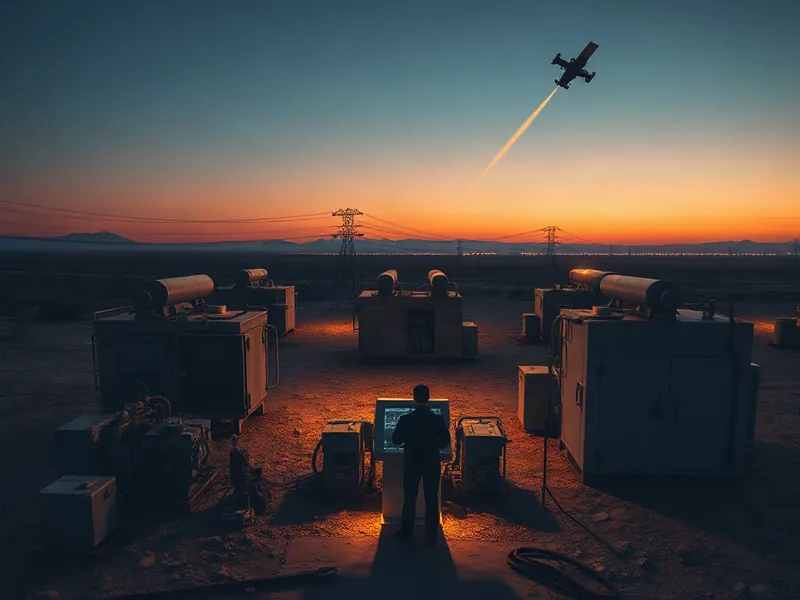
The third example on display had nothing to do with generators or satellites, and everything to do with aerodynamics. Jacqueline Burns, who leads the Aircraft Optimization Division at Tinker Air Force Base in Oklahoma, explained how her team is squeezing more mileage out of aircraft that have been flying for decades, simply by reducing drag.
One tool, called Finlets, attaches to a C-130 transport plane and cuts drag by 6% to 8%. That might sound modest, but Burns said it translates into 160 extra nautical miles on the same tank of fuel. Another technology, Flight Film, is an adhesive material with microscopic grooves that sticks to the plane's outer skin, smoothing airflow and cutting drag by another 4%. Combined, the two technologies reduce drag by roughly 10%, according to Burns, and her division is continuing to test additional options.
It's worth pausing on why this kind of work matters beyond military logistics. Aircraft fuel consumption is a significant source of emissions, and any technology that lets existing planes fly farther on less fuel reduces that footprint without requiring an entirely new fleet. Retrofitting old aircraft, rather than replacing them, is also far cheaper and faster, an approach that commercial aviation has been exploring for similar reasons.
None of these projects were designed with climate policy in mind. The Pentagon's stated goal is operational readiness: keeping troops powered, mobile and connected in places where the electrical grid simply doesn't exist. But the overlap with civilian energy challenges is hard to ignore. Efficient microgrids that reduce fuel dependency, satellite power systems that reach places the grid can't, and retrofits that cut fuel use in aging vehicles are all problems shared by rural communities, disaster relief agencies and utility planners working to decarbonize.
Military research budgets have historically served as an early proving ground for technologies that later find their way into civilian life, from GPS to the internet's early architecture. Space solar power, in particular, has been discussed in scientific circles for decades, but funding and engineering complexity have kept it largely theoretical. A dedicated 2028 test flight, even a modest one, would mark real progress toward something that could eventually help power remote clinics, disaster zones or islands cut off from a stable grid.
There are legitimate questions to ask as these technologies mature. Beaming concentrated energy through the atmosphere raises safety and regulatory questions that will need careful oversight before any civilian application follows. Efficiency gains in military hardware, while genuinely useful, shouldn't be mistaken for a broader climate strategy. But as engineers like Ruiz, Rodenbeck and Burns keep chipping away at these problems, the rest of us stand to benefit from lessons learned in some of the world's harshest, most power-starved environments.
Tags
Original Sources
Expo Showcases Innovative Energy Technologies That Support Warfighters
↗ https://www.war.gov/News/News-Stories/Article/Article/4608847/expo-showcases-innovative-energy-technologies-that-support-warfighters
About the author
Amara's entry point into AI was an epidemiology role at a London research hospital, where she spent five years studying how digital health tools reached — or conspicuously failed to reach — underserved communities. Watching early algorithmic systems in healthcare quietly entrench existing inequalities, she redirected her career toward the systemic consequences of AI at scale. She covers AI through an unflinching lens: who benefits, who bears the cost, and what evidence actually says versus what the press release claims. Her writing is calm and precise, but she doesn't mistake balance for neutrality.
More from The Steward →This Week's Edition
23 September 2026
29 articles
Related Articles

Australian Farmers Warm to Renewables, But Big Projects Still Face Resistance
Environment & Climate · 5 min

Record-Shattering El Niño, AI's Energy Habit, and a Renewables Gap That Won't Close Itself
Environment & Climate · 6 min

Anthropic's Claude Opus 5.5 Ships as Five Models in One, Tuning Intelligence Against Cost
Models & Research · 5 min
Related Articles
Australian Farmers Warm to Renewables, But Big Projects Still Face Resistance
Environment & Climate · 5 min
Record-Shattering El Niño, AI's Energy Habit, and a Renewables Gap That Won't Close Itself
Environment & Climate · 6 min
Anthropic's Claude Opus 5.5 Ships as Five Models in One, Tuning Intelligence Against Cost
Models & Research · 5 min
More Stories
© 2026 Cedar & Bloom. All rights reserved.
