The Drum · Weekly AI news, freeSubscribe →
Share
For people who've lost a hand, modern prosthetics can grip and grasp, but they can't feel. Engineers are now working to close that gap, and the stakes for amputees are more than cosmetic.
Losing a hand changes more than what a person can physically do. It changes how they move through the world. Reaching for a coffee cup, buttoning a shirt, holding a child's hand, these are tasks most of us do without a second thought, relying on an unconscious stream of sensory feedback telling us how hard we're gripping and whether something is slipping from our fingers. Take that feedback away, and even a mechanically sophisticated prosthetic hand becomes a tool you have to watch constantly, rather than one you can simply trust.
That's the problem a growing group of biomedical engineers is trying to solve. Today's advanced prosthetic hands can already flex individual fingers, rotate wrists, and respond to signals from a user's residual muscles. What they can't do, at least not yet in any widely available form, is relay sensation back to the brain. A hand that moves but doesn't feel is a bit like driving a car with no sense of the road: you can still steer, but you're missing the subtle cues that make control feel natural and safe.
The engineering challenge here is fundamentally about rebuilding a loop that the human nervous system has refined over millions of years. Normally, when your fingertip touches something, nerve receptors convert that pressure into electrical signals, which travel up through the arm and spinal cord and into the brain, where they're interpreted almost instantly. Researchers working on sensory-enabled prosthetics are trying to recreate pieces of that pathway artificially, using sensors on the prosthetic hand to detect pressure or texture, then translating that data into electrical signals that can be delivered to the nerves or brain in a form the body can understand.
This isn't a simple plug-and-play swap. The nervous system is exquisitely specific about how it encodes information, and researchers have had to work closely with neuroscientists to figure out which patterns of stimulation produce a sensation the brain will interpret as, say, light touch versus firm pressure. Getting this wrong doesn't just mean a prosthetic that feels clumsy. It can mean sensations that are confusing, uncomfortable, or simply ignored by the brain as noise.
Progress has been incremental but meaningful. Teams have demonstrated that by stimulating peripheral nerves, the nerves that run through the arm rather than the spinal cord or brain itself, amputees can perceive a crude but functional sense of touch and pressure through their prosthetic hand. Some participants in these studies have described being able to tell the difference between a soft object and a hard one, or sensing how tightly they're gripping something, without having to look down and check. That kind of feedback can meaningfully reduce the cognitive load of using a prosthetic, since the brain no longer has to substitute vision for touch at every single moment.
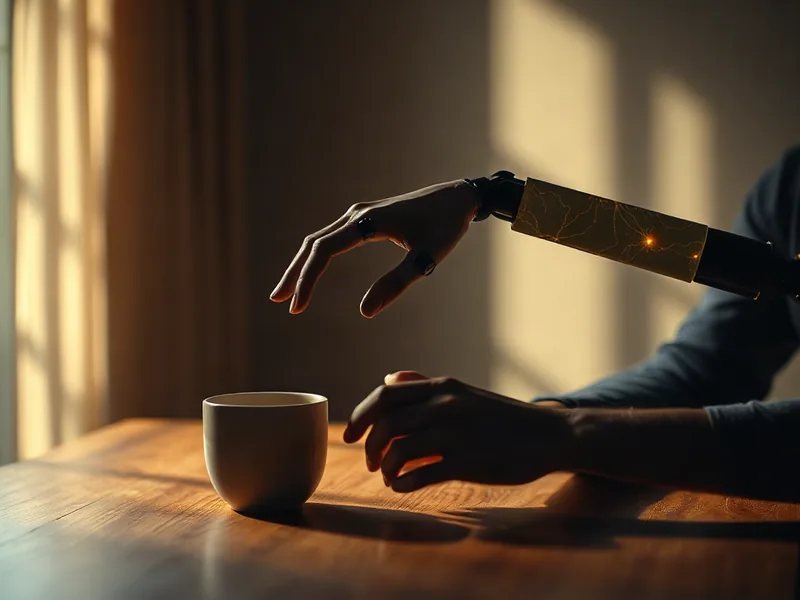
The engineering here sits at the intersection of several disciplines that don't always speak the same language. Mechanical engineers design the sensors and actuators. Electrical engineers build the circuitry that converts raw sensor data into stimulation patterns. Neuroscientists and surgeons figure out where and how to interface with the nervous system safely. And the end users, the amputees themselves, are essential collaborators throughout, since their subjective reports of what a given stimulation actually feels like are often the only way to calibrate the system at all.
There are real technical hurdles still standing in the way of a sensory prosthetic hand becoming something a person could use reliably, every day, outside a lab setting. Implanted electrodes can degrade or shift over time. The body's immune response to foreign hardware can scar tissue around nerve interfaces, weakening the signal. And the systems need to be durable, low-power, and comfortable enough to wear for years, not just for the duration of a research trial. Miniaturizing the electronics while keeping them reliable is its own significant engineering puzzle, one that doesn't have an easy shortcut.
It's worth being honest about where this technology currently stands. Sensory feedback in prosthetics is still largely confined to research settings, not something available off the shelf to the broader amputee community. The gap between a promising lab demonstration and a device that's affordable, durable, and covered by insurance is often wider than people outside the field realize. That gap matters, because the people who stand to benefit most from this work are often dealing with the practical, daily frustrations of limb loss right now, not in some hypothetical future.
Still, the direction of this research carries real weight. Restoring even a basic sense of touch can reduce the mental exhaustion of relying entirely on vision to compensate for what a hand used to feel automatically. It can also reduce the risk of accidentally damaging objects, or worse, injuring oneself, by gripping too hard without realizing it. Some researchers and clinicians have also pointed to a less obvious benefit: sensory feedback may help reduce phantom limb pain, a condition in which amputees feel persistent, sometimes debilitating sensations from a limb that's no longer there, possibly because the brain is finally getting some of the input it's been missing since the amputation.
None of this is just an engineering curiosity. For the people living with limb loss, every incremental gain in sensory feedback is a gain in independence, safety, and dignity. The work is slow and the obstacles are real, but the goal, a prosthetic hand that doesn't just move like a human hand but feels like one too, is squarely aimed at restoring something fundamental that medicine and technology have, until recently, struggled to give back.
Tags
Original Sources
Creating a Prosthetic Hand That Can Feel
↗ https://spectrum.ieee.org/creating-a-prosthetic-hand-that-can-feel/particle-9
About the author
Amara's entry point into AI was an epidemiology role at a London research hospital, where she spent five years studying how digital health tools reached — or conspicuously failed to reach — underserved communities. Watching early algorithmic systems in healthcare quietly entrench existing inequalities, she redirected her career toward the systemic consequences of AI at scale. She covers AI through an unflinching lens: who benefits, who bears the cost, and what evidence actually says versus what the press release claims. Her writing is calm and precise, but she doesn't mistake balance for neutrality.
More from The Steward →This Week's Edition
1 November 2026
21 articles
Related Articles
Seabirds That Navigate by the Sun Get Jet-Lagged Too, Study Finds
Health & Science · 7 min
Scientists Try to Resurrect a Bizarre 1960s Memory Experiment, and the Worms Won't Cooperate
Health & Science · 5 min
VA, Energy and HHS Join Forces to Mine Veterans' Health Data for COVID-19 Insights
Health & Science · 5 min
Related Articles
Seabirds That Navigate by the Sun Get Jet-Lagged Too, Study Finds
Health & Science · 7 min
Scientists Try to Resurrect a Bizarre 1960s Memory Experiment, and the Worms Won't Cooperate
Health & Science · 5 min
VA, Energy and HHS Join Forces to Mine Veterans' Health Data for COVID-19 Insights
Health & Science · 5 min
More Stories
© 2026 Cedar & Bloom. All rights reserved.
