The Drum · Weekly AI news, freeSubscribe →

Share
Manx shearwaters crossing the Atlantic in a single day confuse their own internal clocks, skewing their sun compass. The discovery, two decades in the making, hints that jet lag may be far more common across the animal kingdom than we assumed.
Anyone who has flown from New York to Tokyo knows the strange fog of jet lag: your body insists it's 3 a.m. while the sun outside says otherwise. It turns out humans aren't the only creatures stuck fighting their own internal clocks. A new study published in Science shows that Manx shearwaters, seabirds that can cover hundreds of kilometers a day over the North Atlantic, jet-lag themselves during their foraging trips. And because these birds steer by the sun, that mismatch leaves a measurable fingerprint on their flight paths.
Manx shearwaters aren't flashy animals. "They are medium-sized birds, about the same size as a pigeon," said Patrick Lewin, a behavioral and sensory ecologist at the University of Oxford and lead author of the study. "They are white underneath and black on top, but they have very long wings, and they are closely related to albatross." The birds nest in burrows on coastal islands around the North Atlantic, with roughly half the world's population breeding in Wales. From their colonies, they venture out to feed anywhere from a few dozen kilometers to more than 1,000 kilometers offshore, then have to find their way home.
That homecoming relies on two senses working in tandem. Scientists think shearwaters use a map sense, possibly built on smell, to figure out roughly where they are. Then they switch to a sun compass to pick a direction and hold it. The catch is that the sun doesn't sit still. "You can imagine an animal or a human that wants to travel south all day," Lewin explained. "At sunrise, when the sun's in the east, it needs to be traveling 90 degrees clockwise of the sun, but by midday it needs to be traveling straight towards the sun, and by sunset it needs to be traveling 90 degrees anticlockwise of the sun." Tracking a fixed course against a moving landmark only works if you know what time it is. That's where the trouble starts.
Birds, like nearly every animal, carry an internal clock. Shearwaters reset theirs each dawn and dusk, using the sunrise and sunset as timestamps. But fly far enough east or west between those resets, and the clock quietly drifts out of sync with local time, by about four minutes for every degree of longitude crossed. Local solar time in a particular spot depends on longitude, since the sun appears to move 15 degrees across the sky every hour. A bird's body still thinks it's running on the clock it set at sunrise back at the colony, not the time it actually is where it's now flying. The result is subtle but consistent: a shearwater misjudges where the sun should be and drifts off course clockwise when flying east, or anticlockwise when flying west, exactly as a sleep-deprived traveler might misjudge the hour.
Researchers had already demonstrated something similar by physically transporting penguins across lines of longitude in captivity. But nobody had caught wild animals doing this to themselves during ordinary movement, mostly because the effect is tiny and easy to miss without a mountain of data. Lewin's team had exactly that kind of mountain. Tim Guilford, Lewin's Oxford supervisor, and longtime shearwater researcher Chris Perrins began strapping GPS tags onto the birds back in 2004, as soon as the devices shrank small enough for a bird this size. Two decades of tagging produced tracks from 3,688 foraging trips made by 1,045 birds from colonies along the UK's western coasts, trips ranging from a single day to two weeks.
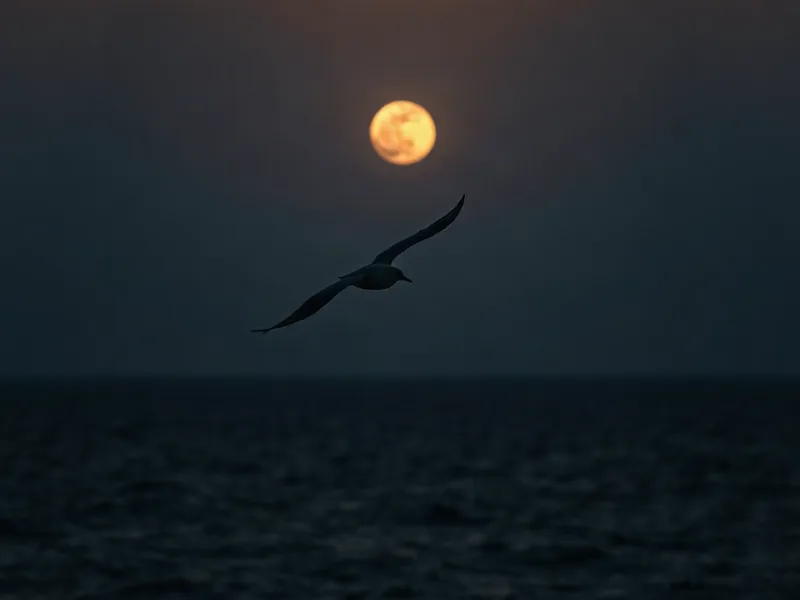
Picking out the homeward legs of those journeys turned out to be straightforward. While foraging, shearwaters fly in short, wandering bursts between dives. Then something shifts. "When they are deciding to go back to their colony, they kind of switch into this mode where they are flying as fast as they can in pretty much a straight line continuously without stopping for really long periods," Lewin said. For each of these homing flights, the team pinpointed the last sunrise the bird witnessed, the moment its internal clock should have matched the real local time. From there, they tracked how far east or west the bird flew and calculated how much that drift should bend its sun compass, then compared the prediction against where the bird actually ended up relative to its burrow.
The clock errors involved were small, often barely noticeable to a human. "About an hour is pretty much the maximum that we observed. Most of these are probably 15-minute, 10-minute time differences," Lewin said. "For us, that would be pretty imperceptible, but it does still have an effect on their compass orientation that we can detect." Across 335 homing flights made out of sight of land, the birds veered in exactly the direction the sun compass model predicted. Lewin is careful to note this wasn't a controlled experiment, so causation can't be claimed outright. Still, his team checked whether crosswinds, the Coriolis effect, or a magnetic compass could explain the pattern just as well. None fit nearly as cleanly as the jet lag hypothesis did.
The navigational errors topped out around 15 degrees, which sounds alarming but turns out to be fairly cheap for the birds. Unlike a plane locked onto one bearing, a shearwater with a working map sense can notice it's drifting and nudge itself back. For a bird flying 1,000 kilometers east in a single day, about the farthest the team observed, the average error worked out to roughly seven degrees, adding only about five kilometers to the overall trip if the bird kept checking its position along the way. Interestingly, birds hugging the coastline still drifted slightly closer to or farther from shore depending on their predicted compass error, mirroring decades-old Oxford work showing that homing pigeons with artificially shifted clocks do the same thing even while following a familiar road. That pattern has led some researchers to suspect birds run two navigation systems side by side, one built on compass bearings and one on recognizable landmarks, with neither ever fully overriding the other. Lewin also floats a simpler possibility: the birds might not know exactly where they are along the coast and use the sun to decide which direction to follow it.
Lewin's study can't yet say whether shearwaters suffer the fuller human experience of jet lag, the poor sleep, the hunger at odd hours, the general malaise. "We've not been able to investigate that yet," he said. His team's next questions are practical ones: does this clock drift change when birds forage, how much food they bring home, or how successfully they breed. There's also a bigger question lurking behind the data. Any creature with an internal clock that travels far enough east or west in a day, fliers especially, or animals living near the poles where longitude lines pack tightly together, could be quietly jet-lagging itself on a regular basis. For humans, chronic jet lag is linked to real, lasting health costs. If some animals have evolved ways to shrug off a burden that wears us down, understanding how they do it might be worth more than academic curiosity. "Maybe we could take some inspiration from these animals that are constantly experiencing jet lag," Lewin said, "and see if there are ways that we can mitigate jet lag affecting humans."
Tags
Original Sources
Seabirds racing home over the ocean can get jet-lagged
↗ https://arstechnica.com/science/2026/10/seabirds-racing-home-over-the-ocean-can-get-jet-lagged
About the author
Amara's entry point into AI was an epidemiology role at a London research hospital, where she spent five years studying how digital health tools reached — or conspicuously failed to reach — underserved communities. Watching early algorithmic systems in healthcare quietly entrench existing inequalities, she redirected her career toward the systemic consequences of AI at scale. She covers AI through an unflinching lens: who benefits, who bears the cost, and what evidence actually says versus what the press release claims. Her writing is calm and precise, but she doesn't mistake balance for neutrality.
More from The Steward →This Week's Edition
1 November 2026
21 articles
Related Articles
Related Articles
More Stories
© 2026 Cedar & Bloom. All rights reserved.