The Drum · Weekly AI news, freeSubscribe →

Share
Seagate's new Forge drive promises SSD speed with HDD capacity in one volume, but the "intelligent" hybrid caching trick comes with a DIY SSD install, a bottlenecked USB-C link, and some oddly half-finished engineering choices.
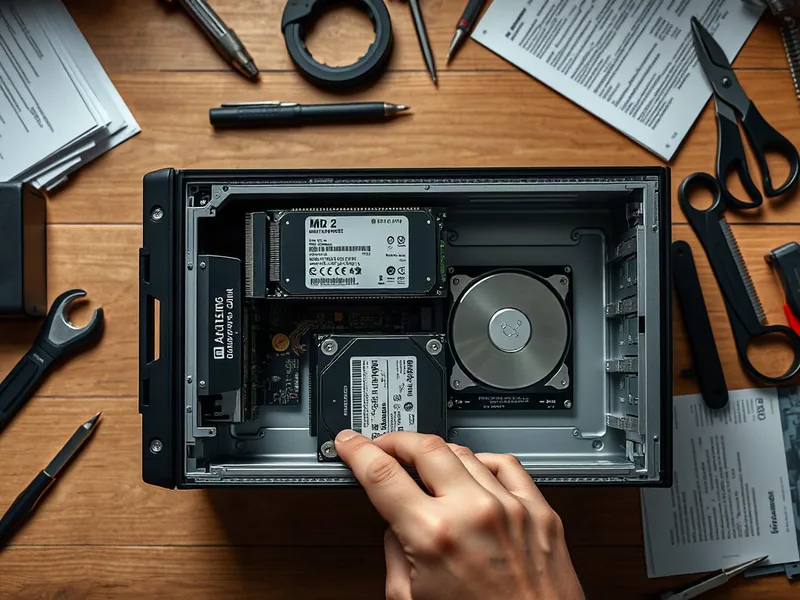
Seagate just launched a hybrid external drive that asks you to finish building it yourself. The FireCuda Forge pairs a hard disk drive with a user-supplied M.2 SSD inside a single desktop enclosure, using software called Alkemi to present both as one unified volume to your OS. It's a clever idea on paper. In practice, it's got some rough edges worth unpacking.
Here's the pitch: you get up to 20 TB of HDD capacity plus SSD-level responsiveness for your hottest files, all managed automatically. No manual tiering, no separate drive letters to juggle. Sounds great until you realize Seagate didn't actually put an SSD in the box.
The DIY tax. To get the Forge running, you need to source your own M.2 2280 NVMe SSD, minimum 1 TB recommended, with DRAM cache, no heatsink, and PCIe gen3 or better support. Then you open the enclosure yourself. Four screws on the base panel, a supplied screwdriver, access to the SSD slot. Seagate includes thermal pads you place on the SSD by hand before resealing everything. It's not a terrible process if you've built a PC before, but it's a strange ask for a product marketed partly at "creators" who may not want to crack open their storage device on day one.
Seagate has certified a short list of compatible drives: Samsung's 990 Pro, Sandisk's SN850X/GX Pro 850X, and the SN710/GX7100. Oddly, Seagate makes its own qualifying SSD, the FireCuda 530R, which hits 7,400 MB/s read and 6,900 MB/s write. It's just not in the box.
This is where the Forge gets genuinely puzzling. Whatever SSD you install, its real-world throughput is going to get strangled by the enclosure's interface. The Forge connects over USB 4, capping out at 2,400 MB/s read and 2,000 MB/s write. Compare that to the SSD options being recommended, all of which can push well past 6,000 MB/s on a proper PCIe link. You're buying a fast drive to run at a third of its potential speed.
To be fair, that capped throughput still dramatically outpaces the mechanical side of the equation. A 20 TB Seagate Exos X24 disk tops out under 300 MB/s, so the USB 4 ceiling is still a massive upgrade over spinning rust alone. The hybrid approach genuinely helps there. But it's hard not to notice the disconnect between "buy a premium NVMe SSD" and "we're going to bottleneck it anyway."
There's a business logic reason for the empty SSD slot, and it's not subtle. By not bundling an SSD, Seagate avoids carrying SSD inventory and the price volatility that comes with it. NAND flash pricing has been swinging hard this year, and letting the customer absorb that risk is a tidy way to sidestep it. It also lets Seagate hit a lower sticker price: $699 for 8TB, $899 for 20TB, available now through Seagate's store and authorized partners (pricing and availability may vary by market).
For context, that's not cheap compared to plain external HDDs. A 20TB Seagate external disk drive runs up to $700 on its own, and an 8TB external goes for as little as $330 at retailers like Amazon and Newegg. So you're paying a real premium for the hybrid architecture, on top of whatever you spend sourcing and installing your own SSD separately.
As for the actual caching mechanism: Alkemi runs on a controller system-on-chip inside the enclosure, though Seagate hasn't disclosed which SoC it's using. The software monitors file access patterns and uses machine learning to decide what gets promoted to the SSD cache versus what stays on the disk. High-access files land on flash. Lower-frequency files, or anything over 1 TB, stay on the HDD. It's a classic hot/cold tiering model, just automated and invisible to the user.
One catch: even if you install an SSD larger than 1 TB, Alkemi won't use the extra capacity for anything beyond caching. The SSD is purely a dynamic cache layer, not addressable storage in its own right. Seagate calls this a feature of keeping the system simple. Critics might call it leaving capacity on the table, especially if you've already sunk money into a 2TB or 4TB drive.
The Forge presents its combined storage as a single 8TB or 20TB volume to Windows 11 (or later) and macOS 26 (or later) hosts, so from the OS's perspective, there's no visible tiering happening at all; it just looks like one big fast-ish disk. Seagate also says the HDD itself is field-upgradable later, by removing six additional screws, which at least suggests some longevity planning beyond initial purchase.
Lance Ohara, VP of Edge IoT Marketing at Seagate, framed the product as solving a speed-versus-scale tradeoff: "For years, external storage has forced users to choose: speed or scale. Forge is built on the idea that they shouldn't have to." The hybrid-tiering concept behind that statement is sound engineering. Automated hot/cold data placement using ML-driven heuristics is a reasonable way to get SSD-like responsiveness without paying all-flash prices for 20TB of capacity.
The core idea here isn't new, hybrid drives with tiered caching have existed in various forms for years, but packaging it as a consumer desktop product with user-serviceable components is a fairly unusual move for Seagate. Whether gamers and creators want to be their own SSD installation technician is an open question. The underlying Alkemi caching logic sounds solid on paper: ML-driven hot/cold placement, single-volume presentation, decent speed uplift over pure HDD. But the execution leaves real gaps. A USB 4 bottleneck undercuts the SSD options Seagate itself recommends, the cache can't use extra SSD capacity you paid for, and the DIY build process pushes real cost and complexity onto the buyer that a fully integrated product wouldn't. If Seagate irons out the interface bottleneck and bundles a qualified SSD in a future revision, this could be a genuinely compelling hybrid storage category. Right now, it reads like a half-finished product shipped at a premium price.
Tags
Original Sources
Seagate combines dynamically cached SSD and HDD in single volume desktop drive
↗ https://www.theregister.com/disk/2026/11/10/seagate-combines-dynamically-cached-ssd-and-hdd-in-single-volume-desktop-drive/5308782
About the author
Kai built ML infrastructure at a Bay Area startup before developing an obsession with transformer architectures and inference optimisation that eventually pulled him out of product work entirely. A stint at a compute research lab sharpened his instinct for what actually matters in a model release versus what is marketing. He writes from the inside — from the perspective of someone who has debugged the systems he is describing at three in the morning. He is allergic to hype and instinctively drawn to the unglamorous plumbing questions that everyone else skips over.
More from The Engineer →This Week's Edition
11 November 2026
14 articles
Related Articles

Tether Evo's New Research Tackles BCI's Calibration Problem with Cross-Subject Models
Models & Research · 5 min

Why Some Engineers Think the Ocean Floor Is the Future of Data Centers
Environment & Climate · 5 min

Europe's Digital ID Push Tests a New Privacy Tool: Zero-Knowledge Proofs
Policy & Regulation · 5 min
Related Articles
Tether Evo's New Research Tackles BCI's Calibration Problem with Cross-Subject Models
Models & Research · 5 min
Why Some Engineers Think the Ocean Floor Is the Future of Data Centers
Environment & Climate · 5 min
Europe's Digital ID Push Tests a New Privacy Tool: Zero-Knowledge Proofs
Policy & Regulation · 5 min
More Stories
© 2026 Cedar & Bloom. All rights reserved.
