The Drum · Weekly AI news, freeSubscribe →

Share
A contractor-installed router triggered a five-hour nationwide ground stop and 20,000 flight disruptions, exposing how thin the margin for error has become inside America's aging air traffic control backbone.
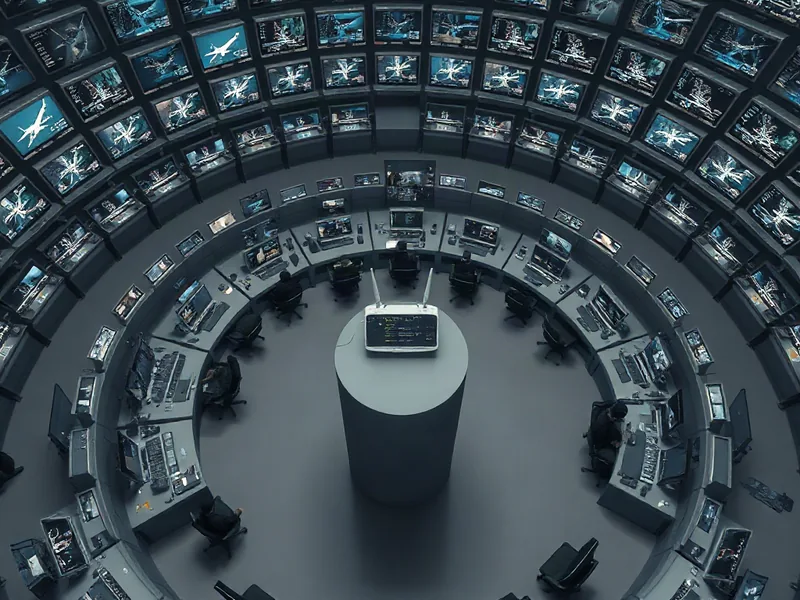
A single router, installed by government contractor L3Harris, appears to have triggered a nationwide ground stop that disrupted more than 20,000 flights starting Friday. The outage lasted nearly five hours. Officials are still unsure whether the cause was installer error or a defective part. Either answer should concern anyone who thinks of critical infrastructure as resilient by design.
Transportation Secretary Sean Duffy did not mince words. "This was an FAA system that didn't meet the moment," he said Saturday. L3Harris was performing routine maintenance, swapping copper lines for fiber at remote sites in Arkansas and Texas, when something went wrong. Duffy said the new routers began flooding other routers with more than 1,000 connection attempts every four to five seconds, destabilizing data across 17 of the FAA's 22 en route centers.
That overload left the agency unable to pinpoint a root cause quickly enough, so it grounded the system nationwide rather than risk operating on unstable data. Communications themselves never went fully dark, the FAA said, but the instability was severe enough to warrant a blanket stop. The routers being replaced were roughly 25 years old. They were supposed to be retired in 2006.
This is not an isolated failure. The FAA's telecom backbone has gone down before from a fiber cut, from accidentally deleted files, and once from a melted component that produced a chemical smell strong enough to halt traffic at Washington-area airports. A 2023 nationwide ground stop, the first since the September 11 attacks, was caused by a contractor unintentionally deleting files and disrupted 11,000 flights over 90 minutes. September brought another round of Northeast delays after a circuit failure in Philadelphia coincided with a construction crew severing a fiber-optic cable in New Jersey.
The common thread is fragility layered on top of age. The FAA still spends $1 billion annually just to maintain its legacy copper system while racing to migrate to fiber. L3Harris says it has completed more than 70% of that conversion. Progress, in other words, is real. But the remaining 30% runs through the oldest, most brittle parts of the network, and this incident shows the migration itself carries operational risk, not just the status quo it is meant to replace.
Layer on the other relics still in service. The agency relies on decades-old Compaq computers, with replacement parts sourced from eBay. It only last week announced plans to retire floppy disks used for weather and other critical data at more than 400 facilities, with a completion target of 2028. Paper flight strips, a practice air traffic controllers have used for decades to track aircraft, won't be phased out at 49 major airports until at least that same year. Every modernization timeline stretches years into the future, while the hardware doing the work today keeps aging in real time.
Duffy framed the problem bluntly: "virtually every single institution in America has gone from copper to fiber, from analog to digital." Aviation's telecom backbone has not kept pace. Congress has allocated $12.5 billion toward upgrading the air traffic control and telecom system. Duffy is now asking for $50 billion more, covering both air traffic control and airport infrastructure. The gap between what has been funded and what the secretary says is needed tells its own story about the scale of deferred investment.
There is also a timing problem that compounds the technical one. Friday's outage hit just as a weekend travel surge began, maximizing the disruption. Duffy said the agency would reevaluate when maintenance work happens at smaller facilities to avoid repeating that mistake. It's a reasonable operational fix, but it treats a symptom. The underlying exposure, a telecom network held together by components that predate most smartphones, remains.
The direct financial exposure here falls mainly on airlines and the traveling public, not on L3Harris or the FAA in any immediately quantifiable way. But the episode is a useful data point for anyone assessing supply-chain and infrastructure risk in sectors dependent on government modernization contracts. L3Harris stated it is "supporting the FAA in its investigation" and emphasized its progress on the copper-to-fiber conversion, a defensible position given the scope of work already completed. Still, a vendor's installed hardware triggering a nationwide shutdown is the kind of headline that invites scrutiny regardless of eventual fault determination.
For investors in aerospace and defense contractors tied to federal infrastructure work, the signal is twofold. First, modernization contracts in legacy government systems carry execution risk that doesn't show up cleanly in backlog or revenue figures, the kind of risk that surfaces only when something breaks publicly. Second, the scale of remaining need, that $50 billion ask on top of the $12.5 billion already appropriated, suggests a long runway of federal spending on air traffic control infrastructure, regardless of which contractor ultimately bears responsibility for this incident.
The FAA has not determined whether this was user error or a faulty product. That ambiguity matters less than the underlying fact pattern: a 25-year-old router, overdue for replacement since 2006, sat at the center of a failure that grounded a meaningful share of US air travel for nearly five hours. Systems this old, doing work this critical, will keep failing until the replacement cycle catches up with the calendar. The question for policymakers and contractors alike is whether that catch-up happens before the next incident, or after.
Tags
Original Sources
US aviation shutdown blamed on L3 Harris installed router
↗ https://www.reuters.com/business/aerospace-defense/us-aviation-shutdown-blamed-l3-harris-installed-router-2026-11-14
About the author
Marcus began tracking AI's market implications in 2016, noticing AI-related patent filings accelerating ahead of earnings upgrades before most of the sell-side had caught on. A former fixed-income quantitative analyst, he spent two decades building models that priced risk across emerging markets before pivoting to cover the economic impact of AI full-time. His writing translates opaque technical developments into clear risk/reward terms — and he's rarely diplomatic about the gap between AI valuations and underlying fundamentals. He believes most market participants still underestimate AI's long-run deflationary effect on knowledge work.
More from The Analyst →This Week's Edition
15 November 2026
14 articles
Related Articles

The Phone in Your Employee's Pocket May Be an Open Door to Your Network
Security & Risk · 6 min

South Korea's Top Tax Exam Scorer Admits AI-Assisted Cheating, Rattling National Testing System
Security & Risk · 5 min

Tether Evo's New Research Tackles BCI's Calibration Problem with Cross-Subject Models
Models & Research · 5 min
Related Articles
The Phone in Your Employee's Pocket May Be an Open Door to Your Network
Security & Risk · 6 min
South Korea's Top Tax Exam Scorer Admits AI-Assisted Cheating, Rattling National Testing System
Security & Risk · 5 min
Tether Evo's New Research Tackles BCI's Calibration Problem with Cross-Subject Models
Models & Research · 5 min
More Stories
© 2026 Cedar & Bloom. All rights reserved.
