The Drum · Weekly AI news, freeSubscribe →

Share
A confession of microcamera-and-AI cheating on South Korea's accountant exam has exposed how generative tools can quietly undermine tests that shape entire careers, just days before the country's biggest academic exam of the year.
For millions of South Korean families, exam day is not just a test. It's the hinge on which a child's entire future swings. The certified public accountant exam, and the national college entrance exam that follows it every November, decide who gets into elite universities, who lands prestigious jobs, and who spends years retaking tests to try again. That pressure is exactly why a confession made on a YouTube channel this past Sunday landed like a gut punch across the country.
A man identified only by his surname, Han, admitted he cheated his way to the top score on South Korea's national tax accountant exam this year. He didn't just bend the rules a little. Han said he photographed exam questions with a hidden microcamera, sent the images to a generative AI tool, and read the answers off a smartphone during the test. "I cheated using electronic devices and generative AI," he said, wearing a face mask as he apologized on the channel "Attorney Lee Don-ho." "My passing the exam with the top score was not the result of fair effort."
The admission ends months of quiet suspicion. Han scored near-perfect marks across hundreds of questions on two separate exam sittings, in April and July. Results that clean, on a test that difficult, raised eyebrows long before anyone had proof. Now there's proof, and a written confession has reportedly been submitted to Seoul police. Calls to the Seoul Jungbu police station seeking comment went unanswered Sunday.
Think of what Han did like smuggling a tiny spy camera into a locked vault, except the vault is a testing room and the loot is answers. A microcamera, small enough to go unnoticed, captured each question. Those images were sent off to an AI system capable of reading and answering complex tax and accounting questions in real time. The answers came back to a smartphone, hidden well enough to pass whatever physical screening the exam administrators had in place.
That's the uncomfortable part of this story. It isn't really about one dishonest test-taker. It's about how easily modern AI tools can turn a determined cheater into someone who looks like a genius. The accountant exam tests dense, technical material that takes years to master. An AI model that can parse and solve those problems in seconds effectively erases the preparation gap between someone who studied for years and someone who didn't study at all. That's a structural vulnerability, not a one-off trick.
South Korean officials are treating it that way. A senior presidential office official told reporters Sunday that "the presidential office views the matter very seriously," pointing out that the college entrance exam, known locally as the Suneung, falls just four days after the confession became public. The chief of staff for policy convened an emergency meeting the same afternoon to figure out how to keep Thursday's exam secure.
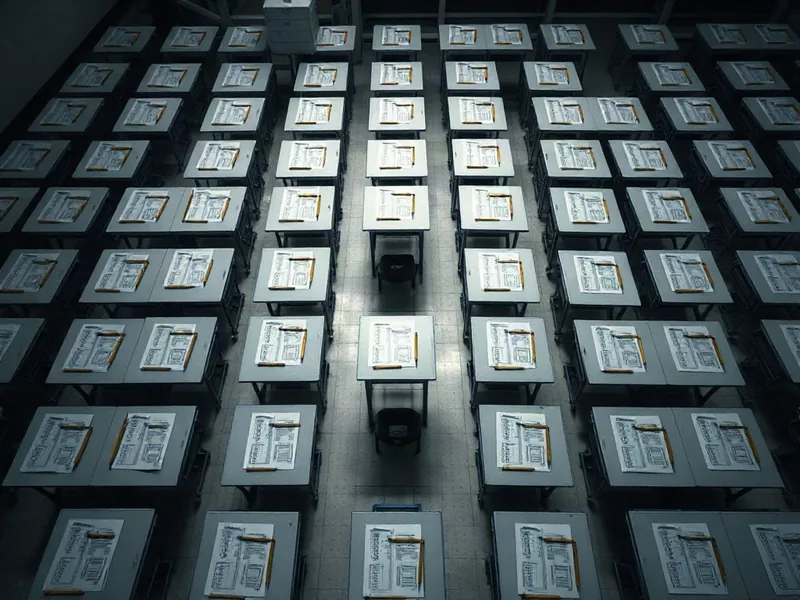
Prime Minister Han Seok-sook had already flagged the problem days earlier. On Friday, before Han's confession went public, she acknowledged growing public concern over AI-assisted cheating ahead of the Suneung, an event so central to South Korean life that many students describe years of their childhood as preparation for a single morning. Her office promised the government "will prepare thoroughly in advance and closely oversee the process until the very end to ensure the college entrance exam is conducted fairly and stably."
That's a tall order. Microcameras have existed for years, and exam cheating predates smartphones by decades. What's new, and what makes this scandal different, is the AI layer. A photographed question used to need a human accomplice somewhere, someone outside the exam hall who also knew the material well enough to answer fast. Generative AI removes that bottleneck entirely. It doesn't get tired, doesn't need to be bribed, and doesn't leave a trail of suspicious phone calls to a tutor. It just answers.
South Korea isn't alone in grappling with this. Universities and testing bodies worldwide have spent the past few years scrambling to adapt to AI tools that can write essays, solve math problems, and now apparently pass professional certification exams meant to measure years of specialized study. But the stakes feel sharper in South Korea, where these tests aren't just academic exercises. They're gatekeepers for social mobility in a society where where you went to school and what credentials you hold can shape your entire adult life.
This case should worry anyone who relies on standardized testing to measure competence, not just students and parents in Seoul. If a determined cheater with a hidden camera and a chatbot can top a national professional exam, the credential itself stops meaning what it's supposed to mean. Employers who hire based on exam results, regulators who license professionals based on passing scores, and students who spend years studying in good faith are all exposed when the system can be gamed this cleanly.
The fix isn't obvious, and it isn't going to be a single new rule or a better metal detector. Exam security has always been a cat-and-mouse game between test administrators and cheaters, but AI has changed the speed and sophistication of the mouse. Any serious countermeasure will likely need to combine better physical screening for hidden devices, smarter monitoring during the exam itself, and probably some rethinking of what these tests are actually trying to measure in an age when a chatbot can answer almost anything almost instantly.
For now, South Korean officials have four days to show that Thursday's college entrance exam, the one that so many families have built years of their lives around, can still be trusted. Whether that trust survives this scandal may depend less on catching the next Han and more on whether the system can evolve faster than the tools being used to beat it.
Tags
Original Sources
Top scorer on South Korean tax exam confesses to cheating with AI
↗ https://www.reuters.com/world/asia-pacific/top-scorer-south-korean-tax-exam-confesses-cheating-with-ai-2026-11-15
About the author
Amara's entry point into AI was an epidemiology role at a London research hospital, where she spent five years studying how digital health tools reached — or conspicuously failed to reach — underserved communities. Watching early algorithmic systems in healthcare quietly entrench existing inequalities, she redirected her career toward the systemic consequences of AI at scale. She covers AI through an unflinching lens: who benefits, who bears the cost, and what evidence actually says versus what the press release claims. Her writing is calm and precise, but she doesn't mistake balance for neutrality.
More from The Steward →This Week's Edition
15 November 2026
14 articles
Related Articles

The Phone in Your Employee's Pocket May Be an Open Door to Your Network
Security & Risk · 6 min

Single Router Grounds US Aviation: A $1 Billion-a-Year System Still Can't Hold
Security & Risk · 5 min

Tether Evo's New Research Tackles BCI's Calibration Problem with Cross-Subject Models
Models & Research · 5 min
Related Articles
The Phone in Your Employee's Pocket May Be an Open Door to Your Network
Security & Risk · 6 min
Single Router Grounds US Aviation: A $1 Billion-a-Year System Still Can't Hold
Security & Risk · 5 min
Tether Evo's New Research Tackles BCI's Calibration Problem with Cross-Subject Models
Models & Research · 5 min
More Stories
© 2026 Cedar & Bloom. All rights reserved.
